



This article is part 10 of the series “How Did the Turks Shape World History?”.
Timur is one of the most controversial rulers in world history. On one side stand the vast empire he built and the construction that made Samarkand one of the most dazzling cities on earth; on the other, the great destruction and loss of life in the cities he conquered. Yet after Timur’s death, under his descendants, Central Asia and Khorasan enjoyed such a brilliant age in art and science that historians call it the “Timurid Renaissance”.
From Kesh to world power
Timur was born in 1336 in Kesh (today’s Shahrisabz) near Samarkand, into a family of the Barlas, a tribe of Mongol origin that had become Turkic. Because a wound in his youth left him with a slight limp, he was called “Timur-i Lang” (Timur the Lame) in Persian, the source of the European name “Tamerlane”. Since he was not descended from Genghis Khan he did not use the title “khan”, contenting himself with “emir” and “güregen” (son-in-law), as he had married a Chinggisid princess. In 1370 he became sole ruler of Transoxiana and made Samarkand his capital.
Campaigns: great power, great destruction
For thirty-five years Timur campaigned almost without pause. He took Iran, Iraq and the Caucasus; defeated the Golden Horde khan Tokhtamysh in 1391 and 1395; sacked Delhi in 1398; and took Aleppo, Damascus and Baghdad in 1400–1401. These campaigns brought great massacres in cities such as Isfahan, Delhi and Baghdad; sources of the time report towers built of severed heads. It is impossible to assess Timur’s legacy while ignoring this human cost.
In 1401, outside Damascus, the great historian Ibn Khaldun met Timur. Ibn Khaldun describes the encounter in his autobiography, portraying Timur as a sharp-witted ruler with a keen interest in history and learning. On 28 July 1402 at the Battle of Ankara, Timur defeated and captured the Ottoman Sultan Bayezid I. The defeat plunged the Ottoman state into an eleven-year struggle for the throne (the Interregnum), and according to some historians delayed the conquest of Constantinople by half a century. Timur died at Otrar in 1405 while setting out on a campaign against China and was buried in the Gur-i Amir mausoleum in Samarkand.
Samarkand: “mirror of the world”
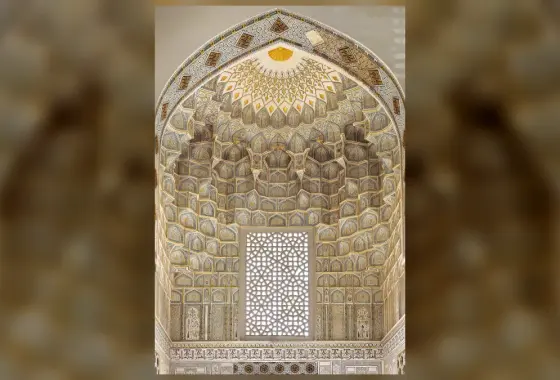
Timur set architects, masters and artisans brought from conquered lands to work in Samarkand. The Bibi-Khanym Mosque, the Shah-i Zinda complex of mausoleums and the blue-domed Gur-i Amir are works of this period. Ruy González de Clavijo, who came to Samarkand in 1403–1406 as envoy of the King of Castile, described the city’s gardens, palaces and crowded bazaars with admiration. The ruins of the Ak-Saray Palace in Shahrisabz, Timur’s birthplace, also show the scale of his architectural ambition.
The Timurid Renaissance
Timur’s son Shahrukh (1405–1447) moved the capital to Herat and, unlike his father, was known as a peaceful ruler. His wife Gawhar Shad became one of the greatest female patrons of Islamic architecture with the magnificent mosques and madrasas she built in Herat and Mashhad. Shahrukh’s son Ulugh Beg, while governing Samarkand, worked as both ruler and scientist: the star catalogues prepared at his madrasa and observatory were among the most precise measurements of the age. In Registan Square, at the heart of Samarkand, the Ulugh Beg Madrasa today faces two madrasas built in later centuries.
Timurid culture reached its peak in Herat under Sultan Husayn Bayqara (1469–1506). The poet and statesman Ali-Shir Navoi, the great master of Persian poetry Jami and Kamal al-Din Bihzad, one of the greatest names in miniature painting, all lived and worked in the same city. The Herat school of painting deeply influenced Safavid, Ottoman and Mughal art in the following centuries.
A legacy reaching the Mughals
The Timurid state broke up at the end of the 15th century with the rise of the Uzbeks. But Babur, a descendant of Timur, moved from Fergana to Kabul and then to India, founding the Mughal Empire in 1526. Timurid traditions of art and statecraft thus lived on in the empire that built the Taj Mahal, and the blue-tiled domes of Timurid architecture continued to influence a wide region from Iran to India.
Frequently asked questions
Was Timur a Turk or a Mongol?
Timur belonged to the Barlas, a tribe of Mongol origin that had become Turkic. His mother tongue was Chagatai Turkic and culturally he belonged to the Turkic-Islamic world. Although he saw himself as part of Genghis Khan’s legacy, he acted more within the Turkic-Islamic tradition than the Mongol one.
How is Timur seen in Uzbekistan today?
In independent Uzbekistan, Timur (Amir Temur) has been promoted as one of the founding figures of national history, with monuments in Tashkent, Samarkand and Shahrisabz. Historiography in neighbouring countries tends to stress the destructive side of his campaigns.
Sources and further reading
- Türkiye Diyanet Vakfı İslâm Ansiklopedisi, “Timur”, “Timurlular”, “Uluğ Bey”, “Bihzâd”.
- Ruy González de Clavijo, Embassy to Tamerlane, 1403–1406.
- Beatrice Forbes Manz, The Rise and Rule of Tamerlane (1989).
- Thomas W. Lentz and Glenn D. Lowry, Timur and the Princely Vision (1989).
- UNESCO World Heritage Centre, “Samarkand – Crossroad of Cultures”, “Historic Centre of Shakhrisyabz”.
People also ask
What was the Timurids? The Timurid state was founded in 1370 by Timur, with Samarkand as its centre.
When was the Timurids founded? Founded: 1370, Timur.
What was the Timurids’s capital? Capitals: Samarkand, later Herat.
When did the Timurids end? End: 1507, Herat taken by Shaybani Khan.






Leave a comment
Your email address will not be published. Required fields are marked *