



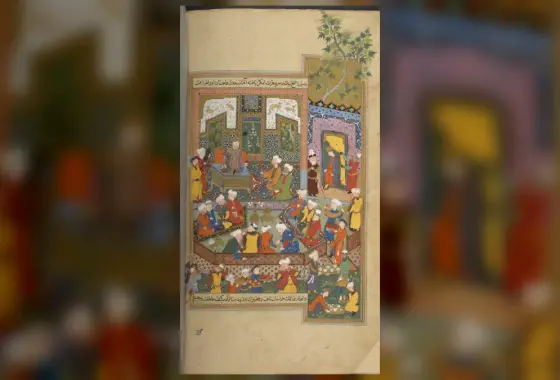
Ulugh Beg (1394–1449) was the grandson of Timur and ruler of Samarkand. Yet history remembers him less for conquest than for a life devoted to science. He turned Samarkand into one of the brightest centres of learning of his age, and he was himself a skilled astronomer and mathematician who made observations and calculations personally.
Samarkand as a city of science
Between 1417 and 1420, Ulugh Beg built his madrasa on Samarkand's famous Registan Square, which still stands today. Astronomy, mathematics and philosophy were taught there, and the most talented scholars of the time gathered in Samarkand. In the 1420s he built his magnificent observatory on a hill outside the city.
A giant instrument
The heart of the observatory was a huge meridian arc set into the ground. With a radius of about 40 metres, it allowed the positions of the sun and stars to be measured with unprecedented precision. The instrument's sheer size minimised small errors in measurement. The observatory's remains were found in excavations in 1908, and the underground part of the arc can still be visited.
The Zij of Ulugh Beg: a reference for centuries
- Star catalogue: The tables compiled by Ulugh Beg and his team give the positions of more than a thousand stars. It is one of the most comprehensive star catalogues based on new observations since antiquity.
- The length of the year: He calculated the sidereal year to within less than a minute of the modern value.
- Trigonometry: He computed sine and tangent tables to many decimal places with remarkable accuracy.
- Influence on Europe: The work was translated into Latin at Oxford in the 17th century and attracted the interest of European astronomers.
A legacy that reached Istanbul through Ali Qushji
Ali Qushji, one of Ulugh Beg's most brilliant students, came to Istanbul in the years after his teacher's death and taught at the Hagia Sophia madrasa under Sultan Mehmed II. In this way, Samarkand's scientific legacy was carried into Ottoman schools.
His name in the sky
Ulugh Beg's contributions are recognised internationally: a crater on the Moon and a minor planet are named after him.
The life of a ruler who was a scientist
Ulugh Beg's real name was Muhammad Taraghay; he was born in 1394 and was the grandson of Timur and the son of Shah Rukh. His father made him governor of Samarkand while he was still young; over about forty years Ulugh Beg turned this city into a centre of science and art.
- The madrasa: The Ulugh Beg Madrasa on Samarkand's Registan Square was built in 1417–1420; mathematics and astronomy were also taught there.
- The observatory: The observatory, set up on a hill outside the city, was built in the 1420s, and observations continued there for many years.
- A tragic end: Ulugh Beg came to the throne after the death of his father Shah Rukh in 1447; however, in 1449 he lost a struggle for the throne with his son Abd al-Latif and was killed.
After his death the observatory was neglected and in time fell into ruin. Its remains were only rediscovered in 1908 by the archaeologist Vasily Vyatkin.
Visiting the observatory today
Samarkand is in Uzbekistan today and was added to the UNESCO World Heritage List in 2001 under the name “Samarkand – Crossroad of Cultures”. The remains of the observatory stand on Kuhak hill near the city centre and are open to visitors.
Visitors can see the lower part of the giant marble arc that remained buried in the ground and a small museum describing Ulugh Beg's work. Visiting the madrasa on Registan Square and Timur's mausoleum, the Gur-e-Amir, on the same trip lets you see the world Ulugh Beg lived in as a whole.
Ulugh Beg's name also lives on in the sky today: a crater on the Moon and a minor planet bear his name. In Uzbekistan, his name has been given to universities, schools and streets; the observatory in Samarkand remains one of the regular stops for travellers interested in the history of science.
Frequently asked questions
Did the Ulugh Beg Observatory use telescopes?
No. The telescope was only invented in the early 17th century. Ulugh Beg's measurements were made with the naked eye and huge precision instruments, which makes his achievement all the more impressive.
Which country is Samarkand in today?
Samarkand is in Uzbekistan. Registan Square and the Ulugh Beg Madrasa are part of the city's UNESCO World Heritage Site.
Sources and further reading
- Encyclopaedia Britannica – Ulugh Beg
- UNESCO World Heritage – Samarkand – Crossroad of Cultures
- TDV Encyclopedia of Islam – Uluğ Bey
People also ask
Who was Ulugh Beg? Ulugh Beg was the grandson of Timur and the son of Shah Rukh.
When and where was Ulugh Beg born? Born: 1394, Soltaniyeh.
When did Ulugh Beg reign? Reign: 1447 – 1449.
Who was Ulugh Beg’s father? Father: Shah Rukh.






Leave a comment
Your email address will not be published. Required fields are marked *