



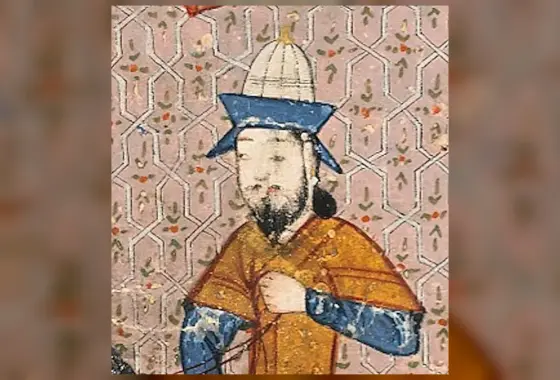
Shah Rukh was the youngest of Timur’s four sons, and his father had put him in charge of Khurasan. After Timur’s death in 1405 a succession struggle broke out among his sons and grandsons; Shah Rukh took Samarkand in 1409, becoming head of the state, and appointed his son Ulugh Beg governor of Samarkand.
His government
Unlike his father, Shah Rukh concentrated on preserving and developing the state rather than on long campaigns of conquest. He campaigned against the Kara Koyunlu, who were growing strong in the west, and established diplomatic relations with Ming China and the Ottomans. He was known for his devotion to Islamic law.
Herat and culture
Shah Rukh moved the capital to Herat. His wife Gawhar Shad built magnificent mosques and madrasas bearing her name in Herat and Mashhad. The library-workshop founded by his son Baysunghur opened a new era in miniature painting and the art of the book, and the historian Hafiz-i Abru wrote important sources for the period.
Death
Shah Rukh died near Rayy in 1447 on a campaign to put down a revolt. He was succeeded by his son Ulugh Beg, but succession struggles soon began again.
Embassies to China and India
Shah Rukh's reign was one of the periods in which the Timurids built the most intensive diplomatic relations with the outside world. Before his death his father Timur had been preparing a campaign against China; Shah Rukh instead chose peaceful relations with the Ming dynasty, and envoys travelled between the two courts.
- The embassy to Beijing (1419–1422): A large delegation that set out from Herat reached the court of the Ming emperor Yongle at the end of 1420 and returned in 1422. The diary kept by the painter Ghiyath al-Din, a member of the delegation, is a valuable testimony describing ceremonies, roads and cities in China; the text was also included in the work of Hafiz-i Abru.
- The embassy to India (1442–1444): The historian Abd al-Razzaq Samarqandi travelled by sea as Shah Rukh's envoy to Calicut on the south-west coast of India and to the kingdom of Vijayanagara. His account is an important source on the commercial life of the region at the time.
The struggle with the Qara Qoyunlu
In the west, the Qara Qoyunlu, who had grown strong in Azerbaijan and Iraq, became Shah Rukh's greatest military problem. He led three major campaigns to the region: in 1420–1421, 1429 and 1434–1435. As he set out on the first, the Qara Qoyunlu ruler Qara Yusuf died; Shah Rukh defeated his sons and entered Tabriz. But each time the Timurid army withdrew, the Qara Qoyunlu regained strength.
Shah Rukh therefore chose, instead of ruling the region directly, to recognise as governors those Qara Qoyunlu princes who declared loyalty to him. This approach brought peace in the short term, but after his death the Qara Qoyunlu became strong enough to advance into Timurid lands. The long peace of Shah Rukh's reign also laid the ground for the flourishing of cultural life in Herat.
History writing also enjoyed state support at Shah Rukh's court. At the ruler's request, Hafiz-i Abru produced both a general world history and works of geography. His son Ulugh Beg, with the observatory he founded in Samarkand and the star tables he had compiled, became the most brilliant representative of the scientific and artistic movement that began in his father's reign.
The Timurid world after Shahrukh
After Shahrukh's death in 1447, the Timurid lands quickly fragmented. Ulugh Beg, who took the throne in Samarkand, was killed in 1449 on the orders of his own son Abd al-Latif; this end of the scholar-ruler is counted among the most bitter events of Timurid history.
Despite the political fragmentation, the cultural life Shahrukh had begun in Herat continued. Under Husayn Bayqara, who ruled Herat from 1469 to 1506, the city flourished again: Ali-Shir Nava'i, the great poet of Chagatai Turkish, supported both literature and building activity as vizier, while the miniature master Bihzad represented the peak of the Herat school of painting. This heritage was later carried to the Safavid and Mughal courts.
Sources and further reading
- Türkiye Diyanet Vakfı İslâm Ansiklopedisi, “Şâhruh”.
- Hafiz-i Abru, Zubdat al-Tawarikh.
- Encyclopaedia Britannica, “Shāh Rokh”.
- Beatrice Forbes Manz – Power, Politics and Religion in Timurid Iran (Cambridge University Press, 2007)
- Ghiyath al-Din Naqqash – Account of the embassy to China (in Hafiz-i Abru, Zubdat al-Tawarikh)
- Abd al-Razzaq Samarqandi – Matla al-Sa'dayn
- Beatrice Forbes Manz – Power, Politics and Religion in Timurid Iran (Cambridge University Press, 2007)
- Encyclopaedia Iranica – "Herat iii. History, Medieval Period"
People also ask
Who was Shah Rukh? Shah Rukh was Timur’s youngest son, who won the succession struggles after his father’s death and ruled the Timurid state from 1405 to 1447.
When and where was Shah Rukh born? Born: 1377, Samarkand.
When did Shah Rukh reign? Reign: 1405 – 1447.
When did Shah Rukh die? Died: 1447, near Rayy.





Leave a comment
Your email address will not be published. Required fields are marked *