



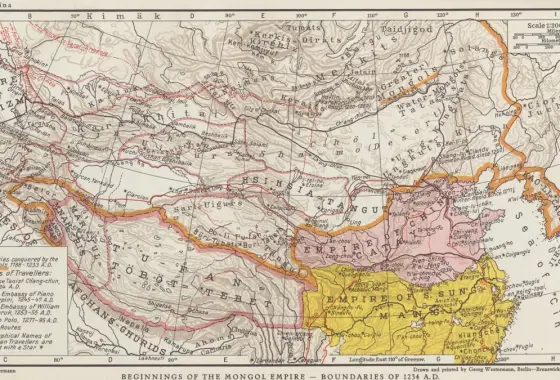
The Mongol Empire was a power that shaped much of Asia and Europe in the 13th and 14th centuries. At its height it stretched from the Pacific coast to Eastern Europe and from Siberia to the Middle East. It is considered the largest contiguous land empire in history.
From Temüjin to Genghis Khan
Temüjin grew up in hard conditions among rival nomadic clans. A gifted leader, he built alliances, united competing tribes under one structure and took the title "Genghis Khan" at an assembly (kurultai) in 1206. An army organised on a decimal system that weakened old tribal ties, and appointments based on merit and loyalty, formed the foundations of the new state.
Expansion
Under Genghis Khan and his successors, Mongol armies advanced into northern China, Central Asia, Persia, the Russian steppes and Eastern Europe. Fast-moving mounted archers, advanced communication and siege expertise gained from conquered peoples played key roles. These campaigns caused great destruction and loss of life in many cities; historians consider both the destructive and the transformative sides of the period.
Government and the Silk Road
- The Yam (postal) system: Relay stations at regular intervals let messengers and official travellers cover huge distances quickly.
- Trade: With vast lands under a single authority, the Silk Road saw a period of relatively safe trade, sometimes called the "Pax Mongolica".
- Religion and culture: Mongol rulers generally followed a policy of tolerance towards different religions. Travellers such as Marco Polo journeyed between East and West in this period.
- Law: A body of rules known as the "Yassa", attributed to Genghis Khan, governed the army and society.
Division and legacy
From the 1260s the empire split into four major parts: the Yuan dynasty founded by Kublai Khan in China, the Golden Horde on the Russian steppes, the Ilkhanate in Persia and the Chagatai Khanate in Central Asia. Over time these states blended with local cultures; the rulers of the Ilkhanate and the Golden Horde, for example, adopted Islam. The empire's legacy was felt for centuries through trade, diplomacy, mapmaking and cultural exchange.
The Mongol army: the decimal system and discipline
The success of the Mongol army rested not only on the skill of its mounted archers but also on strong organisation. Genghis Khan rebuilt the army according to a decimal structure in a way that broke tribal ties. In this structure, soldiers showed loyalty to the unit they belonged to rather than to their own tribe.
- Arban, jaghun, mingghan: These were units of 10, 100 and 1,000 men; each unit had its own commander.
- Tumen: The largest unit, of 10,000 men, comes from the same root as the Turkish word "tümen".
- Yassa: The body of rules attributed to Genghis Khan played an important role in maintaining order in the army and society; however, the full content of the text has not survived.
The Yam: the postal system that held the empire together
Fast communication was essential to govern such a vast area. The Mongols set up a relay system called the "yam": at stations built at regular intervals, rested horses, food and shelter were kept ready. Messengers could cover very long distances in a short time by changing horses from station to station.
Those travelling on official business were given metal or wooden tablets called "paiza". These tablets served as a kind of passport, entitling the bearer to horses and provisions at the stations. The yam system made easier not only military communication but also the journeys of envoys, merchants and clergy; this in turn sped up the movement of information and goods across Eurasia.
Frequently asked questions
How large was the Mongol Empire?
At its height it is estimated to have covered about 23–24 million square kilometres. Only the British Empire, which lasted into the 20th century, controlled a larger area, but it was not a contiguous land empire.
Where is Genghis Khan buried?
Nobody knows. According to tradition he was buried in a secret place whose location was deliberately hidden. The tomb has still not been found.
Sources and further reading
- Encyclopaedia Britannica – Mongol empire
- David Morgan – The Mongols (2nd ed., 2007)
- Timothy May – The Mongol Art of War (2007)
People also ask
What was the Mongol Empire? The Mongol Empire was founded in 1206 when Genghis Khan united the steppe tribes.
When was the Mongol Empire founded? Founded: 1206, Genghis Khan.
What was the Mongol Empire’s capital? Capital: Karakorum, later Khanbaliq (Beijing).
When did the Mongol Empire end? End: 1368, fall of the Yuan dynasty.
Leave a comment
Your email address will not be published. Required fields are marked *