



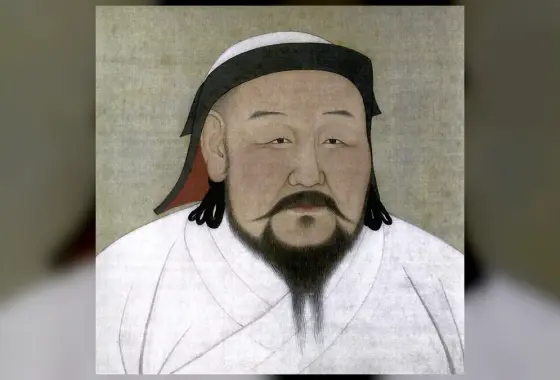
Kublai was the son of Tolui, Genghis Khan’s youngest son. Under his elder brother, the great khan Möngke, he was responsible for governing northern China and took part in campaigns against the Southern Song.
Great khan
After Möngke’s death in 1259, Kublai was proclaimed great khan in 1260, but his brother Ariq Böke was also elected khan at Karakorum. Kublai won the civil war, which lasted until 1264; the struggle hastened the effective break-up of the Mongol Empire.
The Yuan dynasty
In 1271, following Chinese tradition, Kublai took the dynastic name Yuan and moved his capital to Dadu (Khanbaliq), on the site of today’s Beijing. In 1279 he destroyed the Southern Song, reunifying China. Paper money spread, the Grand Canal was repaired and extended, and the Tibetan monk Phagpa was commissioned to devise a new script.
Failed campaigns
His naval invasions of Japan in 1274 and 1281 failed, largely because of storms, which the Japanese called “kamikaze” (divine wind). Campaigns in Vietnam and Java also fell short.
Death
Kublai died in 1294. The Yuan dynasty lasted until it was overthrown by the Ming in 1368.
The summer capital Shangdu and the system of government
Kublai created a two-capital system: he spent the winter in Dadu (Beijing) and the summer in Shangdu, on the edge of the steppe. The remains of Shangdu, which became legendary in Western literature under the name "Xanadu", lie today in China's Inner Mongolia region and were inscribed on the UNESCO World Heritage List in 2012. The city's plan combines the Mongol nomadic tradition with the Chinese urban layout.
- Social ranking: It is widely said that under the Yuan the population was divided into four groups: Mongols, "people of various categories" (semu) from Central Asia and the west, Northern Chinese and Southern Chinese; how rigidly this division was applied is debated among historians.
- Writing: In 1269 the Phagpa script was proclaimed the official script, but it could not replace Chinese writing.
- Migration of experts: Uyghur scribes, Iranian astronomers and physicians, and craftsmen from different countries served at the Yuan court.
Kublai as described by Marco Polo
The Venetian Marco Polo says that he was in Kublai's service from about 1275 to 1292 and was sent on missions to different parts of the empire. In his book, paper money, postal stations and the size of the capital appear as astonishing details for European readers.
Some parts of Marco Polo's account have been found exaggerated, and it has even been debated whether he really went to China at all. Most historians, however, note that many of the details he gives about Yuan government are confirmed by other sources. The work is therefore accepted as a valuable testimony that must be read with care.
Paper money, a canal and a calendar
The most lasting traces of Kublai's reign are found not on battlefields but in the everyday tools of government. The paper money that amazed Marco Polo was only one of these tools.
- Paper money: In 1260 a paper currency called "Zhongtong" was issued and made the state's main means of payment. In later years, excessive printing led to a loss of value.
- The Grand Canal: The canal network was extended northwards to carry rice from the south to the new capital Dadu (present-day Beijing). The Tonghui Canal, directed by the engineer Guo Shoujing, was completed in 1293.
- The calendar: The Shoushi calendar, prepared by Guo Shoujing and his colleagues, came into force in 1281. It reckoned the year at 365.2425 days, the same value as the Gregorian calendar adopted in Europe centuries later.
- Script: In 1269 an alphabet devised by the Tibetan cleric Phagspa was proclaimed the official script, intended to write all the languages of the empire in a single writing system; however, it never spread among the population.
Sources and further reading
- Rashid al-Din, Jami al-Tawarikh.
- Marco Polo, The Description of the World (Il Milione).
- Encyclopaedia Britannica, “Kublai Khan”.
- Morris Rossabi – Khubilai Khan: His Life and Times (University of California Press, 1988)
- UNESCO World Heritage – "Site of Xanadu" (2012)
- Morris Rossabi – Khubilai Khan: His Life and Times (University of California Press, 1988)
- The Cambridge History of China, Vol. 6: Alien Regimes and Border States, 907–1368 (Cambridge University Press, 1994)
People also ask
Who was Kublai Khan? Kublai, a grandson of Genghis Khan, became great khan in 1260.
When and where was Kublai Khan born? Born: 1215.
When did Kublai Khan reign? Reign: 1260 – 1294.
When did Kublai Khan die? Died: February 1294.



Leave a comment
Your email address will not be published. Required fields are marked *