



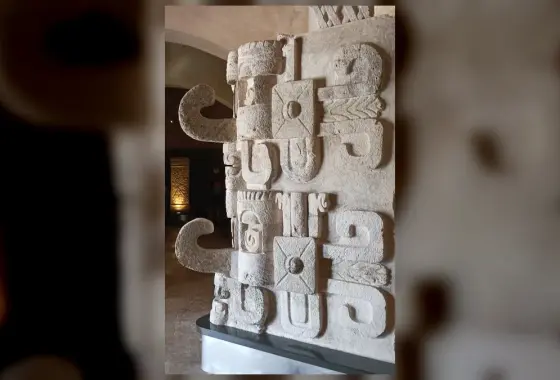
Village communities appeared in the Maya region in the 2nd millennium BC, and in the 1st millennium BC large cities such as El Mirador were founded. The Maya were never united under a single state; their world consisted of city-states, each ruled by its own king (ajaw).
The Classic period
In the Classic period (AD 250–900) cities such as Tikal, Calakmul, Palenque and Copán flourished with pyramid temples, palaces and ballcourts. The long rivalry between Tikal and Calakmul led to wars that also affected many smaller cities.
Writing, calendar and science
The Maya used one of the few fully developed writing systems of the Americas, most of which was deciphered in the second half of the 20th century. The Long Count calendar, which counts days from a fixed starting date, and a number system using the concept of zero show the Maya’s knowledge of astronomy and mathematics. Claims that the world would end in 2012 have nothing to do with the Maya calendar, in which a great cycle simply came to an end.
Collapse and after
In the 9th century most cities of the southern lowlands were abandoned. Drought, warfare and environmental pressures are among the suggested causes. In the north, cities in Yucatán such as Chichén Itzá and Mayapán remained important for some time. The Spanish conquered the region in the 16th century; the last independent Maya city, Nojpetén, fell in 1697. Today millions of people still speak Mayan languages.
Maize, Cacao and Livelihood: The Agricultural Foundations
Behind the growth of Maya cities lay an agricultural order adapted to the tropical forests of Mexico and Central America. The staple food was maize, grown together with beans and squash, a trio that gave a balanced diet. Slash-and-burn farming (milpa) was practised in fields cleared in the forest, while raised fields, terraces and irrigation channels were also used in some regions.
Cacao was not only a raw material for a drink but also a valuable trade good and, in some regions, a means of payment. Elites consumed cacao as a frothy drink at ceremonies. In cities such as Tikal large reservoirs collecting rainwater were built to supply water in the dry season. Laser scanning (LiDAR) surveys carried out in Guatemala in 2018 revealed traces of tens of thousands of structures, roads and farmland beneath the forest, suggesting that the region’s population may have been larger than earlier estimates.
City-States and Political Rivalry: Tikal, Calakmul and Palenque
The Maya political world was a network of kingdoms that made alliances and fought one another. Tikal in the south and Calakmul in the north are known as the two great rivals of the Classic period. The dynasty of Calakmul is recorded in inscriptions with the “Snake” (Kaanul) emblem and had allied with many smaller cities. Inscriptions show that Tikal was defeated in 562 by forces linked to Calakmul, and in the years after that defeat Tikal’s political influence declined for a time. In 695, however, Tikal won an important victory over Calakmul.
The Palenque king Pakal (615–683), with his long reign, brought the city’s art and architecture to its peak. His tomb beneath the Temple of the Inscriptions was discovered in 1952 by Alberto Ruz Lhuillier. Thanks to inscriptions, the names, birth and death dates and wars of many kings are known, which makes the Maya one of the few American civilisations whose history can be reconstructed through writing.
Deciphering the Script: Knorozov, Proskouriakoff and Beyond
Maya writing went unread for a long time. Until the mid-20th century many scholars thought the signs carried only calendrical and ritual meaning. The Soviet linguist Yuri Knorozov argued in the 1950s that the script consisted largely of signs with syllabic values; although this view was controversial at first, later research confirmed it.
Tatiana Proskouriakoff, studying the Piedras Negras inscriptions in 1960, showed that the texts told of the births, accessions and wars of real kings rather than only of gods and ritual. Linda Schele, David Stuart and other researchers advanced the decipherment on this basis, and today a large part of Maya texts can be read. The script was used on stone monuments, ceramic vessels and folding bark-paper books (codices).
The Fate of the Codices: Diego de Landa and the Popol Vuh
The great majority of Maya bark-paper books were destroyed in the 16th century. In Yucatán the Franciscan friar Diego de Landa had many Maya books and cult objects burned in 1562 during proceedings at Maní. Today only four Maya codices are securely known: the Dresden, Madrid and Paris codices and the Grolier Codex, whose authenticity was later accepted. The Venus tables in the Dresden Codex show the precision of Maya observations of celestial bodies.
Landa himself later wrote a work called “Account of the Things of Yucatán”, which gave a clue for the decipherment of the script and the calendar but also contains errors. The Popol Vuh, recorded in the Latin alphabet by the K’iche’ Maya in the 16th century, conveys creation myths and the story of the Hero Twins and is among the basic texts for understanding Maya thought.
Calendar Systems: the Tzolk’in, Haab’ and Long Count
The Maya used several interlocking calendars. The 260-day Tzolk’in, formed by combining 20 day names with the numbers 1–13, was used as a ritual calendar. The 365-day Haab’ was an everyday calendar close to the solar year. Together they form a 52-year “Calendar Round”.
The Long Count made it possible to express very long spans in a single system by counting days from a fixed starting date. The year 2012, when the 13th baktun ended, was popularly linked to “end of the world” claims, but Maya inscriptions contain no such prophecy; the date is merely the end of a cycle. The number system was base 20 and could also express zero with dot, bar and shell symbols.
Abandoned Cities and the Living Maya
At the end of the Classic period, between the 8th and 10th centuries, many southern cities were abandoned or shrank. Drought, deforestation, population pressure and wars are among the debated causes; no single reason can be pointed to. In the north Chichén Itzá and later Mayapán rose to prominence. On the Kukulkan Pyramid (El Castillo) at Chichén Itzá, light and shadow form the image of a serpent on the days of the equinox.
With the fall of Nojpetén in 1697 the last independent Maya kingdom came to an end, but the Maya peoples did not disappear. Resistance continued, such as the Caste War of Yucatán in the 19th century. Today millions of people in Guatemala, Mexico, Belize and Honduras still speak Maya languages such as K’iche’, Yucatec and Q’eqchi’. Tikal and Chichén Itzá are on the UNESCO World Heritage List.
Sources and further reading
- Encyclopaedia Britannica, “Maya”.
- UNESCO World Heritage, “Tikal National Park” and “Pre-Hispanic City of Chichen-Itza”.
- Michael D. Coe, The Maya.
- Encyclopaedia Britannica, entry “Maya”.
- UNESCO World Heritage Centre, “Tikal National Park” and “Pre-Hispanic City of Chichen-Itza”.
- Michael D. Coe, The Maya (Thames & Hudson).
- Popol Vuh, K’iche’ Maya creation text.
People also ask
What was the Maya Civilisation? The Maya civilisation developed over thousands of years in what are now southern Mexico, Guatemala, Belize and Honduras.
Leave a comment
Your email address will not be published. Required fields are marked *