



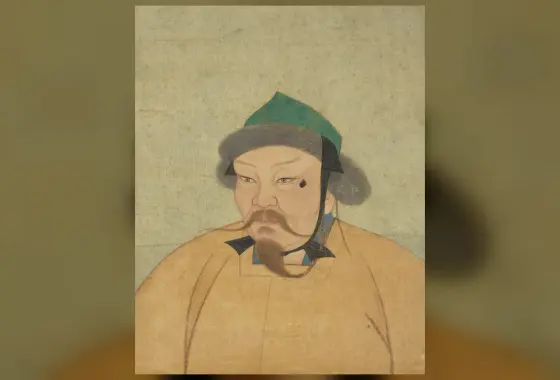
Ögedei was the third son of Genghis Khan and Börte. His father named him successor for his conciliatory character, and he was elected great khan at the kurultai of 1229.
China and Karakorum
With his brother Tolui, Ögedei continued the war against the Jin dynasty in northern China, which was finally destroyed in 1234. In 1235 he had Karakorum built as a walled capital in the Orkhon Valley. On the advice of the Khitan adviser Yelü Chucai a regular tax system was set up.
The western campaign
The kurultai of 1235 decided on a great campaign to the west. An army led by Genghis Khan’s grandson Batu and the general Subutai defeated the Volga Bulgars and the Kipchaks and conquered the Rus principalities; Kiev fell in 1240. In 1241 the Mongols defeated European armies at Legnica (Poland) and Mohi (Hungary).
Death
Ögedei died in December 1241. The news of his death and the question of electing a new khan are given as one of the reasons Batu withdrew from central Europe. His widow Töregene acted as regent for a time, and in 1246 his son Güyük was elected great khan.
Yam stations and administration
One of Ögedei's most lasting achievements was turning the courier stations called "yam", spread across every corner of the empire, into a regular network. At stations set up at fixed intervals, horses, food and shelter were kept ready for couriers, so orders and news could cross great distances quickly. The right to use the stations was shown by authority tablets called "paiza".
In The Secret History of the Mongols, Ögedei, assessing his own reign, counts setting up courier stations and having wells dug in the waterless steppe among his good deeds, while naming his excessive drinking among his faults. This frank self-criticism is one of the most striking passages of the work. Most sources note that drink also played a part in Ögedei's death.
Karakorum: a capital on the steppe
Karakorum, built on Ögedei's orders, was conceived as the permanent administrative centre of a nomadic empire. The city had the khan's palace, craftsmen's quarters, markets and places of worship of different religions. Envoys, merchants and craftsmen from every corner of the empire met here.
One of the most vivid descriptions of the city belongs to the Franciscan friar William of Rubruck, who came to Karakorum in 1254, in the period after Ögedei. When the Mongol capital was later moved to China under Kublai, Karakorum lost its importance. Today its remains are part of the Orkhon Valley Cultural Landscape, inscribed on the UNESCO World Heritage List in 2004, and are being excavated by Mongolian-German archaeological teams.
The sources describe Ögedei as a generous and tolerant ruler, and many stories are told of the large gifts he made from the treasury. His brother Chagatai, by contrast, was known as a strict guardian of Genghis Khan's laws. The harmony between the two brothers played an important part in keeping the empire united in Ögedei's reign; Chagatai also died shortly after Ögedei.
Korea in the east, Iran in the west: the other fronts
Under Ögedei, Mongol armies were fighting not only in China and Europe but on other fronts at the same time. These simultaneous campaigns show how wide an area the empire could organise.
- Iran and the Caucasus: In 1230 the commander Chormaqan was sent with a large army against the Khwarazmshah Jalal al-Din. After Jalal al-Din's death in 1231, Chormaqan brought Armenian and Georgian lands under Mongol rule in the following years.
- Korea: In 1231 the first campaign was launched against the Goryeo kingdom. The Korean court withdrew to Ganghwa Island in 1232 and resisted for many years; the wars continued after Ögedei's death.
- Southern China: After the fall of the Jin dynasty in 1234, conflict with the Song dynasty began; the conquest of southern China was completed only under Kublai.
Administrative Approach and Yasa
Ögeday continued to meticulously implement the legal system and laws established by his father, Genghis Khan, ensuring the continuity of the state. He sought to strike a delicate balance between the nomadic traditions of the steppe and the complex administrative forms of sedentary societies, thereby making it possible for different cultures to coexist.
This administrative approach facilitated the maintenance of central authority and the establishment of order across the vast territories of the empire. The stability in the application of laws contributed to the state mechanism operating in a more predictable manner.
Religious Tolerance and Policies
A generally tolerant attitude was exhibited toward communities of different faiths and sects within the borders of the empire. The presence of places of worship for different religions side by side in the capital, Karakurum, is a concrete manifestation of this inclusive policy.
The ability of religious leaders to communicate directly with the khan and possess certain privileges supported social peace in the conquered regions and reduced the risk of rebellions. This indicates that the Mongol administration used different belief systems as a political tool.
Economic Order and Trade
The development and security of trade formed one of the cornerstones of the empire's economic power. The security of caravan routes was increased, and merchants were encouraged to move freely within the imperial territories.
This situation accelerated the flow of valuable goods, such as silk and spices, between the east and the west, while also speeding up the transfer of knowledge and technology between different geographies. The expansion of trade networks increased treasury revenues while deepening cultural interaction.
Court Life and the Role of Women
In the structure of the Mongol court, women, especially the wives and mothers of the khan, held significant influence in administrative processes and decision-making mechanisms. During periods when the khan was on campaign or experiencing health issues, they took an active role in managing court affairs and internal politics.
This reflects that the position of women in the social structure of Mongol society was more influential compared to most sedentary societies. The political weight of women in the court was a decisive factor in establishing intra-dynastic balances.
Military Organization and Strategy
The Mongol army was managed with high discipline, a strict hierarchy, and an extraordinary capacity for coordination. The ability of units on different fronts to move simultaneously, despite the vast distances between them, provided the Mongols with a strategic advantage.
- Cavalry units capable of rapid movement and high maneuverability.
- Advanced and fast communication networks established through Yam stations.
- Effective psychological warfare methods that exerted pressure on the enemy.
- The capturing of cities through expertise in siege engines and engineering.
- The uncompromising application of the chain of command based on strict discipline.
These structural features ensured that the army prevailed on the battlefields not only through numerical strength but also through organizational competence.
Diplomatic Relations and Envoys
The reception of foreign envoys and the conduct of diplomatic relations were central to the Mongol statecraft. Karakurum became a cosmopolitan center where representatives, merchants, and artisans from all over the world met.
These intense interactions allowed the Mongols to gain in-depth knowledge of foreign languages, different forms of governance, and new technologies, thereby increasing the administrative capacity of the empire. Diplomatic channels were used as a tool to facilitate the governance process following the conquests.
Sources and further reading
- The Secret History of the Mongols.
- Rashid al-Din, Jami al-Tawarikh.
- Encyclopaedia Britannica, “Ögödei”.
- UNESCO World Heritage – "Orkhon Valley Cultural Landscape" (2004)
- Christopher P. Atwood – Encyclopedia of Mongolia and the Mongol Empire (Facts on File, 2004)
- William of Rubruck – The Journey (1253–1255)
- Thomas T. Allsen – "The rise of the Mongolian empire and Mongolian rule in north China", The Cambridge History of China, Vol. 6 (Cambridge University Press, 1994)
- Timothy May – The Mongol Conquests in World History (Reaktion Books, 2012)
People also ask
Who was Ögedei Khan? Ögedei was the third son of Genghis Khan and was elected great khan in 1229 to succeed his father.
When and where was Ögedei Khan born? Born: c. 1186.
When did Ögedei Khan reign? Reign: 1229 – 1241.
When did Ögedei Khan die? Died: December 1241.






Leave a comment
Your email address will not be published. Required fields are marked *