



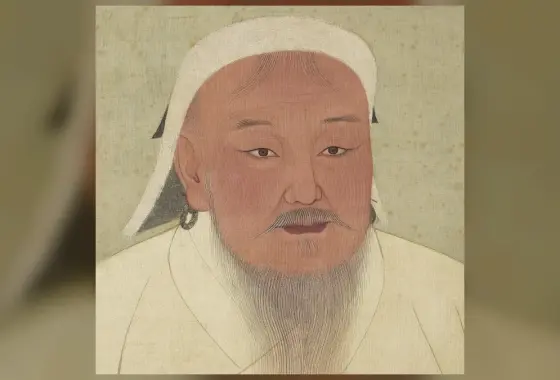
Temüjin was the son of the Mongol chief Yesügei. When his father was poisoned while Temüjin was still a child, the family was cast out by its tribe and lived in great hardship. Through alliances and victories Temüjin gradually became the most powerful leader on the steppe.
Becoming khan
After defeating rival tribes such as the Tatars, Keraites and Naimans, he was proclaimed ruler of all the tribes with the title “Genghis Khan” at a kurultai on the Onon River in 1206. He organised the army into units of ten, a hundred, a thousand and ten thousand (tümen), replacing tribal ties with loyalty to the ruler.
Campaigns
In 1209 he made the Tangut state (Western Xia) a vassal. In 1211 he attacked the Jin dynasty in northern China, and in 1215 its capital Zhongdu (today’s Beijing) fell. After Mongol merchants were killed at Otrar in 1218, he turned against the Khwarazmian Empire in 1219; Bukhara, Samarkand, Urgench and the cities of Khurasan were taken with great destruction.
Government
Under Genghis Khan rules known as the Yasa were applied, the Uyghur script was adopted for Mongolian, and a mounted relay postal system (yam) was created. His policy towards different religions was generally tolerant.
Death
Genghis Khan died in the summer of 1227 during a renewed campaign against the Tanguts. The location of his grave is unknown. The empire was divided among his sons and grandsons, and in 1229 his son Ögedei was elected great khan.
Börte and the four sons
As a young man Temüjin married Börte, to whom he had been betrothed as a child. According to the Secret History of the Mongols, shortly after their marriage the Merkits carried off Börte in a raid. Temüjin attacked the Merkits and rescued his wife with the help of Toghrul Khan, ruler of the Keraits and his father's former sworn brother, and of his childhood friend Jamukha. The four sons born to Börte, Jochi, Chagatai, Ögedei and Tolui, became in the next generation the ancestors of the empire's four great branches. Börte is also remembered with respect in the sources as an adviser to Genghis Khan.
Jamukha: from sworn brother to rival
Jamukha was Temüjin's anda from childhood, that is, a brother gained by oath. After the Merkit campaign they camped together for a while, but it was not long before they began competing for leadership on the steppe. Jamukha gathered some tribes around him, took the title "gür khan" and fought against Temüjin. After the defeat of the Naimans he was captured, handed over to Temüjin and put to death around 1205. The Secret History describes the last meeting of the two former friends as a moving scene.
The strength of the army: the keshig, mounted archers and engineers
The organisation of the army was decisive in Genghis Khan's success. The guard unit around the ruler, called the keshig, served both as a bodyguard and as a school that trained future commanders. The core of the army consisted of mounted archers who, with spare horses at their side, could cover long distances quickly. To take the cities of China and Central Asia, the Mongols also learned to build siege engines by using Chinese and Muslim engineers from the regions they had conquered.
Burkhan Khaldun: the sacred mountain
According to the Secret History, the young Temüjin took refuge on Burkhan Khaldun mountain while fleeing his enemies and made offerings to the mountain in gratitude after his escape. The mountain is considered sacred in Mongol tradition, and Genghis Khan's tomb is thought possibly to lie in this area; however, the tomb has not been found to this day. The "Great Burkhan Khaldun Mountain and its surrounding sacred landscape" in Mongolia was added to the UNESCO World Heritage List in 2015.
Shigi Qutuqu and the "Blue Register"
According to the Secret History of the Mongols, after 1206 Genghis Khan appointed his adopted son of Tatar origin, Shigi Qutuqu, as supreme judge. Shigi Qutuqu's task was to put into writing in the Uyghur script the decisions on the distribution of the people and on legal cases, and to keep them in a record called the "Blue Register". This arrangement is regarded as one of the first steps in the transition from oral steppe tradition to written administration.
Frequently asked questions
What does “Genghis” mean? It is uncertain; suggestions include “strong, firm” or “vast like the ocean”.
Sources and further reading
- The Secret History of the Mongols (13th century).
- Türkiye Diyanet Vakfı İslâm Ansiklopedisi, “Cengiz Han”.
- Encyclopaedia Britannica, “Genghis Khan”.
- UNESCO World Heritage Centre – Great Burkhan Khaldun Mountain and its surrounding sacred landscape, inscribed 2015
- Paul Ratchnevsky – Genghis Khan: His Life and Legacy (1991)
- Igor de Rachewiltz – The Secret History of the Mongols: A Mongolian Epic Chronicle of the Thirteenth Century (2004)
People also ask
Who was Genghis Khan? Born Temüjin, Genghis Khan was proclaimed ruler of all the Mongol and Turkic tribes at a kurultai in 1206.
When and where was Genghis Khan born? Born: c. 1162, Onon River area.
When did Genghis Khan reign? Reign: 1206 – 1227.
Who succeeded Genghis Khan? Successor: His son Ögedei (1229).




Leave a comment
Your email address will not be published. Required fields are marked *