



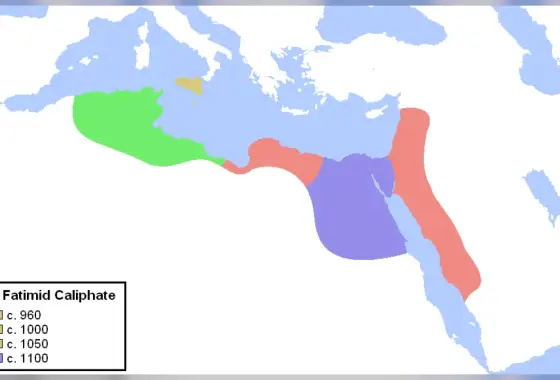
The Fatimids take their name from Fatima, the Prophet’s daughter, to whom they traced their descent. As a result of Ismaili missionary work among the Kutama Berbers of North Africa, Ubayd Allah al-Mahdi was proclaimed caliph in today’s Tunisia in 909.
Egypt and Cairo
The Fatimid general Jawhar al-Siqilli conquered Egypt in 969 and founded a new city beside Fustat: al-Qahira (Cairo). The al-Azhar Mosque, built in 970–972, became over time one of the oldest centres of learning in the Islamic world. The caliph al-Mu‘izz moved his capital to Cairo in 973.
The height
In the 10th and 11th centuries the Fatimids ruled North Africa, Sicily, Egypt, Palestine, part of Syria and the Hejaz. Cairo became the centre of trade between the Mediterranean and the Indian Ocean. The Dar al-Ilm (House of Knowledge), founded under the caliph al-Hakim, was an institution for scholarly work.
Decline and end
In the second half of the 11th century the Seljuk advance into Syria, economic crises and divisions in the army weakened the state. The Crusaders took Jerusalem from the Fatimids in 1099. In the last period real power lay with the viziers. Saladin, who became vizier, ended the Fatimid Caliphate in 1171 by having the Friday sermon read in the name of the Abbasid caliph.
Foundation: A Caliphate from North Africa
The Fatimids emerged in the late 9th century from the Ismaili mission conducted in North Africa. The missionaries, organised among the Kutama Berbers, overthrew the Aghlabid state in 909 and proclaimed Ubayd Allah al-Mahdi caliph. This event marked the beginning of a new political order that was not subordinate to the Abbasids and made its own claim to the caliphate.
At first the centre was the city of Mahdia, founded on the coast of present-day Tunisia. By also bringing Sicily under control, the Fatimids became an important naval power in the Mediterranean. Their real goal, however, was Egypt, the rich and strategic region of the Islamic world. This goal was reached about sixty years later, in 969, when the army under Jawhar al-Siqilli took Egypt.
The Founding of Cairo and al-Azhar
In 969 Jawhar al-Siqilli founded a new palace city north of Fustat and named it al-Qahira. The name means “the victorious”. At first the city was an enclosure only for the caliph, the army and the court, while ordinary people continued to live in neighbouring Fustat. Over time the two cities merged to form present-day Cairo.
The al-Azhar Mosque, built between 970 and 972, soon turned into a centre of learning. Under the caliph al-Aziz, who ruled from 975 to 996, regular teaching circles were established at al-Azhar. After the Fatimids, al-Azhar continued as one of the centres of Sunni education and today is counted among the world’s oldest continuously operating educational institutions. The gates of Cairo such as Bab al-Futuh and Bab Zuwayla are examples of Fatimid architecture added to the city walls in the 11th century.
Economy, Trade and Tolerance
Under the Fatimids Egypt became a hub where the trade of the Mediterranean, the Red Sea and the Indian Ocean met. Goods such as spices, textiles, flax and sugar were carried through Cairo to Europe and Asia. One of the sources that best shows the commercial life of the period is the Cairo Geniza documents from a synagogue in Fustat. These documents were discovered in the 1890s and reflect the correspondence, contracts and daily life of Jewish merchants.
The Fatimids did not at every period try to impose sectarian pressure on the Egyptian population, which was mostly Sunni. Christian and Jewish officials served in the administration; the vizier Yaqub ibn Killis was a statesman of Jewish birth who later became a Muslim. Even so, harsh measures against non-Muslims were also seen during al-Hakim’s reign; in other words, tolerance varied from period to period.
Al-Hakim, the House of Knowledge and the Druze
Al-Hakim, who ruled from 996 to 1021, is one of the most controversial caliphs in Fatimid history. In 1005 he founded the Dar al-Ilm; lectures were given there in fields such as medicine, astronomy, law and language, and the library was opened to the public. Observatory work and astronomical tables from the same period are also notable.
Alongside this, some of al-Hakim’s decisions, especially his measures against non-Muslims and the destruction of the Church of the Holy Sepulchre in Jerusalem in 1009, drew strong reaction both in the Christian world and in later historical writing. His mysterious disappearance in 1021 led some circles to regard him as divine and prepared the ground for a separate faith known as the Druze. The Druze faith is today maintained by a community living in Lebanon, Syria, Israel and Jordan.
The Great Famine, Schism and Collapse
Al-Mustansir’s long reign (1036–1094) is both the peak and the crisis of Fatimid history. In the late 1060s the Nile’s failure to flood sufficiently, together with political turmoil, led to the great famine known as al-Shidda. Rivalry between Turkish, Berber and Sudanese units in the army weakened the state’s central authority. Badr al-Jamali, summoned from Syria, became vizier in 1073 and restored order; after this, however, real power remained in the hands of the viziers.
After al-Mustansir’s death in 1094, the struggle for the throne between his two sons caused the Ismailis to split into Nizaris and Musta’lis. In the 12th century the advance of the Crusaders in Palestine and Syria, rivalry among viziers and outside interventions wore the state down further. In 1171 Saladin had the Friday sermon read in the name of the Abbasid caliph and the last caliph al-Adid died shortly afterwards, so the Fatimids passed into history.
Fatimid Architecture and Art
The Fatimids built Cairo not only as a political centre but also as a centre of art and architecture. Al-Azhar, the al-Hakim Mosque and Cairo’s gates of Bab al-Futuh and Bab al-Nasr reflect the stonework and architectural outlook of the period. The height of the gates and the solid towers symbolised both security and the splendour of the palace.
In the field of art, glass, ceramics, woodcarving and weaving were especially famous. Fatimid textiles, embroidered fabrics and ceramics with floral motifs were valuable products exported across the Mediterranean world. Rock crystal work was also a separate specialty; some of these works are today preserved in the world’s great museums, in the Museum of Islamic Art in Cairo and in church treasuries in Europe.
The Fatimid Legacy
The Fatimids’ most lasting legacy is the city of Cairo. Cairo, home today to tens of millions of people, was founded in 969 as a palace enclosure. The city’s Fatimid-era walls, gates and mosques make up an important part of the Historic Cairo area on the UNESCO World Heritage List.
The second legacy is al-Azhar, which still operates today as one of the world’s most respected Islamic educational institutions. The third is the later development of Ismaili thought: the Nizaris and Musta’lis are present today in India, Pakistan, Central Asia, Syria and many parts of the world. Thus, although they ended politically in 1171, the Fatimids left a trace extending to the present in the fields of city, institution and faith.
Sources and further reading
- Türkiye Diyanet Vakfı İslâm Ansiklopedisi, “Fâtımîler”.
- UNESCO World Heritage, “Historic Cairo”.
- Encyclopaedia Britannica, “Fāṭimid dynasty”.
- Türkiye Diyanet Foundation Encyclopaedia of Islam, entries “Fâtımîler”, “Hâkim-Biemrillâh” and “Ezher”.
- Encyclopaedia Britannica, entries “Fāṭimid dynasty” and “al-Ḥākim”.
- UNESCO World Heritage, “Historic Cairo”; Cambridge University Library, Taylor-Schechter Genizah Collection.
People also ask
What was the Fatimids? The Fatimid Caliphate was founded in North Africa in 909 and was based on Ismaili Shi‘i belief.
When was the Fatimids founded? Founded: 909, Ubayd Allah al-Mahdi (today’s Tunisia).
What was the Fatimids’s capital? Capitals: Raqqada, Mahdia, later Cairo.
When did the Fatimids end? End: 1171, Saladin.
Leave a comment
Your email address will not be published. Required fields are marked *