



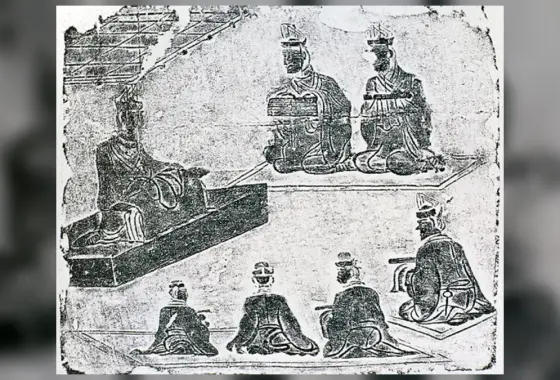
After the Qin dynasty, which had first unified China, quickly collapsed, Liu Bang, a leader of peasant origin, defeated his rivals and founded the Han dynasty in 202 BC. Its capital was Chang’an (near today’s Xi’an).
Emperor Wu and expansion
Under Emperor Wu (141–87 BC) Han China reached its greatest extent. Wu launched great campaigns against the Xiongnu to the north, and the journeys of his envoy Zhang Qian to the west began regular relations with Central Asia and the Silk Road. Confucianism became the state ideology, and officials were trained in its teachings.
Culture and science
The Shiji (Records of the Grand Historian) by the historian Sima Qian became the foundational work of Chinese historiography. According to tradition the court official Cai Lun improved papermaking in AD 105. Seismograph-like instruments and advanced farming techniques also appeared in this period.
Interruption and the Eastern Han
In AD 9 the court official Wang Mang seized the throne and founded the Xin dynasty. After his overthrow, a Han prince moved the capital to Luoyang in AD 25, beginning the Eastern Han period.
End
In the 2nd century conflicts between court eunuchs and aristocrats and peasant revolts weakened the state. After the Yellow Turban rebellion of 184, power passed to warlords. In 220 the last Han emperor abdicated and China entered the “Three Kingdoms” period.
Sources and further reading
- Sima Qian, Shiji.
- Ban Gu, Hanshu.
- Encyclopaedia Britannica, “Han dynasty”.
People also ask
What was the Han Dynasty? The Han dynasty was founded by Liu Bang in 202 BC and, apart from a short interruption, ruled China until AD 220.
When was the Han Dynasty founded? Founded: 202 BC, Liu Bang (Emperor Gaozu).
What was the Han Dynasty’s capital? Capitals: Chang’an (Western Han), Luoyang (Eastern Han).
When did the Han Dynasty end? End: AD 220, the Three Kingdoms period.


Leave a comment
Your email address will not be published. Required fields are marked *