



As the short-lived Sui dynasty collapsed, the general Li Yuan founded the Tang dynasty in 618. His son Li Shimin (Emperor Taizong, 626–649) strengthened the state and is remembered in Chinese history as a model ruler.
The Göktürks and Central Asia
In 630 Taizong defeated the Eastern Göktürk Khaganate and captured its qaghan, Illig; the Göktürks remained under Chinese rule for about half a century. Independence was regained in 682 under Ilterish Qutlugh Qaghan, a period described in the Orkhon inscriptions. Tang armies advanced into Central Asia but were defeated by an Abbasid army at the Battle of Talas in 751, where the Karluks’ switch to the Abbasid side affected the outcome.
Wu Zetian and the golden age
Wu Zetian is the only woman in Chinese history to rule in her own name with the title of emperor (690–705). Under Emperor Xuanzong Tang culture reached its height. Poets such as Li Bai and Du Fu lived in this period, and Buddhism spread widely. The Diamond Sutra (868), the oldest dated printed book, made with woodblocks, belongs to this era.
The An Lushan rebellion and the end
The rebellion launched in 755 by An Lushan, a general of Sogdian-Turkic origin, lasted eight years and caused enormous loss of life. The Tang were able to suppress it with the help of Uyghur cavalry, but central authority never regained its former strength. After peasant revolts in the 9th century, the dynasty ended in 907.
Chang’an: One of the Most Cosmopolitan Cities in the World
The Tang capital Chang’an (modern Xi’an) was one of the most populous and cosmopolitan cities in the world in the 7th and 8th centuries. The city was laid out on a regular grid, with wide avenues and walled wards. Sources put its population at about a million, one of the highest estimates for the period and not to be accepted as exact.
Sogdian merchants, Turks, Tibetans, Koreans, Japanese and Iranian communities lived in the city. Two great markets, the Eastern and Western Markets, were centres of Silk Road trade. Alongside Zoroastrian and Manichaean temples there were Christian and Buddhist buildings as well. A stele of 781 belonging to Nestorian Christianity can still be seen in Xi’an today. The plan of Chang’an also served as a model for the cities of the Nara and Heian periods in Japan.
State Organisation: Examinations, Law and Taxation
Tang government developed the centralised state order that had begun under the Sui. The written examination system gained importance in selecting officials; although it did not entirely remove the privileges of noble families, it opened a path for capable people to reach state office. The Tang Code compiled in 653 is regarded as a comprehensive text that influenced the legal systems of neighbouring countries such as Japan, Korea and Vietnam in later centuries.
At first an equal-field land distribution system and a tax and labour-service order tied to it were applied. In the 8th century population growth, transfers of land and wars broke down this system. With the reform of 780 taxes were collected twice a year on the basis of land and property rather than per person. This change preserved state revenue for a while, but the growing military and fiscal powers of regional governors weakened the centre.
Taizong’s Khaganate and Tang Policy in the West
After the fall of the Eastern Turkic Khaganate in 630 the Tang emperor Taizong was acknowledged by the steppe peoples with the title “Heavenly Khagan”. This title shows that Tang rulers wished to be seen as legitimate leaders both of the settled Chinese state and of the steppe world. Many Turkic chiefs and commanders served in the Tang army, and Turkic cavalry was used in frontier defence and campaigns.
In the west the Tang stationed garrisons in cities such as Kucha and Kashgar to control the oases of the Tarim Basin. These regions were governed through the so-called Four Garrisons system. A long rivalry with the Tibetan Empire also took place in this period; the marriage of Princess Wencheng to the Tibetan king Songtsen Gampo in 641 is one of the best-known examples of diplomatic relations between the two states. Even so, Tibet seriously challenged the Tang position in the west in the 8th century.
Buddhism, Pilgrimage and Xuanzang
Buddhism in China lived one of its most brilliant eras under the Tang. The monk Xuanzang set out on pilgrimage to India around 629 and, after a journey of about sixteen years through Central Asia and Afghanistan, returned to Chang’an in 645. He began translating the many Sanskrit texts he had brought back into Chinese, and his account of the journey, the “Record of the Western Regions of the Great Tang”, became an important source for the history of Central Asia and India.
Buddhist monasteries came to own extensive lands and revenue. Over time this led to a conflict of interest with the state; during the restrictions begun under Emperor Wuzong in 845, thousands of monasteries were closed and the number of monks was reduced. This event shook the institutional strength of Buddhism in China for a long time, although the faith continued to live among the people.
Poetry, Art and Technology: The Cultural Legacy of the Golden Age
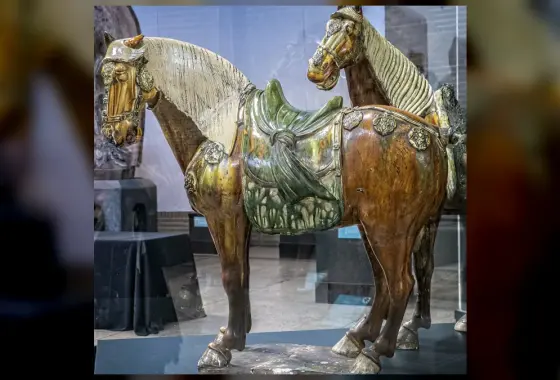
The Tang period is regarded as the summit of poetry in Chinese literature. The works of poets such as Li Bai, Du Fu and Wang Wei are still taught in Chinese schools today. The short, dense forms of Tang poetry became a literary standard in East Asia in later centuries. Painting, ceramics and music also flourished; the famous three-colour Tang ceramics and horse figurines remain important pieces in museums.
In technology, printing developed. The Diamond Sutra of 868 is cited as the oldest printed book with a precisely known date. The habit of drinking tea spread in this period, and Lu Yu’s “Classic of Tea” made tea a subject of culture. Porcelain production also developed under the Tang and reached the Middle East by the Silk Road and sea routes.
The Long Decline: Governors, Huang Chao and 907
After the An Lushan rebellion the Tang dynasty survived for about another century and a half, but real authority passed increasingly to military governors (jiedushi). These governors collected taxes in their own regions, maintained armies and sometimes acted independently of the centre. The court was meanwhile occupied with rivalries between eunuchs and officials.
In the late 9th century famines and the tax burden produced peasant uprisings. The rebellion led by Huang Chao lasted from 875 to 884; in 880 Chang’an fell to the rebels and the city suffered heavily. The dynasty managed to put down the revolt, but Zhu Wen, one of the commanders who had grown stronger in the process, deposed the last emperor in 907 and founded his own dynasty. China thereby entered the fragmented period known as the Five Dynasties and Ten Kingdoms.
Sources and further reading
- Encyclopaedia Britannica, “Tang dynasty”.
- Orkhon inscriptions (Kül Tegin and Bilge Qaghan inscriptions).
- Türkiye Diyanet Vakfı İslâm Ansiklopedisi, “Talas Savaşı”.
- Encyclopaedia Britannica, entries “Tang dynasty” and “Chang’an”.
- The Cambridge History of China, Vol. 3: Sui and T’ang China, 589–906.
- Xuanzang, Great Tang Records on the Western Regions (Da Tang Xiyu Ji).
- Orkhon inscriptions (Kül Tigin and Bilge Khagan inscriptions).
People also ask
What was the Tang Dynasty? The Tang dynasty ruled China from 618 to 907 and is considered one of the most brilliant periods in Chinese history.
When was the Tang Dynasty founded? Founded: 618, Li Yuan (Emperor Gaozu).
What was the Tang Dynasty’s capital? Capital: Chang’an.
When did the Tang Dynasty end? End: 907.
Leave a comment
Your email address will not be published. Required fields are marked *