



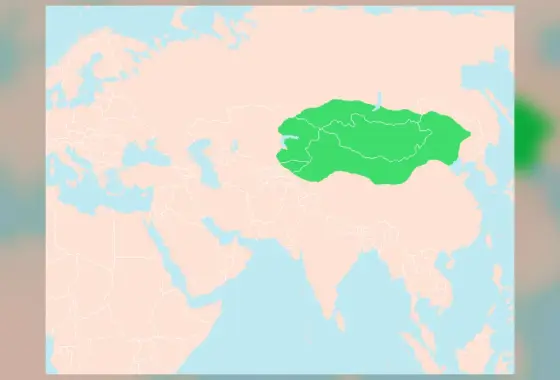
By the mid-1st century BC the Asian Huns had been weakened by long Han pressure, natural disasters and succession struggles. In 58 BC some tribal chiefs proclaimed Huhanye chanyu, but several rival chanyus soon appeared.
A struggle between brothers
Most rivals were eliminated, but Huhanye’s elder brother Zhizhi remained a powerful rival in the north, defeating Huhanye and taking the heartland of the Xiongnu.
Submission to Han China
In difficulty, Huhanye chose to come to terms with Han China, despite objections from some of his advisers. In 51 BC he travelled to the Han capital Chang’an, paid homage to the emperor and acknowledged Han supremacy, receiving large amounts of provisions and silk in return. The event symbolised the division of the Xiongnu into the Eastern Xiongnu (Huhanye) and the Western Xiongnu (Zhizhi).
Wang Zhaojun
In 33 BC Huhanye was married to Wang Zhaojun, a woman of the Han court. For centuries Wang Zhaojun was remembered in Chinese literature and folk tradition as a symbol of peace.
Death
Huhanye died in 31 BC. The chanyus descended from him generally maintained peaceful relations with Han China.
Reasons behind the peace decision
Huhanye’s decision to submit to Han China was not just the result of a defeat; it was an answer to the harsh realities of steppe politics. Defeated by his brother Zhizhi, the shanyu saw that he could not deal with his northern rival alone. According to the Hanshu, some tribal leaders around Huhanye argued that losing the independence the Xiongnu had won by the sword by bowing to a state went against the way of the ancestors; others said that hunger, livestock losses and civil war were wearing the people down.
In the end the shanyu chose the path of agreement with the Han. This choice was a turning point in the Han–Xiongnu relationship, which had lasted two centuries: the Xiongnu now approached the Han court not as a “brother state” but as a subordinate ally. On the other hand, Huhanye aimed to keep this submission symbolic and to remain independent in internal affairs. The Xiongnu administration continued its traditional institutions under the protection of the Han army.
The Chang’an visit and the tribute system
The visit to Chang’an in 51 BC set the ceremonial framework of this new relationship. The shanyu was hosted by the emperor in the Han capital and received gifts such as a gold seal, belts, garments and countless bolts of silk. Chinese sources record that Huhanye was placed above the other vassals in the emperor’s presence and was shown a respect “proper to rulers”. This detail shows that the Han court sought to keep the Xiongnu under control without humiliating them completely.
The Xiongnu were obliged to present tribute to the Han as vassals, and in return they received grain, silk and food aid. For the Han this arrangement was a cheap way to keep the frontier safe; for the Xiongnu it was vital support in times of famine. Huhanye and later shanyu traded at Han-controlled markets along the border. A relationship based more on exchange than on war thus developed, although this balance always remained fragile.
Wang Zhaojun and diplomacy
The marriage of Wang Zhaojun in 33 BC is the best-known symbol of this diplomacy. The sources record that the young woman, a palace attendant at the Han court, was sent to the steppe to marry the shanyu. The Hanshu records this event briefly; in later centuries Wang Zhaojun’s story became the subject of poetry, theatre and painting. Accounts often treat the event romantically or dramatically, yet the historical core rests on the tradition of strengthening relations between two states through marriage ties.
Marriage diplomacy was a common method between steppe empires and China. By sending princesses or court women to Xiongnu shanyu, the Han court aimed to maintain relations through kinship. During the years Wang Zhaojun lived among the Xiongnu the frontier remained relatively calm; Chinese historiography often describes this period as a symbol of peace. Still, the foundation of this peace was Han political superiority and the Xiongnu’s acceptance of it.
Consequences of the division of the Xiongnu
Huhanye’s choice put the Xiongnu on two separate paths in the long run. The Xiongnu who settled in the south remained attached to the Han and became known as the “Southern Xiongnu”, while Zhizhi’s branch that turned west was destroyed in 36 BC. In the following centuries the Southern Xiongnu settled in Chinese border regions, came into close contact with Chinese culture and played a role in Chinese politics as a military force. Those who remained in the north dispersed over time under pressure from new steppe powers such as the Xianbei.
Historians evaluate Huhanye in two ways: to some he is a realistic leader who saved his people from famine and extinction by giving up independence; to others he marks the beginning of the end of the Xiongnu as a steppe empire. It should be remembered that sources such as the Hanshu were written from the Han point of view. A more balanced approach is therefore to read Huhanye’s decision not only as “submission” but also as a survival strategy.
The later fate of the Southern Xiongnu
The system of submission begun by Huhanye did not end with his death. The shanyu descended from him maintained relations with Han China for about a century. When the Han dynasty was interrupted by Wang Mang’s coup in AD 9, however, the balance between the Xiongnu and China was upset and conflicts resumed on the frontier. Shortly after the Han dynasty was re-established as the Eastern Han in AD 25, the Xiongnu split again internally, and the southern group submitted once more to Han China in AD 48. Chinese sources call this group the “Southern Xiongnu”.
The Southern Xiongnu settled in regions along China’s northern frontier and gradually moved to a semi-sedentary life. The descendants of these communities took on important roles in Chinese political history in later centuries; commanders and dynasties of Xiongnu origin emerged in the periods of the Three Kingdoms and the Sixteen Kingdoms. Thus Huhanye’s decision in 51 BC can also be read, in the long run, as the beginning of the integration of the Xiongnu into the Chinese world. Although the sources do not describe this process in detail, its general direction is accepted by historians.
Sources and further reading
- Ban Gu, Hanshu, chapter 94 (the Xiongnu).
- Türkiye Diyanet Vakfı İslâm Ansiklopedisi, “Hunlar”.
- Encyclopaedia Britannica, “Xiongnu”.
- Ban Gu – Hanshu, chapter 94 (the Xiongnu)
- Türkiye Diyanet Foundation Encyclopaedia of Islam – “Hunlar” entry
- Encyclopaedia Britannica – Xiongnu
- Ban Gu – Hanshu, chapter 94 (the Xiongnu)
- Türkiye Diyanet Foundation Encyclopaedia of Islam – “Hunlar” entry
- Encyclopaedia Britannica – Xiongnu
People also ask
Who was Huhanye Chanyu? Huhanye was chanyu of the Asian Huns (Xiongnu) during the civil war of the mid-1st century BC.
When did Huhanye Chanyu reign? Reign: 58 – 31 BC.
When did Huhanye Chanyu die? Died: 31 BC.






Leave a comment
Your email address will not be published. Required fields are marked *