



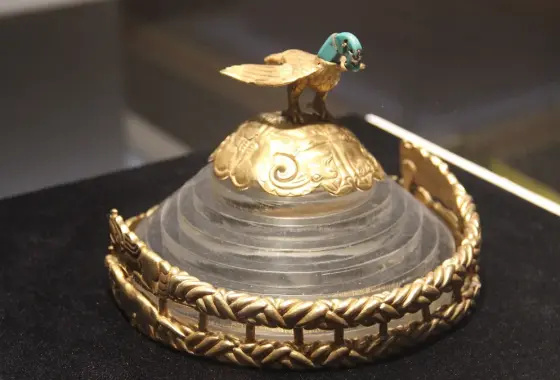
Known in Chinese sources as the Xiongnu, the Huns built a powerful tribal union on the steppes north of China in the 3rd century BC. Their first known ruler, Touman, fought the Qin dynasty that had unified China. The joining of large sections of the Great Wall at this time against steppe raids shows how strong they were.
Modu and expansion
Modu Chanyu, who took power in 209 BC, defeated the Donghu in the east and the Yuezhi in the west and united the steppe. His siege of Han Emperor Gaozu in 200 BC led to a treaty system under which the Han court sent regular gifts to the Xiongnu. His decimal army and the division of the realm into eastern and western wings became models for later steppe states.
A long struggle with Han China
In the late 2nd century BC Han Emperor Wudi launched major campaigns against the Xiongnu, and the struggle for the Silk Road intensified. Long wars and succession disputes weakened the empire.
Division
In the mid-1st century BC a succession struggle split the state: Huhanye came to terms with Han China while his brother Zhizhi moved west and was killed fighting a Han army in 36 BC. The empire recovered briefly but split permanently into Northern and Southern Xiongnu in AD 48. Some historians link the Huns who later reached Europe with the Asian Huns; this remains debated.
The chanyu title and how the state was governed
In Chinese sources the title of the Xiongnu ruler appears as "chanyu" (tanhu in Turkish spelling). The Han Shu gives the ruler's full title as "Chengli Gutu Chanyu"; most researchers link the word "chengli" in this phrase to Tengri, the sky god. The state was divided into a left (eastern) and a right (western) wing, each headed by "wise kings". Sima Qian writes that the leaders gathered every year at great assemblies in particular months to offer sacrifices to the ancestors, heaven and earth.
Marriage and gifts: Wang Zhaojun
Under the peace arrangement set up after 200 BC, the Han court sent the chanyus princesses linked to the court as well as gifts; this practice, called "heqin" in Chinese, formed the basis of relations between the two states for a long time. The most famous example is Wang Zhaojun, who was married from the Han court to the chanyu Huhanye in 33 BC. Wang Zhaojun is portrayed in Chinese literature and painting as a symbol of peace on the frontier, and a memorial tomb in her name stands near Hohhot.
The end of the Northern Xiongnu and an inscription found in 2017
After the split of AD 48 the Southern Xiongnu submitted to Han China, while the Northern Xiongnu stayed on the steppe. In AD 89 the Han commander Dou Xian led a large campaign against the Northern Xiongnu together with the Southern Xiongnu. After the victory a text written by the historian Ban Gu was carved into the rock at Mount Yanran. In 2017 Mongolian and Chinese researchers announced that they had found this inscription in Mongolia's Middle Gobi region, confirming in the field an event known only from books.
The Xiongnu in archaeology: Noin-Ula and Ivolga
The Noin-Ula (Noyon Uul) burial mounds in northern Mongolia were excavated in 1924–1925 by Pyotr Kozlov's expedition. The graves contained woollen carpets, silk textiles and an inscribed Chinese lacquer cup dated to 2 BC; a large part of the finds is now in the Hermitage Museum in St Petersburg. Excavations at the Ivolga fortress in Russia's Buryatia region showed that the Xiongnu were not only nomads but also included settled communities that farmed and worked iron.
Frequently asked questions
Were the Xiongnu Turkic? Turkish historiography counts them among the ancestors of the Turks. They were a confederation of many tribes, and views on their language differ.
How long did the empire last? About 270 years, from the late 3rd century BC to the final split in AD 48.
Sources and further reading
- Sima Qian, Shiji, chapter 110; Ban Gu, Han Shu, chapter 94.
- Türkiye Diyanet Vakfı İslâm Ansiklopedisi, “Hunlar”.
- Bahaeddin Ögel, Büyük Hun İmparatorluğu Tarihi.
- Encyclopaedia Britannica, “Xiongnu”.
- Sima Qian, Shiji, chapter 110 (Xiongnu)
- Nicola Di Cosmo – Ancient China and Its Enemies (Cambridge UP, 2002)
- State Hermitage Museum – Noin-Ula finds collection
People also ask
What was the Xiongnu Empire (Asian Huns)? The Xiongnu state emerged on the Mongolian steppe in the late 3rd century BC and, under Modu Chanyu, became an empire stretching from northern China into Central Asia.




Leave a comment
Your email address will not be published. Required fields are marked *