



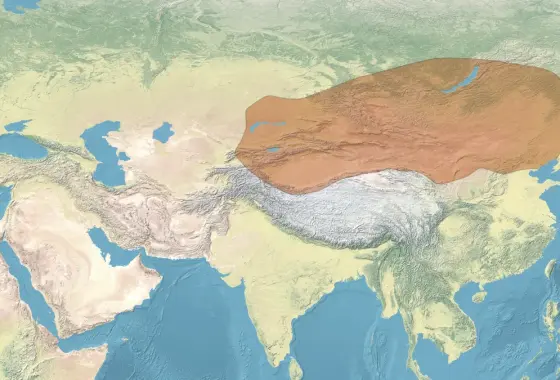
Modu Chanyu, called Mete Han in Turkish, was a ruler of the Xiongnu, often called the Asian Huns. He succeeded his father Touman in 209 BC and ruled until his death in 174 BC. Under him the Xiongnu became a vast steppe empire centred on Mongolia.
Rise to power
According to the Chinese historian Sima Qian, our most detailed source, Touman wanted another son as heir and sent Modu as a hostage to the neighbouring Yuezhi. Modu escaped, built a fiercely loyal and disciplined force and then took his father’s place. Some scenes of this account carry legendary elements.
Uniting the steppe
- In the east: he defeated the Donghu.
- In the west: he defeated the Yuezhi and pushed them westward.
- North and south: he brought many tribes under his rule, reaching the northern frontier of Han China.
Relations with the Han dynasty
In 200 BC Han Emperor Gaozu campaigned against the Xiongnu, and Modu surrounded him near Baideng. Afterwards the two states adopted the “heqin” arrangement: the Han court sent regular gifts of silk, grain and other goods, and dynastic marriages were arranged, a sign of the steppe power’s strength.
State and army
Under Modu the army was organised on a decimal system of units of 10, 100, 1,000 and 10,000, and the realm was divided into eastern and western wings. Traces of this order appear in many later steppe states. Türkiye’s Land Forces trace their founding date to 209 BC, a sign of Modu’s place in Turkish history.
The story of the whistling arrow
The most famous story told by Sima Qian concerns Modu's rise to the throne. Modu had arrows made that whistled in flight and ordered his men to shoot wherever such an arrow struck, warning that anyone who failed to do so would be punished. He first shot at his own horse, then at his beloved wife, and punished those who hesitated. When he shot at his father's horse, everyone followed. Finally he aimed the whistling arrow at his father Touman and seized the throne. Historians treat this account as a partly legendary story that stresses the testing of discipline and loyalty.
The demands of the Donghu and the saying about land
According to the Shiji, the powerful Donghu tribes in the east tested Modu's strength by first asking for a prized horse left by his father and then for one of his consorts. Modu gave them both, despite the objections of his advisers. When the Donghu then demanded an empty stretch of border land between the two peoples, some advisers said the barren ground could be given away. Modu, however, grew angry, saying that land is the foundation of a state, set out at once and inflicted a heavy defeat on the Donghu. In Turkish historical writing the story is often cited as a symbol of the value placed on the homeland.
The letter to Empress Lü
After the death of the Han Emperor Gaozu in 195 BC, power lay in practice with his widow, Empress Lü. According to Chinese sources, Modu sent her a letter proposing marriage in a mocking and contemptuous tone. The court angrily debated war, but commanders recalled the siege at Baideng and argued that fighting the Xiongnu was too risky. Empress Lü wrote a mild reply, sent gifts, and the heqin arrangement continued. The episode shows that the balance between the two powers favoured the Xiongnu at the time.
The letter of 176 BC and expansion to the west
A letter dated 176 BC that Modu sent to the Han Emperor Wen, preserved in the Shiji, describes the extent the state had reached. It reports that the Yuezhi had been defeated, that Loulan, the Wusun and many small states around them had submitted to the Xiongnu, and that the “peoples who draw the bow” had become one family. This expansion brought the oasis cities of the Tarim Basin and the eastern part of the Silk Road under Xiongnu influence. The westward migration of the Yuezhi, in turn, set off a long movement of peoples in Central Asia.
Frequently asked questions
Are Mete and Modu the same person? Yes. Modu is the Chinese rendering; Turkish historiography also uses Mete or Bagatur Tanhu.
Is the origin of the Xiongnu certain? Their language and origins are debated. Turkish historiography counts them among the ancestors of the Turks, while international scholarship also sees them as a multi-ethnic steppe confederation.
Sources and further reading
- Sima Qian, Shiji (Records of the Grand Historian), chapter 110, “Xiongnu”.
- Türkiye Diyanet Vakfı İslâm Ansiklopedisi, “Hunlar”.
- Bahaeddin Ögel, Büyük Hun İmparatorluğu Tarihi.
- Encyclopaedia Britannica, “Xiongnu” and “Modu”.
- Sima Qian, Records of the Grand Historian: Han Dynasty II, trans. Burton Watson, Columbia University Press (1993), chapter 110
- Nicola Di Cosmo, Ancient China and Its Enemies, Cambridge University Press (2002)
People also ask
Who was Modu Chanyu (Mete Han)? Modu Chanyu, known in Turkish as Mete Han, ruled the Xiongnu (Asian Huns) from 209 to 174 BC.
When did Modu Chanyu (Mete Han) reign? Reign: 209 – 174 BC.
Who was Modu Chanyu (Mete Han)’s father? Father: Touman.


Leave a comment
Your email address will not be published. Required fields are marked *