



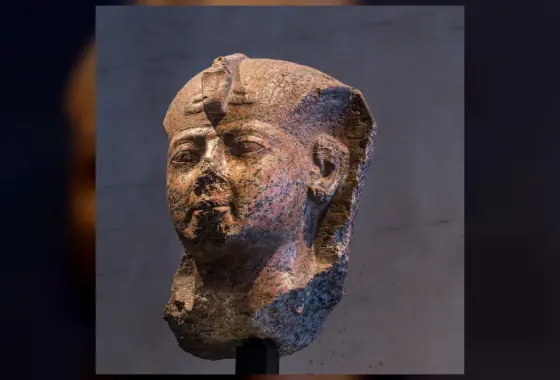
Hatshepsut was the daughter of Pharaoh Thutmose I and married her half-brother Thutmose II. When Thutmose II died young, the heir was Thutmose III, his infant son by another wife, and Hatshepsut took over government as his regent.
Pharaoh Hatshepsut
A few years later Hatshepsut declared herself pharaoh and took all the royal titles. Some statues and reliefs show her like male pharaohs, with a false beard and royal dress. Thutmose III remained co-ruler during this period.
A peaceful reign
Her reign was largely one of peace and prosperity. She sent a trading expedition to the Land of Punt, thought to have been on the Red Sea coast, which brought back incense trees, ebony and ivory. The expedition is depicted in detailed reliefs on the walls of her temple.
Deir el-Bahari
Built in stepped terraces against the cliffs west of Thebes, the temple of Deir el-Bahari is one of the most striking examples of Egyptian architecture. One of the obelisks she erected at Karnak still stands today.
Death and aftermath
Hatshepsut died around 1458 BC. Late in the reign of Thutmose III her name and images were erased from many monuments; the reason is debated. In 2007 Egyptian archaeologists announced that a previously found mummy belonged to Hatshepsut.
Senenmut and her daughter Neferure
The most prominent official of Hatshepsut's reign was the royal steward Senenmut. Senenmut was responsible for the upbringing of Neferure, the daughter of Hatshepsut and Thutmose II; many statues showing him holding the princess are today in museums around the world. He is also associated with the building of the temple at Deir el-Bahari. In some documents Neferure is referred to with titles typical of queens, which has been interpreted as a sign that Hatshepsut was preparing her daughter for the future.
Her works at Karnak
Hatshepsut commissioned major buildings at Karnak, the main cult centre of Amun. Of the two obelisks she raised for her jubilee, the one still standing, at about 29 metres, is among the tallest ancient obelisks still upright in Egypt. The "Red Chapel", built of red quartzite, was later dismantled; its blocks were found in the 20th century and reassembled in the Karnak Open Air Museum. The inscription at the rock-cut temple of Speos Artemidos near Beni Hasan shows Hatshepsut presenting herself as a ruler who repaired the damage of the Hyksos period.
How was her mummy identified?
A female mummy found in tomb KV60 in the Valley of the Kings, whose identity had long been unknown, was announced as Hatshepsut in 2007 by Egypt's Supreme Council of Antiquities. The most important evidence was a small box bearing Hatshepsut's name that contained a molar: the tooth was reported to fit a gap in the mummy's jaw. DNA analyses were also carried out, but some researchers continue to question how certain the identification is. The mummy is now displayed at the National Museum of Egyptian Civilization in Cairo.
The details of the Punt expedition
The reliefs at Deir el-Bahari tell the story of the Punt expedition step by step: ships sailing on the Red Sea, houses built on stilts, the ruler and queen of Punt, and myrrh trees carried with their roots in baskets. The trees that were brought back are thought to have been planted on the temple's terraces; archaeologists have found tree pits there. The exact location of Punt is still debated. Researchers generally point to the region that includes the coasts of present-day Eritrea, Sudan, Ethiopia and Somalia. An isotope study of baboons mummified in Egypt, published in 2020, also supported the view that Punt should be sought in this region, around the Horn of Africa.
Sources and further reading
- Encyclopaedia Britannica, “Hatshepsut”.
- The Metropolitan Museum of Art, Hatshepsut: From Queen to Pharaoh (2005).
- UNESCO World Heritage, “Ancient Thebes with its Necropolis”.
- Joyce Tyldesley – Hatchepsut: The Female Pharaoh (Viking, 1996)
- Kara Cooney – The Woman Who Would Be King (Crown, 2014)
- Nathaniel J. Dominy et al. – "Mummified baboons reveal the far reach of early Egyptian mariners", eLife 9 (2020)
People also ask
Who was Hatshepsut? Hatshepsut, of Egypt’s 18th dynasty, was a female pharaoh who reigned for about twenty years in the 15th century BC.
When did Hatshepsut reign? Reign: c. 1479 – 1458 BC.
Who was Hatshepsut’s father? Father: Thutmose I.
Leave a comment
Your email address will not be published. Required fields are marked *