



Tutankhamun was most probably the son of Pharaoh Akhenaten, who had set aside the traditional gods to promote the worship of the sun disc, the Aten, and founded a new capital at Amarna. The boy’s birth name, “Tutankhaten”, reflected this belief.
His reign
Tutankhamun came to the throne around the age of nine, and advisers such as the vizier Ay and the general Horemheb had great influence. Early in his reign he changed his name to “Tutankhamun”; Amarna was abandoned and the traditional religion, above all the god Amun, was restored.
Death
Tutankhamun died around 1323 BC aged 18 or 19. The cause of death is uncertain; DNA and CT studies published in 2010 pointed to signs of malaria and bone disease.
Discovery of the tomb
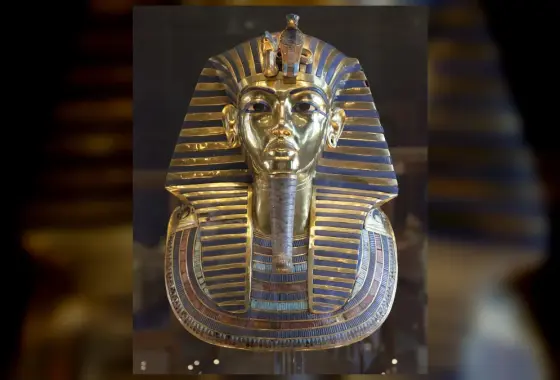
On 4 November 1922 the British archaeologist Howard Carter, excavating with the backing of Lord Carnarvon, found the entrance to the tomb in the Valley of the Kings. Although robbed twice in antiquity, the tomb had remained largely intact. Of the more than five thousand objects found, the gold funerary mask is the best known. The objects are displayed in Egypt today.
The Restoration Stela: a return to the old beliefs
One of the most important documents of Tutankhamun's reign is the Restoration Stela found in the Temple of Amun at Karnak. This inscription relates that when the young king came to the throne, the temples of the land had fallen into neglect, the gods had turned their backs on Egypt and campaigns abroad had failed. It then states that the king had the statues of the gods remade, appointed priests and increased temple revenues. The stela is read as the official proclamation of the return from the Aten-centred religious order of Akhenaten's era to traditional polytheistic belief; it is thought to reflect the policy of his advisers more than the king's own will.
His wife Ankhesenamun and the royal family
Tutankhamun married Ankhesenamun, a daughter of Akhenaten and Nefertiti; her name too was originally "Ankhesenpaaten", referring to the Aten. According to the 2010 genetic study, the mummies of two small girls found in the tomb are thought most likely to be the couple's children who died before or at birth. Hittite archives tell of an Egyptian queen whose husband had died asking the Hittite king Suppiluliuma I for one of his sons as a husband; the prince who was sent was killed on the way. Although it is often suggested that this queen was Ankhesenamun, her identity is not certain.
Extraordinary objects from the tomb
The finds from the tomb are not limited to gold. An X-ray fluorescence study published in 2016 showed that the blade of the iron dagger found beside the king's mummy was made of meteoritic iron. Two trumpets from the tomb were played in a BBC radio broadcast in 1939 and are counted among the oldest playable instruments surviving from ancient Egypt. The gilded throne, chariots, chests, game sets and baskets of seeds show in detail what a pharaoh was equipped with for the afterlife. Recording these objects took Carter's team about ten years.
Ay, Horemheb and a forgotten king
When Tutankhamun died childless, the aged vizier Ay took the throne, and after Ay the commander Horemheb became king. Horemheb and the Ramesside dynasty that followed removed the kings associated with the Amarna period from the official records: Akhenaten, Tutankhamun and Ay do not appear in the king list at Abydos. Some of Tutankhamun's monuments were also re-inscribed in Horemheb's name. When this "forgetting" combined with the covering of the tomb by debris from later building work, the tomb remained hidden for about three thousand years; today the king's fame has outgrown that of those who tried to erase him.
Frequently asked questions
Is the “curse of the pharaoh” real? The belief, which spread after Lord Carnarvon’s death in 1923, has no scientific basis; Carter lived for many years after the discovery.
Sources and further reading
- Encyclopaedia Britannica, “Tutankhamun”.
- Hawass et al., “Ancestry and Pathology in King Tutankhamun’s Family”, JAMA (2010).
- Griffith Institute (Oxford), Howard Carter excavation archive.
- Daniela Comelli et al. – “The meteoritic origin of Tutankhamun’s iron dagger blade”, Meteoritics & Planetary Science (2016)
- Nicholas Reeves – The Complete Tutankhamun (Thames & Hudson, 1990)
People also ask
Who was Tutankhamun? Tutankhamun, of Egypt’s 18th dynasty, came to the throne around the age of nine in the 14th century BC and reigned for about ten years.
When did Tutankhamun reign? Reign: c. 1332 – 1323 BC.


Leave a comment
Your email address will not be published. Required fields are marked *