



Ancient Egyptian civilisation grew up along the Nile, whose annual flood made the land fertile. According to tradition, around 3100 BC a ruler named Narmer (Menes) united Upper and Lower Egypt. Historians divide this long history into more than thirty dynasties and several major periods.
The Old Kingdom: the age of pyramids
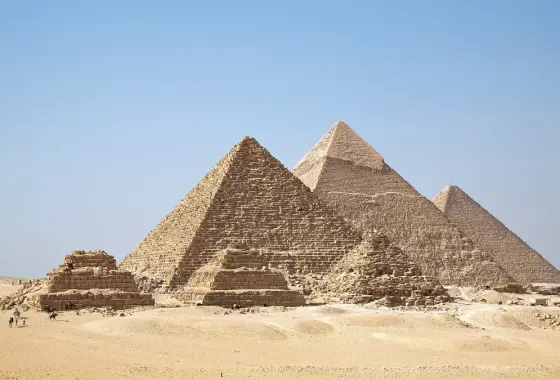
In the Old Kingdom (c. 2686–2181 BC) the capital was Memphis. The Step Pyramid and the pyramids of Giza were built in this period, the largest being the Great Pyramid, built in the 26th century BC for Pharaoh Khufu.
The Middle and New Kingdoms
In the Middle Kingdom central government grew strong again and literature flourished. The New Kingdom (c. 1550–1070 BC) was Egypt’s most powerful era: Hatshepsut, Thutmose III, Akhenaten with his worship of the Aten, Tutankhamun, famous for his tomb, and Ramses II all reigned then. Egyptian power reached from Nubia to Syria.
The Late Period and the end
In 525 BC the Persians conquered Egypt. In 332 BC Alexander the Great entered Egypt; after his death the dynasty founded by his general Ptolemy ruled for about three hundred years. With the death of Cleopatra VII in 30 BC, Egypt became a Roman province.
Legacy
Hieroglyphic writing was deciphered in 1822 by Jean-François Champollion with the help of the Greek text on the Rosetta Stone, found in 1799. Egypt’s knowledge of medicine, mathematics, the calendar and architecture deeply influenced later civilisations.
The Nile flood and the calendar
The life of the Egyptians was organised around the annual flood of the Nile. The year was divided into three seasons: Akhet, the season of inundation; Peret, when the land emerged from the water and was sown; and Shemu, the harvest season. The height of the flood was monitored with nilometers, stepped measuring structures at places such as Elephantine, and taxes were set accordingly. The Egyptians used a 365-day administrative calendar consisting of twelve months of 30 days plus five days added at the end of the year. The reappearance of the star Sirius (Sopdet) at dawn was taken as a sign that the flood was approaching. This calendar later also inspired the Julian calendar used in Rome.
Medical and mathematical papyri
The papyri that have survived from Egypt show how advanced scientific knowledge was. The Edwin Smith Papyrus, dated to around 1600 BC, describes 48 injury cases arranged from the head downwards, under the headings of examination, diagnosis and treatment; it stands out for an approach based more on observation than on magic. The Ebers Papyrus from around 1550 BC contains hundreds of prescriptions. The Rhind Mathematical Papyrus, now in the British Museum, with fraction calculations and area and volume problems copied by the scribe Ahmose, is in effect a textbook used in teaching.
Who built the pyramids?
It is a widespread belief that the pyramids were built by slaves, but archaeological finds paint a different picture. In the workers' settlement uncovered south of the pyramids at Giza, bakeries, brewing areas, large quantities of animal bones and the workers' tombs were found. The location of these tombs near the royal necropolis and healed fractures showing that workers received medical care point to a workforce largely divided into organised crews that received food in return. The craftsmen who built the tombs of the Valley of the Kings, meanwhile, lived for generations in the village of Deir el-Medina.
The first known strike in history
The craftsmen of Deir el-Medina were a literate community and left behind thousands of ostraca, that is, fragments of pottery and stone with writing on them. These documents describe everyday life in detail, from rent, debts and purchases to family disputes. A papyrus in the Egyptian Museum in Turin records that in year 29 of the reign of Ramesses III, in the 12th century BC, workers whose grain rations were late stopped work and marched to the temples. This event is remembered as the oldest strike known from written records and also sheds light on the economic difficulties of the state.
Sources and further reading
- Encyclopaedia Britannica, “ancient Egypt”.
- British Museum, “Rosetta Stone” collection record.
- UNESCO World Heritage, “Memphis and its Necropolis – the Pyramid Fields from Giza to Dahshur”.
- British Museum – Rhind Mathematical Papyrus collection record
- Museo Egizio (Turin) – Strike Papyrus (Cat. 1880)
- Ancient Egypt Research Associates (AERA) – excavations of the Giza workers’ settlement
People also ask
What was Ancient Egypt? Ancient Egypt was a civilisation born around 3100 BC with the unification of Upper and Lower Egypt that lasted about three thousand years.
What was Ancient Egypt’s capital? Capitals: Memphis, Thebes, Amarna, Pi-Ramesses.
When did Ancient Egypt end? End: 30 BC, annexed by Rome.




Leave a comment
Your email address will not be published. Required fields are marked *