



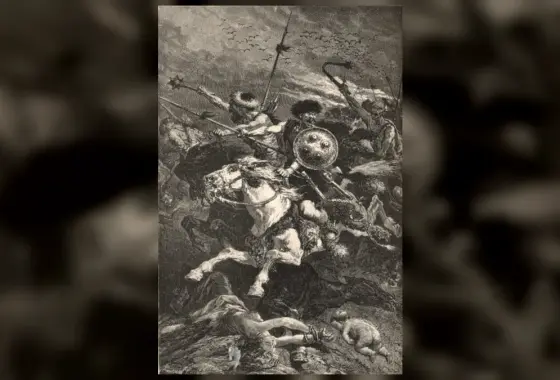
In the 370s the Huns crossed the Volga and advanced west. Under a leader named in the sources as Balamber they defeated first the Alans and then, around 375, the Ostrogoths. Fleeing the Huns, the Visigoths sought refuge in Roman territory; these movements began the great wave of migrations known in European history as the Migration Period.
Relations with Rome
In the early 5th century the Huns grew strong along the Danube under Uldin and Rua and moved their centre to Pannonia. They received regular tribute from the Eastern Roman Empire and at times allied with the Western Empire.
The age of Attila
In 434 Rua was succeeded by his nephews Bleda and Attila; from around 445 Attila ruled alone. He campaigned in the Balkans, Gaul (451) and Italy (452), and the empire ruled many peoples across a wide area from the Rhine to north of the Black Sea.
Collapse
Attila died in 453. Taking advantage of the struggle among his sons, subject peoples revolted and defeated the Huns at the Battle of Nedao in 454. Attila’s son Dengizich was killed fighting the Eastern Empire in 469, while another son, Ernakh, withdrew north of the Black Sea. This date is taken as the end of the Hunnic Empire in Europe.
Origins
Turkish historiography regards the European Huns as a continuation of the Asian Huns (Xiongnu) and as a Turkic state. In international scholarship the Huns’ language and their link to the Xiongnu remain debated.
Priscus's account of the embassy
The most vivid testimony on the inner life of the Huns comes from the historian Priscus, who travelled to Attila's headquarters with an Eastern Roman embassy in 449. Priscus describes, in a settlement surrounded by wooden walls on the plain north of the Danube, palace buildings made of polished planks and a stone bathhouse nearby. He relates that at the banquet the guests ate and drank from gold and silver vessels, while Attila used a plain wooden cup and dressed without ostentation. His note that Hunnic, Gothic and Latin were spoken at the court shows the multilingual character of the empire. Priscus's work has survived only in fragments, through quotations by later authors.
Warfare: the mounted archers
The main reason the Huns made such an impact in Europe was the steppe style of mounted archery. Composite bows reinforced with bone plates allowed powerful shots from a distance; units attacked quickly and withdrew, then returned after scattering the enemy. Although the Roman historian Ammianus Marcellinus describes the Huns in hostile language, he draws particular attention to their speed and their skill on horseback. Over time the infantry of Germanic peoples subject to the Huns also joined the Hunnic army; at the Battle of the Catalaunian Plains in 451 there were Goths in the ranks of both sides.
Subject peoples and administration
The Hunnic Empire did not consist of a single people; many peoples such as the Gepids, Ostrogoths, Sciri, Rugians and Alans were subject to the Hunnic ruler and were governed by their own leaders. The Gepid king Ardaric and the Ostrogothic leader Valamir were in Attila's closest circle. Priscus relates that trusted advisers such as Onegesius and high-ranking nobles served beside Attila and that tribute and soldiers were collected from the subject peoples. This loose structure worked while there was a strong ruler, but it dissolved quickly after Attila's death.
Archaeological traces and later echoes
Foremost among the finds associated with the Huns are large bronze cauldrons found over a wide area from Hungary to Central Asia; they are thought to have been used in ceremonies. The custom of artificial skull shaping also spread in Central Europe during the Hunnic period. Attila's son Ernak is identified by some researchers with Irnik in the "Nominalia of the Bulgarian Khans", which lists the names of Bulgar rulers. The name of the Huns and the figure of Attila lived on in medieval Germanic epics, especially in the Nibelungenlied under the name "Etzel".
Sources and further reading
- Priscus, History fragments.
- Türkiye Diyanet Vakfı İslâm Ansiklopedisi, “Hunlar”.
- Encyclopaedia Britannica, “Hun”.
- R. C. Blockley – The Fragmentary Classicizing Historians of the Later Roman Empire, vol. II (fragments of Priscus, 1983)
- Ammianus Marcellinus, Res Gestae, Book XXXI
- E. A. Thompson – The Huns (Blackwell, 1996)
People also ask
What was the Hunnic Empire? The Hunnic Empire in Europe was founded by the Huns, who moved west from beyond the Volga in the late 4th century.
When was the Hunnic Empire at its height? Height: Reign of Attila (434 – 453).
When did the Hunnic Empire end? End: 469, death of Dengizich.

Leave a comment
Your email address will not be published. Required fields are marked *