



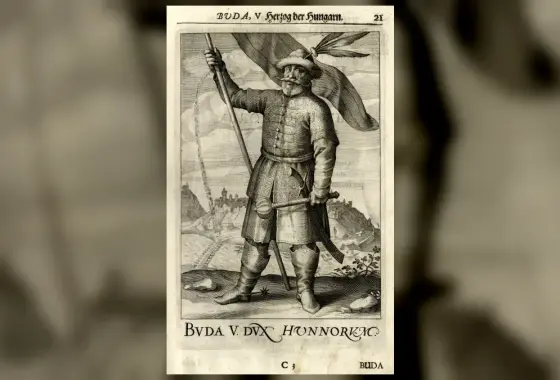
Bleda and his brother Attila were the sons of the Hunnic noble Mundzuk. After the death of their uncle Rua in 434 they took over the Huns together. The sources suggest that the realm was divided between the two brothers.
The Treaty of Margus
In 435 at Margus on the Danube (in today’s Serbia), the Huns won important concessions from Eastern Roman envoys: the annual tribute was raised to 700 pounds of gold, Huns who had fled to Rome were to be returned, and Hunnic merchants gained equal rights at frontier markets.
Balkan campaigns
When the Eastern Empire failed to keep the treaty, the Huns launched a major campaign into the Balkans in 441–443. Cities such as Sirmium, Singidunum (Belgrade) and Naissus (Niš) were taken, and the Hunnic army advanced close to Constantinople. The campaign ended with a peace that tripled the tribute.
Death
Bleda died around 445. Some contemporary sources write that he was killed by Attila, but the details are unknown. From then on Attila was sole ruler of the Huns.
How did the joint rule work?
The sources do not clearly explain how Bleda and Attila shared power over the Huns after 434. Some historians think that Bleda, as the elder brother, was regarded as the senior ruler and that the two brothers held authority over different tribes and regions; the limits of this division, however, are unknown. In negotiations with the Eastern Roman Empire the two brothers are seen acting together. It is reported that at the meeting at Margus the Hun side made the Roman envoys negotiate on horseback as well, a detail suggesting that the Huns conducted talks according to their own customs.
The story of Zercon told by Priscus
The most vivid information about Bleda's character comes from a story told by the historian Priscus. A jester of North African origin named Zercon enjoyed great favour at Bleda's court. Bleda had a special suit of armour made for him and took him along on campaigns. When Zercon once tried to escape and was caught, Bleda laughed instead of growing angry and forgave him. According to Priscus, Attila did not enjoy such entertainment; after Bleda's death he gave Zercon as a gift to the Western Roman general Aetius.
The terms of the peace of 443
After the Balkan campaign a new peace was concluded through negotiations conducted by Anatolius on behalf of the Eastern Roman Empire. Under this treaty Rome was to pay 6,000 pounds of gold as unpaid arrears, and the annual tribute was raised to 2,100 pounds. The return of fugitive Huns and the payment of ransom for Romans taken captive by the Huns were also among the terms. The date of the treaty is debated among scholars: some accept 443, while others place it after the second great campaign of 447.
Bleda in legend
Bleda's name also lived on in medieval European literature. The thirteenth-century Hungarian chronicler Simon of Kéza calls him "Buda" and relates a legend linking the name of the city of Buda to him; this connection is not based on historical evidence. In the German epic the Nibelungenlied he appears as "Blödelin", the brother of the Hun king Etzel. Priscus also writes that during his embassy of 449 the envoys stayed in a village ruled by one of Bleda's widows and were hosted there.
The spelling and origin of the name Bleda
The ruler's name appears as "Bledas" in Greek sources and as "Bleda" in Latin sources. The origin of the name is debated among researchers: some linguists have proposed Turkic explanations and others explanations from the Germanic languages, but none has been accepted as certain. Because most of the names of the Hun nobility are known only through the transmission of Roman and Byzantine writers, it is often impossible to determine the original form and meaning of these names with certainty.
Sources and further reading
- Priscus, History fragments.
- Türkiye Diyanet Vakfı İslâm Ansiklopedisi, “Attila”.
- Encyclopaedia Britannica, “Attila”.
- Priscus, fragments (R. C. Blockley, The Fragmentary Classicising Historians of the Later Roman Empire, 1983)
- Christopher Kelly, Attila the Hun: Barbarian Terror and the Fall of the Roman Empire, 2008
- Otto J. Maenchen-Helfen, The World of the Huns: Studies in Their History and Culture, University of California Press, 1973
People also ask
Who was Bleda? Bleda, nephew of the Hunnic ruler Rua and elder brother of Attila, ruled the European Huns jointly with Attila from 434 until around 445.
When did Bleda reign? Reign: 434 – c. 445 (jointly with Attila).
When did Bleda die? Died: c. 445.
Who was Bleda’s father? Father: Mundzuk.


Leave a comment
Your email address will not be published. Required fields are marked *