



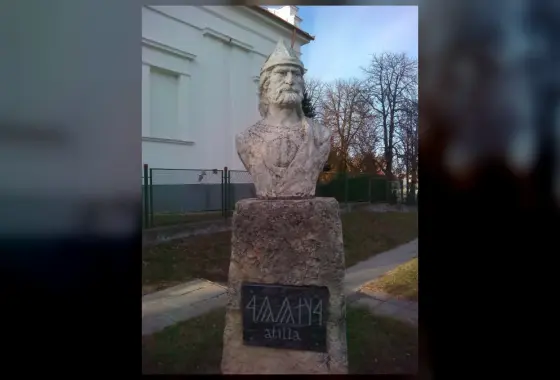
Attila was the nephew of the Hunnic ruler Rua. After Rua’s death in 434 he took over the Huns together with his brother Bleda. Bleda died around 445, leaving Attila sole ruler.
Relations with Rome
With the Treaty of Margus in 435 the Huns forced the Eastern Roman Empire to pay annual tribute and grant trading privileges. Treaties after the Balkan campaigns of 441–443 and 447 raised the tribute. The historian Priscus, a member of an Eastern Roman embassy, left valuable descriptions of Attila’s court and his simple lifestyle.
Campaigns in Gaul and Italy
In 451 Attila invaded Gaul (today’s France). The battle on the Catalaunian Plains against the Roman general Aetius and the Visigoths was indecisive, and Attila withdrew. In 452 he invaded Italy and took cities such as Aquileia. After meeting an embassy led by Pope Leo I he withdrew from Italy, with disease and supply problems also thought to have played a part.
Death and aftermath
Attila died in 453 on his wedding night from a severe nosebleed. Struggles among his sons and revolts of subject peoples soon broke up the empire.
The campaign of 447 and the walls of Constantinople
In January 447 a great earthquake badly damaged the land walls of Constantinople. When Attila entered the Balkans the same year, the Eastern Roman government feared that the city had been left defenceless. The praetorian prefect Constantinus, putting even the city's circus factions to work, had the walls repaired in less than two months; the Latin inscription recording this feat can still be seen today at the Mevlevihane Gate in Istanbul. The Huns did not attack the city, but they defeated a Roman army near the river Utus (today's Vit in Bulgaria). The treaty that followed required a strip of land five days' journey wide south of the Danube to be evacuated.
Joint rule with Bleda
After Rua's death, Hun leadership passed to two brothers. The sources show that Bleda and Attila divided territories and peoples between them, yet acted together in treaties with Rome. Little is known in detail about Bleda's death around 445; some Roman sources write that he was killed by Attila, but this is not certain. After Bleda's death his peoples also came under Attila. This unification allowed the great Balkan campaign of 447 and the later western campaigns to be carried out with a larger force.
Honoria's letter and the turn to the West
In 450 Justa Grata Honoria, sister of the Western Roman emperor Valentinian III, sent Attila a message together with her ring in order to escape a marriage forced upon her. Attila interpreted this as a marriage proposal; he demanded Honoria as his wife and half of the Western Roman lands as her dowry. In the same year Marcian, who had come to the throne in the East, stopped paying the annual tribute. These two developments are counted among the reasons that turned Attila's attention from the Balkans to Gaul and Italy. How serious a political move the Honoria affair really was remains debated among historians.
Aetius: old friend, new rival
Flavius Aetius, the Roman commander who faced Attila on the Catalaunian Plains, had lived among the Huns as a hostage for a time in his youth. In the 430s he relied on Hun auxiliary troops in the internal struggles of the Western Empire, and Hun troops played a part in the destruction of the Burgundian kingdom on the Rhine in 437. This close acquaintance meant that Aetius knew Hun ways of war well. Jordanes writes that after Attila's death in 453 his body was buried secretly at night and that his coffins were covered with gold, silver and iron; the location of the grave is still unknown today.
Frequently asked questions
Was Attila Turkic? Turkish historiography counts the European Huns among the Turkic states; the language and origins of the Huns are debated in international scholarship.
Sources and further reading
- Priscus, History fragments (account of Attila’s court).
- Türkiye Diyanet Vakfı İslâm Ansiklopedisi, “Attila”.
- Encyclopaedia Britannica, “Attila”.
- Jordanes, Getica (The Origin and Deeds of the Goths), chapters 42–49
- Christopher Kelly – Attila the Hun: Barbarian Terror and the Fall of the Roman Empire (Bodley Head, 2008)
- Peter Heather – The Fall of the Roman Empire (Macmillan, 2005)
People also ask
Who was Attila? Attila ruled the Hunnic Empire in Europe from 434 to 453, sharing power with his brother Bleda in the early years.
When did Attila reign? Reign: 434 – 453 (jointly with Bleda until 445).
When did Attila die? Died: 453.
What was Attila’s most famous battle? Famous battle: Catalaunian Plains, 451.



Leave a comment
Your email address will not be published. Required fields are marked *