



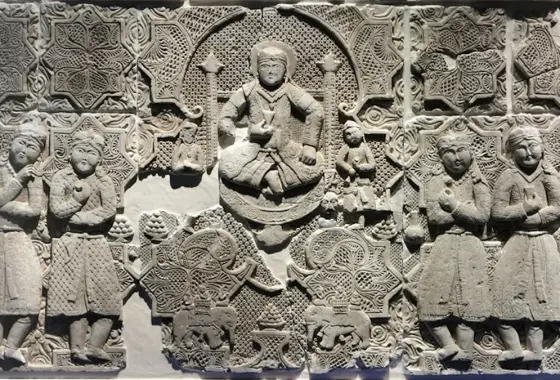
The Great Seljuk Empire was founded by the grandsons of Seljuk Beg of the Kınık tribe of the Oghuz Turks. Ruling a vast area from Central Asia to the Mediterranean in the 11th century, the Seljuks reunited a fragmented Islamic world, became protectors of Sunni Islam and the Abbasid caliphate, and opened the way for the Turks to make Anatolia their homeland.
Foundation: Dandanaqan (1040)
Tughril Beg and his brother Chaghri Beg fought the Ghaznavid state in Khorasan. With their defeat of the Ghaznavid army at the Battle of Dandanaqan near Merv in 1040, the Great Seljuk state was formally founded. At the assembly held after the victory, Tughril Beg was elected ruler, and letters announcing independence were sent to neighbouring states.
Baghdad and the caliphate (1055)
Responding to the Abbasid caliph’s call for help against the Shia Buyids who dominated Baghdad, Tughril Beg entered Baghdad in 1055. The caliph granted him the title "Sultan of the East and the West". From then on, the Seljuk sultans represented the political leadership of the Islamic world and the caliphs its religious leadership.
Alp Arslan and Manzikert (1071)
Alp Arslan (1063–1072), Tughril’s nephew and successor, met the large army of the Byzantine emperor Romanos IV Diogenes at Manzikert (Malazgirt), north of Lake Van, on 26 August 1071. The smaller Seljuk army skilfully used steppe tactics and won a decisive victory. The sources report that before the battle Alp Arslan put on white garments and told his soldiers that if he died, they would be his shroud.
The generous treatment Alp Arslan showed the captured emperor Romanos is also recorded in history: the sultan received him with honour and released him after a treaty. The victory at Manzikert opened Anatolia to the Turks and marked the beginning of a new homeland that would one day be called "Turkey".
Malik-Shah and Nizam al-Mulk: the golden age
Under Malik-Shah (1072–1092) the empire reached its greatest extent. The architect of this period was Nizam al-Mulk, vizier for nearly thirty years:
- The Nizamiyya madrasas: Founded in many cities, starting with the Nizamiyya of Baghdad opened in 1067, these institutions offered students scholarships and lodging and are regarded as one of the first systematic, state-supported networks of higher education. Great scholars such as al-Ghazali taught there.
- The Siyasatnama: Nizam al-Mulk’s book on statecraft became a reference read for centuries for its principles of justice and good government.
- The Jalali calendar: On Malik-Shah’s orders, a team that included the poet and mathematician Omar Khayyam produced one of the most accurate solar calendars of its time.
- Building: Roads, caravanserais, hospitals and mosques were built across the land; the Friday Mosque of Isfahan is among the most important works of the period.
Legacy
After the deaths of Malik-Shah and Nizam al-Mulk in 1092, the empire was weakened by succession struggles; the Great Seljuk era ended with the death of Sultan Sanjar in 1157. Yet the Seljuk legacy lived on for centuries through the Seljuks of Anatolia, the Khwarazmshahs and later the Ottomans. Their state organisation, madrasa system, charitable foundations and architectural style became cornerstones of Turkish-Islamic civilisation.
The army and the iqta system
The Great Seljuk army was made up of ghulam soldiers loyal to the sultan and trained in palace schools, mounted contingents of the Turkmen tribes and the forces of provincial emirs. Under the “iqta” system developed by Nizam al-Mulk, the tax revenue of a given piece of land was assigned to a commander or soldier as pay, in return for military service. The state could thus support a large army without distributing cash from the centre. The iqta system lived on for centuries, developing further among the Seljuks of Anatolia and in the Ottoman timar system.
The Batinis and the death of Nizam al-Mulk
One of the Seljuks’ toughest internal problems was the Nizari Isma‘ilis (Batinis), who under Hasan-i Sabbah established themselves in fortresses in Iran’s mountainous regions. Centred on the fortress of Alamut, the movement was known for assassinating its political rivals. The assassination of Nizam al-Mulk in 1092, followed shortly by the death of Sultan Malik-Shah, plunged the state into a long struggle over the throne. Al-Ghazali’s works criticising the Batinis were also part of the intellectual struggle of the period.
Sultan Sanjar: the last great sultan
Malik-Shah’s son Sultan Sanjar ruled for many years, first as king of Khorasan and from 1118 as great sultan. In his time Merv was one of the largest cities in the Islamic world. But in 1141 he suffered a heavy defeat by the Qara Khitai at the Battle of Qatwan near Samarkand, which led to the loss of Transoxiana. In 1153 Sanjar was captured by Oghuz tribes who had rebelled over taxes; he died in 1157, shortly after his release. His majestic mausoleum in Merv is the most striking monument of the State Historical and Cultural Park “Ancient Merv”, a UNESCO World Heritage Site.
Frequently asked questions
Why is Manzikert commemorated on 26 August?
The battle was fought on Friday, 26 August 1071. In Turkey, commemorations are held at Malazgirt on this date every year.
Are the Great Seljuks and the Seljuks of Anatolia the same state?
No. The Seljuk Sultanate of Anatolia was a separate state with its capital at Konya, founded by Suleiman ibn Qutalmish, a member of a branch of the Seljuk dynasty.
Sources and further reading
- Türkiye Diyanet Vakfı İslâm Ansiklopedisi, “Selçuklular”, “Malazgirt Savaşı”, “Nizâmülmülk”, “Nizâmiye Medreseleri”.
- Ibn al-Athir, al-Kamil fi’l-ta’rikh.
- Nizam al-Mulk, The Book of Government or Rules for Kings (Siyasatnama).
- A. C. S. Peacock, The Great Seljuk Empire.
People also ask
What was the Great Seljuk Empire? The Great Seljuk Empire was founded in the 11th century by the Seljuk family of the Qiniq tribe of the Oghuz.
When was the Great Seljuk Empire founded? Founded: 1040, Battle of Dandanaqan (entry into Nishapur 1038).
What was the Great Seljuk Empire’s capital? Capitals: Nishapur, Rayy, Isfahan, Merv.
When was the Great Seljuk Empire at its height? Height: Reign of Malik-Shah (1072 – 1092).






Leave a comment
Your email address will not be published. Required fields are marked *