



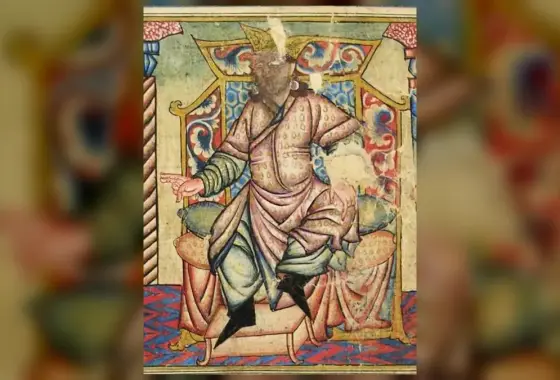
Sanjar was the son of Sultan Malik-Shah, and is said to have been named after the city of Sinjar, where he was born. During the succession struggles among his brothers after their father’s death, he was put in charge of Khurasan in 1097 and governed the eastern provinces successfully for twenty years.
His sultanate
When his brother Muhammad Tapar died in 1118, he took the title of sultan as head of the Seljuk family. He entered Ghazni and made the Ghaznavids vassals, and gained the upper hand over the Karakhanids. Merv became one of the empire’s most splendid cities in his reign.
Qatwan and the Oghuz revolt
In 1141 at Qatwan near Samarkand he suffered a heavy defeat by the Qara Khitai ruler, the Gurkhan, and Transoxiana was lost to the Seljuks. In 1153 he was defeated by Oghuz tribes who had revolted over taxation, and remained their captive for about three years.
Death
Sanjar escaped captivity in 1156 but died a year later, in 1157, in Merv. His mausoleum stands today within the “Ancient Merv” site on the UNESCO World Heritage List. Remembered in folk tradition for his justice, his death ended the main line of the Great Seljuk Empire.
Twenty years as king of Khurasan (1097–1118)
Sanjar was still a child of about eleven when his elder brother Berkyaruq sent him to Khurasan; in the first years the province was run by his atabegs and commanders. As a young man he secured the eastern frontier: in 1102 he defeated the Karakhanid ruler Qadir Khan Jibra'il near Termez and placed Arslan Khan Muhammad, under his own supervision, on the throne of Samarkand. In 1117 he marched on Ghazna and raised Bahram Shah of the Ghaznavid house to the throne; from then on the Friday sermon in Ghazna was read in Sanjar's name.
"Sultan of sultans" and the Iraqi Seljuks
When Muhammad Tapar died in 1118, his son Mahmud was proclaimed sultan in the west. In 1119 Sanjar defeated his nephew near Saveh, but instead of deposing him he left him to govern Iraq and western Iran as his own deputy. Sanjar thus remained the "great sultan" in Merv, while the western branch later came to be called the Seljuks of Iraq. The arrangement preserved the outward unity of the Seljuk world for some forty years, but in reality it split power between two centres.
Khwarazmshah Atsiz and the price of captivity
One of Sanjar's longest-running problems was his own governor, the Khwarazmshah Atsiz. Atsiz broke away several times; Sanjar campaigned against Khwarazm in 1138 and in later years, and each time Atsiz declared his loyalty and then grew strong again. After the defeat at Qatwan the balance shifted in favour of the Khwarazmshahs. When Sanjar was captured in the Oghuz revolt of 1153, Merv and Nishapur were plundered, and the famous madrasas and libraries of Nishapur suffered heavy damage. The power that filled the vacuum in Khurasan after Sanjar's death was, once again, the Khwarazmshahs.
His mausoleum in Merv, with its double-shelled dome, is among the best-known buildings of Seljuk architecture in Central Asia. Ancient Merv was inscribed on the UNESCO World Heritage List in 1999.
Sanjar in popular memory
Sanjar is often cited in Persian literature as an example of the just ruler. Anvari, the great panegyric poet of the age, grew up at his court and wrote poems in praise of the sultan; in Nizami's Makhzan al-Asrar the story is told of an old woman who demands justice from Sanjar. These accounts carry a moral lesson more than a historical event: the ruler is bound to hear the complaint of even the weakest of his subjects. Sanjar's long reign and the unhappy end of his captivity made it easier for such stories to gather around his name.
The length of Sanjar's rule
Counting his years as king of Khurasan and as sultan together, Sanjar ruled for about sixty years. This is one of the longest periods of rule in the Seljuk dynasty. Such a long hold on power made him both the symbol of stability in the eastern Seljuk world and the witness of its collapse.
Sources and further reading
- Türkiye Diyanet Vakfı İslâm Ansiklopedisi, “Sencer”.
- UNESCO World Heritage, “State Historical and Cultural Park ‘Ancient Merv’”.
- Encyclopaedia Britannica, “Sanjar”.
- C. E. Bosworth – "The Political and Dynastic History of the Iranian World (A.D. 1000–1217)", The Cambridge History of Iran, vol. 5 (Cambridge University Press, 1968)
- UNESCO World Heritage – "State Historical and Cultural Park 'Ancient Merv'" (1999)
People also ask
Who was Sultan Sanjar? Sultan Sanjar, son of Malik-Shah, governed Khurasan for many years before becoming Great Seljuk sultan in 1118.
When and where was Sultan Sanjar born? Born: 1086, Sinjar.
When did Sultan Sanjar die? Died: May 1157, Merv.
Who was Sultan Sanjar’s father? Father: Malik-Shah.




Leave a comment
Your email address will not be published. Required fields are marked *