



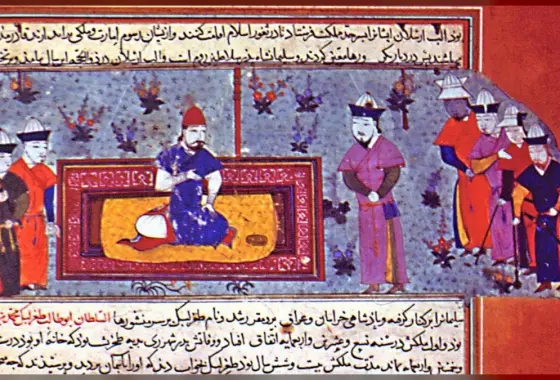
Alp Arslan was the son of Chaghri Beg, one of the founders of the Seljuk state, and grew up in Khurasan at his father’s side. After the death of his uncle Tughril Beg in 1063 he won the succession struggle and became sultan.
His reign
With his famous vizier Nizam al-Mulk, Alp Arslan put the state on a firm footing. In 1064 he campaigned in Georgia and Armenia and took Ani. While planning to move against the Fatimids, he learned that Byzantium had sent a large army east.
The Battle of Manzikert
On 26 August 1071 at Manzikert, north of Lake Van, the Seljuk army defeated the larger army of Emperor Romanos IV Diogenes. The withdrawal of some Byzantine units during the battle and Seljuk crescent tactics decided the outcome. The emperor was captured; Alp Arslan treated him well and released him under a treaty. Afterwards Turkmen tribes began to settle widely in Anatolia.
Death
In 1072, during a campaign in Transoxiana, Alp Arslan was wounded by a captured fortress commander, Yusuf al-Khwarazmi, and died soon after. He was buried in Merv and succeeded by his son Malik-Shah.
Nizam al-Mulk and the Nizamiyya madrasas
The most lasting achievement of Alp Arslan's reign of nearly ten years is the order built by his vizier Nizam al-Mulk. The vizier opened madrasas in major cities to train state officials and strengthen Sunni thought; the most famous of them is the Nizamiyya of Baghdad, which began teaching in 1067. Nizamiyyas were also founded in cities such as Nishapur, Isfahan, Balkh and Herat. Leading scholars of the age, such as al-Ghazali, taught in these madrasas. The iqta system, in which soldiers were assigned the revenue of particular districts instead of a salary, also spread in this period.
The road to Manzikert: the siege of Aleppo
In the spring of 1071 Alp Arslan had set out towards his main target, Fatimid Egypt, and besieged Aleppo on the way. The emir of Aleppo, Mahmud, eventually declared his allegiance. Just then news came that the Byzantine Emperor Romanos IV Diogenes was marching east with a large army. The sultan abandoned the Syrian campaign and turned quickly north; because he had to disperse part of his army along the way, he reached Manzikert with fewer soldiers than the Byzantine army. Sources also relate that he offered peace before the battle and that the emperor refused.
The treaty with Romanos and the memory of Manzikert
According to the sources, Alp Arslan treated the captive emperor honourably and released him under a treaty. The treaty included a ransom, an annual tribute and the release of prisoners; the figures vary from source to source. When Romanos returned to the capital he lost his throne, was blinded in 1072 and died soon afterwards, so the treaty was never carried out. This internal turmoil in Byzantium made it easier for the Turkmen tribes to settle in Anatolia. In Türkiye, commemorations are held every year on 26 August in the Malazgirt district of Muş.
The name "Alp Arslan" and his titles
The epithet of the sultan, whose real name was Muhammad, combines the Turkish words "alp", meaning "valiant hero", and "arslan", meaning "lion", and reflects his reputation as a brave warrior. The Abbasid caliph granted him honorific titles such as "Adud al-Dawla" in official correspondence. Medieval sources describe him as a strong archer and a good horseman. His place in Turkish historiography as the ruler who opened the gateway to Anatolia with the victory at Manzikert keeps his name alive today in the names of schools and streets.
A short but decisive reign
Alp Arslan reigned for only about nine years. Even so, the order he built with Nizam al-Mulk laid the groundwork for the Great Seljuk state to reach its widest borders in the reign of his son Malik Shah.
Frequently asked questions
Why does Manzikert matter? It began the collapse of Byzantium’s eastern defences and the process by which Anatolia became a Turkish homeland.
Sources and further reading
- Türkiye Diyanet Vakfı İslâm Ansiklopedisi, “Alparslan” and “Malazgirt Savaşı”.
- Osman Turan, Selçuklular Tarihi ve Türk-İslâm Medeniyeti.
- Encyclopaedia Britannica, “Alp-Arslan” and “Battle of Manzikert”.
- Carole Hillenbrand – Turkish Myth and Muslim Symbol: The Battle of Manzikert (Edinburgh University Press, 2007)
- A. C. S. Peacock – The Great Seljuk Empire (Edinburgh University Press, 2015)
People also ask
Who was Alp Arslan? Alp Arslan ruled the Great Seljuk Empire from 1063 to 1072.
When and where was Alp Arslan born? Born: c. 1029.
When did Alp Arslan reign? Reign: 1063 – 1072.
Who was Alp Arslan’s father? Father: Chaghri Beg.



Leave a comment
Your email address will not be published. Required fields are marked *