



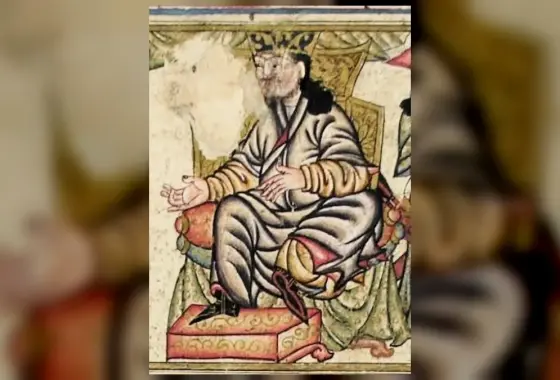
Tughril Beg was the son of Mikail and grandson of Seljuk Beg of the Qiniq tribe of the Oghuz. With his brother Chaghri Beg he led the Turkmens into Khurasan. Growing stronger in the region, the Seljuks entered Nishapur in 1038, where the Friday sermon was read in Tughril’s name.
Dandanaqan and the founding of the state
In 1040 at Dandanaqan near Merv they defeated the army of the Ghaznavid sultan Mas‘ud. At an assembly after the victory Tughril was proclaimed ruler and the Seljuk state was formally founded. Chaghri governed Khurasan in the east, Tughril Iran in the west.
Moving west and Baghdad
In 1048 he defeated Byzantine and Georgian forces at the Battle of Kapetron (Pasinler). In 1055, at the invitation of the Abbasid caliph al-Qa’im, he entered Baghdad and ended Buyid domination. The caliph gave him titles meaning “King of the East and the West”, and the Seljuks took on the political leadership of the Islamic world.
Death
Tughril Beg died in Rayy in 1063. Having no children, he was succeeded after a brief struggle by his nephew Alp Arslan.
Entering Khurasan and the first victory at Nasa
In the mid-1030s the Seljuks crossed the Oxus from Transoxiana into Ghaznavid territory and asked the Ghaznavid Sultan Mas'ud for pastures and a homeland. When the army sent by Mas'ud was defeated near Nasa in 1035, the sultan had to cede Nasa, Farawa and Dihistan to the Seljuks. This was the first time the brothers Tughril and Chaghri sat at the table with a state. The next five years saw the Turkmen tribes spread into the cities of Khurasan and the Ghaznavid army wear itself out; Dandanaqan was the culmination of this process.
State order: the vizier Amid al-Mulk al-Kunduri
Tughril Beg's best-known vizier was Amid al-Mulk al-Kunduri of Nishapur. Kunduri used the Iranian chancery tradition to turn a nomadic military force into a settled state: correspondence, tax registers and diplomatic business were put in order in his time. It is a widespread tradition that the name of the "tughra", the imperial monogram at the head of decrees, comes from Tughril, although the origin of the word is disputed. Kunduri fell from favour and was executed in 1064, at the start of Alp Arslan's reign, and was replaced by Nizam al-Mulk.
The Basasiri affair and the marriage alliance with the caliph
In 1058, while Tughril was dealing with the revolt of his brother Ibrahim Yinal, the Turkish commander al-Basasiri seized Baghdad and had the sermon read in the name of the Fatimid caliph in Egypt. The Abbasid caliph al-Qa'im was removed from the city. After crushing the revolt, Tughril returned to Baghdad and restored the caliph to his throne; al-Basasiri was killed in 1060. The episode strengthened the Seljuks' role as protectors of the Sunni caliphate. Shortly before his death the elderly sultan married the caliph's daughter; contemporary sources describe this marriage, which made a Turkish ruler a son-in-law of the Abbasid family, as an extraordinary event.
The division of labour with Chaghri Beg
In the first years of the Seljuk state, power was shared between the two brothers. After Dandanaqan, Chaghri Beg ruled Khurasan and the eastern frontier from his base in Merv, while Tughril Beg, making Nishapur and then Rayy his centre, governed the lands expanding to the west. This division of labour is an example of the idea, found in the Turkish state tradition, of sharing the realm among members of the dynasty. Chaghri Beg's sons, above all Alp Arslan, grew up within this order; since Tughril had no children, the future of the state also passed to Chaghri Beg's line.
The tomb in Rayy
The building in Rayy, south of present-day Tehran, known as the place where Tughril Beg was buried is called the "Tughril Tower". This tall brick tower was restored in the 19th century; how much of its original Seljuk-period fabric survives is debated among researchers.
Frequently asked questions
Where does the name Seljuk come from? From the dynasty’s ancestor, Seljuk Beg.
Sources and further reading
- Türkiye Diyanet Vakfı İslâm Ansiklopedisi, “Tuğrul Bey” and “Dandanakan Savaşı”.
- Osman Turan, Selçuklular Tarihi ve Türk-İslâm Medeniyeti.
- Encyclopaedia Britannica, “Toghril Beg”.
- A. C. S. Peacock – The Great Seljuk Empire (Edinburgh University Press, 2015)
- C. E. Bosworth – "The Political and Dynastic History of the Iranian World (A.D. 1000–1217)", The Cambridge History of Iran, vol. 5 (Cambridge University Press, 1968)
People also ask
Who was Tughril Beg? Tughril Beg founded the Great Seljuk Empire together with his brother Chaghri Beg.
When and where was Tughril Beg born? Born: c. 990.
When did Tughril Beg reign? Reign: 1040 – 1063.
When did Tughril Beg die? Died: September 1063, Rayy.



Leave a comment
Your email address will not be published. Required fields are marked *