



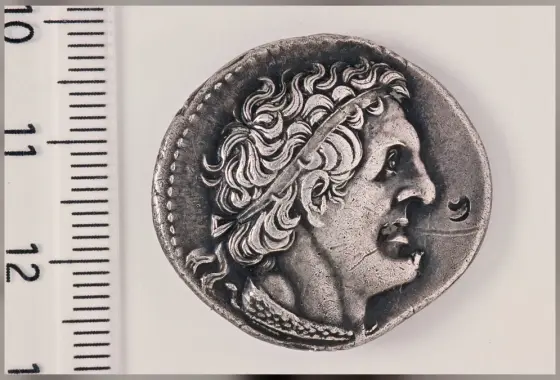
Ptolemy was the son of the Macedonian noble Lagus and from youth belonged to the close circle of Alexander the Great. Throughout the Persian campaign he served among Alexander’s bodyguards and commanders.
Ruling Egypt
In the division after Alexander’s death in 323 BC he received the satrapy of Egypt. He seized Alexander’s body as it was being taken to Macedon and brought it first to Memphis and then to Alexandria, which gave him great prestige. He successfully defended Egypt in the wars with the other generals (the Diadochi).
King Ptolemy
In 305 BC he took the title of king. The Rhodians gave him the epithet “Soter” (Saviour) for helping relieve their city from siege. He built a government that combined Greek administrators with Egypt’s traditional institutions, and promoted the cult of Serapis as a god shared by Egyptians and Greeks.
Alexandria and culture
He moved the capital to Alexandria. The founding of the Mouseion and the great library dates to his reign and his son’s, and work on the Pharos lighthouse began under him. Ptolemy also wrote a history of Alexander’s campaigns; though lost, it was one of Arrian’s main sources.
Death
In 285 BC he made his son Ptolemy II co-ruler, and he died in 282 BC. The dynasty he founded ruled Egypt until the death of Cleopatra VII in 30 BC.
Cyrene and Cyprus
After securing Egypt, Ptolemy also tried to bring important neighbouring regions under his control. In 322 BC he brought Cyrene in the west (today's eastern Libya) under his rule. Cyprus, on the other hand, was of great importance because of its fleet and timber resources. Ptolemy seized the island, but lost it in 306 BC after being defeated by Demetrius Poliorcetes in a naval battle off Salamis. Cyprus came under Ptolemaic rule again around 295–294 BC.
The siege of Rhodes and the Colossus
Demetrius Poliorcetes laid a long siege to Rhodes in 305–304 BC. The supplies and military support sent by Ptolemy helped the Rhodians to hold out, and the siege failed. According to the sources, the Rhodians used the income from selling the equipment left behind after the siege to build a giant statue of the sun god Helios. The Colossus of Rhodes, counted among the seven wonders of the ancient world, fell in an earthquake around 226 BC.
After Ipsus and the Syrian question
At the Battle of Ipsus in 301 BC the coalition of the diadochi defeated Antigonus. Ptolemy did not take part in this battle, but meanwhile seized Coele-Syria (the region covering today's Lebanon, Israel and the Palestinian territories). After the victory the region had been assigned to Seleucus; Ptolemy, however, did not give it up. This dispute laid the foundation for the long-running conflicts between the Ptolemies and the Seleucids in the following century, known as the "Syrian Wars".
His wives and the succession
Ptolemy married more than once. Instead of his elder son Ptolemy Keraunos, born of Antipater's daughter Eurydice, he chose as his successor Ptolemy II, his son by Berenice. Excluded from the throne, Keraunos left Egypt and for a time in 281 BC became king of Macedon. Ptolemy II, after a period of joint rule with his father, enjoyed a long and brilliant reign; the growth of the Library of Alexandria largely falls within his time.
Euclid and the scientific circle of Alexandria
The mathematician Euclid is generally thought to have worked in Alexandria during the reign of Ptolemy I. According to an anecdote related by the later writer Proclus, when Ptolemy asked whether there was a shorter way to learn geometry, Euclid replied that "there is no royal road to geometry". The Athenian statesman Demetrius of Phalerum is also reported to have advised Ptolemy on the founding of the institutions of learning in Alexandria.
Sources and further reading
- Arrian, Anabasis of Alexander (preface).
- Encyclopaedia Britannica, “Ptolemy I Soter”.
- Diodorus Siculus, Library of History, books XVIII–XX.
- Günther Hölbl, A History of the Ptolemaic Empire, Routledge, 2001
- Proclus, A Commentary on the First Book of Euclid's Elements (translated by Glenn R. Morrow, Princeton University Press)
People also ask
Who was Ptolemy I Soter? Ptolemy I was a close companion and general of Alexander the Great.
When and where was Ptolemy I Soter born? Born: c. 367 BC, Macedon.
When did Ptolemy I Soter die? Died: 282 BC.






Leave a comment
Your email address will not be published. Required fields are marked *