



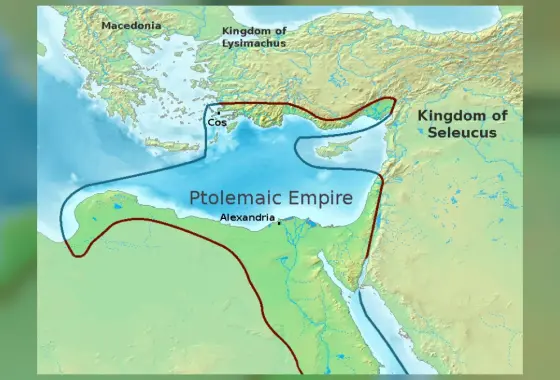
After Alexander the Great’s death in 323 BC, the Macedonian general Ptolemy became governor of Egypt. In 305 BC he took the title of king, founding a dynasty that lasted about three hundred years. All its male rulers bore the name “Ptolemy”.
Alexandria
Founded by Alexander, Alexandria became one of the largest cities in the Mediterranean under the Ptolemies. The Mouseion and the great library created a scholarly community linked to Eratosthenes, Euclid and Archimedes. The Pharos lighthouse, one of the Seven Wonders of the Ancient World, was built in this period, and the Septuagint, the Greek translation of the Hebrew Bible, was produced in Alexandria.
Government and society
The Ptolemies were a Greek-speaking Macedonian dynasty, but to appear legitimate to Egyptians they used pharaonic titles and supported Egyptian temples. In 196 BC a priestly decree written in Egyptian and Greek was carved on the Rosetta Stone, which later made the decipherment of hieroglyphs possible. Sibling marriage was common within the dynasty.
Decline and end
The Syrian Wars with the Seleucids and dynastic struggles weakened the kingdom, and from the 2nd century BC Roman influence grew. The last ruler, Cleopatra VII, allied with Julius Caesar and Mark Antony, but was defeated by Octavian at Actium in 31 BC. With Cleopatra’s death in 30 BC, Egypt became a Roman province.
Leading rulers of the dynasty
The founder of the dynasty, Ptolemy I Soter, strengthened his own legitimacy by bringing Alexander's body to Egypt; the history of Alexander he wrote later became one of Arrian's main sources. His son Ptolemy II Philadelphus married his sister Arsinoe II and continued the investments that turned Alexandria into a cultural capital. Under Ptolemy III Euergetes, the Canopus Decree of 238 BC proposed adding an extra day to the calendar every four years. Ptolemy IV defeated the Seleucid king Antiochus III at the Battle of Raphia near Rafah in 217 BC; phalanx units made up of Egyptian soldiers also fought in this battle.
Economy and administration
The Ptolemies governed Egypt's fertile land through a strict fiscal system. The country was divided into administrative districts called "nomes", and land and harvests were regularly recorded. The "Revenue Laws" papyrus of 259 BC shows how activities such as vegetable oil production were run under a state monopoly. New farmland was opened up in the Fayum depression, and soldiers of Greek origin were settled there; the thousands of papyri found in this region offer unique information about daily life in the ancient world.
Religion and temples
Ptolemy I promoted the cult of Serapis, which combined Greek and Egyptian beliefs; the Serapeum in Alexandria became the centre of this cult. The dynasty also invested heavily in Egypt's local temples. Construction of the temple of Horus at Edfu began in 237 BC under Ptolemy III and was completed in 57 BC; today it is one of the best-preserved temples in Egypt. The temples at Dendera, Kom Ombo and Philae are also works of this period that continued traditional Egyptian architecture.
The fate of the Library of Alexandria
At the Library of Alexandria the poet and scholar Callimachus compiled a vast catalogue called the "Pinakes", classifying authors and works. Eratosthenes, one of the library's heads, calculated the Earth's circumference with surprising accuracy from the difference in shadows between two cities. How the library disappeared, however, is not certain. It is known that the fire during the Alexandrian War of 48 BC damaged some books; but according to most historians the library vanished not in a single catastrophe but gradually over centuries, through declining interest and support, the fighting in the palace quarter of the city in the 3rd century and events such as the destruction of the Serapeum in 391. The modern Bibliotheca Alexandrina opened in the same city in 2002.
Sources and further reading
- Encyclopaedia Britannica, “Ptolemaic dynasty”.
- British Museum, “Rosetta Stone” collection record.
- Strabo, Geography, book XVII.
- Günther Hölbl – A History of the Ptolemaic Empire (Routledge, 2001)
- J. G. Manning – The Last Pharaohs: Egypt Under the Ptolemies, 305–30 BC (Princeton University Press, 2010)
People also ask
What was the Ptolemaic Kingdom? The Ptolemaic Kingdom was founded in Egypt when Ptolemy I, one of Alexander the Great’s generals, was proclaimed king in 305 BC.
When was the Ptolemaic Kingdom founded? Founded: 305 BC, Ptolemy I Soter.
What was the Ptolemaic Kingdom’s capital? Capital: Alexandria.
When did the Ptolemaic Kingdom end? End: 30 BC, annexed by Rome.


Leave a comment
Your email address will not be published. Required fields are marked *