



Cleopatra belonged to the Macedonian-origin Ptolemaic dynasty, founded by Ptolemy I, one of Alexander the Great’s generals. After the death of her father Ptolemy XII in 51 BC she came to the throne together with her younger brother Ptolemy XIII. According to Plutarch she spoke many languages and was the first of her dynasty to learn Egyptian.
Alliance with Caesar
She was pushed from power in a struggle with her brother. With the support of Julius Caesar, who arrived in Alexandria in 48 BC, she regained the throne. She had a son by Caesar, Caesarion. After Caesar’s assassination in Rome in 44 BC she returned to Egypt.
Mark Antony
In 41 BC at Tarsus she met Mark Antony, who governed Rome’s eastern provinces, and the two formed a political and personal partnership. Antony’s grants of eastern territories to Cleopatra and her children caused outrage in Rome and led to war with Octavian.
Actium and death
In 31 BC the fleet of Antony and Cleopatra was defeated by Octavian at the naval Battle of Actium. When Octavian entered Alexandria in 30 BC, first Antony and then Cleopatra took their own lives. Ancient sources attribute her death to the bite of an asp, but the details are uncertain. Egypt then became a Roman province.
The struggle for the throne with her siblings
Cleopatra's siblings were also parties to the struggle for power. Her elder sister Berenice IV had seized the throne while their father was in exile and was executed when Ptolemy XII returned with Roman support in 55 BC. Her younger brother Ptolemy XIII drowned in the Nile in 47 BC during the Alexandrian War fought against Caesar. Her sister Arsinoe IV was paraded as a captive in Caesar's triumph in Rome and was killed at Ephesus in 41 BC on Antony's orders. Cleopatra then ruled jointly with her youngest brother, Ptolemy XIV, who also died in 44 BC.
Her years in Rome and her rule
Between 46 and 44 BC Cleopatra stayed in Rome, at Caesar's estate with gardens on the far side of the Tiber. According to the ancient writer Appian, Caesar placed a golden statue of her in the temple of Venus Genetrix. The letters of the Roman statesman Cicero show the reaction her visit caused in Rome. In Egypt, Cleopatra was known as a capable administrator: some researchers suggest that the Greek note "let it be done" at the foot of a papyrus document in Berlin (33 BC) may be in her own hand.
The fate of her children
After Octavian took Alexandria, Caesarion, her son by Caesar, was killed in 30 BC. Her three children by Antony, the twins Alexander Helios and Cleopatra Selene and the younger Ptolemy Philadelphus, were taken to Rome and raised in the household of Octavia, Antony's former wife. Cleopatra Selene later married the Numidian prince Juba II and became queen of the kingdom of Mauretania in North Africa.
Her appearance and portraits
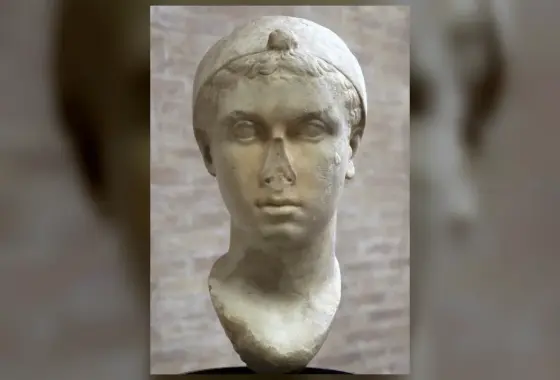
The most reliable information about Cleopatra's appearance comes from coins minted in her time. These coins show an unflattering portrait with a prominent nose and tightly gathered hair. Plutarch writes that her beauty was not in itself incomparable, and that her real effect came from her conversation, her intelligence and the charm of her voice. Marble portrait heads in the Altes Museum in Berlin and in the Vatican Museums are thought to depict Cleopatra. The image of Cleopatra as a legendary beauty spread mainly through post-Renaissance painting, theatre and 20th-century cinema; what the ancient sources actually stress is her political skill and her command of many languages.
The end of the Ptolemaic dynasty
With Cleopatra's death, the Ptolemaic dynasty, which had lasted about three hundred years, came to an end. Unlike other provinces, Octavian governed Egypt through a prefect answerable directly to himself; from then on the country's grain played an important role in feeding Rome.
Frequently asked questions
Was Cleopatra Egyptian? Her dynasty was of Macedonian origin; the identity of her mother is not known for certain.
Sources and further reading
- Plutarch, Parallel Lives: Antony.
- Cassius Dio, Roman History, books 42–51.
- Encyclopaedia Britannica, “Cleopatra”.
- Duane W. Roller – Cleopatra: A Biography (Oxford University Press, 2010)
- Appian – The Civil Wars, book II
People also ask
Who was Cleopatra VII? Cleopatra VII was the last active ruler of the Ptolemaic dynasty, governing Egypt from 51 to 30 BC.
When and where was Cleopatra VII born? Born: 69 BC, Alexandria.
When did Cleopatra VII reign? Reign: 51 – 30 BC.
When did Cleopatra VII die? Died: August 30 BC, Alexandria.




Leave a comment
Your email address will not be published. Required fields are marked *