



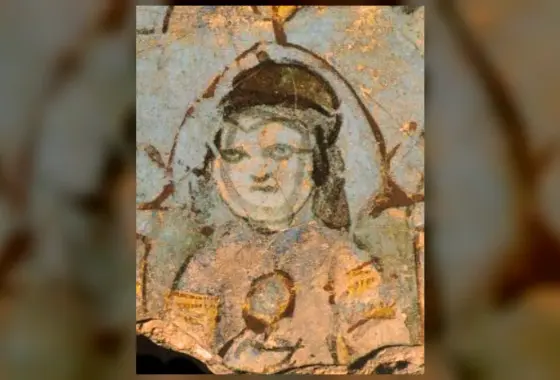
Kilij Arslan was the son of Sultan Mesud I and came to the throne on his father’s death in 1155. In his early years he struggled with his brothers and with rival Turkish principalities in Anatolia.
Unity in Anatolia
Keeping peace with Byzantium for a time, he turned against the Danishmendids in the east, and in the 1170s took their lands around Sivas, Kayseri and Malatya, largely achieving political unity in central Anatolia.
The Battle of Myriokephalon
Alarmed at Seljuk strength, the Byzantine emperor Manuel I Komnenos marched on Konya with a large army. On 17 September 1176, in a mountain pass between Denizli and Isparta at Myriokephalon, the Seljuk army ambushed and heavily defeated the Byzantines. The emperor compared the defeat to Manzikert. The victory is seen as showing that Anatolia had permanently become a Turkish homeland.
Last years
In old age Kilij Arslan divided the country among his eleven sons, leading to internal strife. In 1190 the German emperor Frederick Barbarossa, on the Third Crusade, briefly occupied Konya; a few weeks later Barbarossa drowned in the Göksu (Saleph) river near Silifke. Kilij Arslan died in Konya in 1192.
The visit to Constantinople (1162)
Kilij Arslan, who was occupied with the Danishmendids at the start of his reign, took a surprising step to secure his western border: in 1162 he travelled in person to Constantinople and became the guest of Emperor Manuel I Komnenos. Byzantine sources relate that the sultan stayed in the city for about three months and was entertained with ceremonies and gifts. Under the treaty concluded at the end of the visit, Kilij Arslan agreed to become the emperor's ally. This peace gave him the time and freedom to take the Danishmendid lands in the east.
After Myriokephalon
According to the Byzantine historian Niketas Choniates, Manuel, defeated at Myriokephalon, signed a treaty to save the rest of his army and agreed to demolish the fortresses of Dorylaeum (Eskişehir) and Sublaeum. When the emperor did not demolish Dorylaeum, Seljuk raids resumed. The battle effectively ended Byzantium's hope of recovering the Anatolian interior; from then on Byzantium focused more on defending the coastal regions and the western valleys. On the Seljuk side, the rise of Konya as a regional capital accelerated.
His traces in Konya
Under Kilij Arslan, Konya became a city of palace and mosque around the Alaeddin Hill. One of the sections of the Alaeddin Mosque on the hill is dated to his reign, and several Seljuk sultans, including himself, lie in the tomb in the mosque's courtyard. Of the palace at the foot of the hill only a fragment of wall survives today, protected under the name "Alaeddin Pavilion". The struggle for the throne that broke out among his sons after his death ended only with the second reign of Kaykhusraw I (1205).
The battle order at Myriokephalon
The Byzantine army had to pass through a narrow mountain defile together with a long baggage train. The Seljuk units had taken up positions on the slopes on both sides of the pass. Once the vanguard had passed through, the Turkish archers and horsemen attacked the baggage train and the rear columns; as wagons and pack animals became entangled on the narrow road, the Byzantine army could not regroup. Niketas Choniates writes that the emperor could not forget this disaster for a long time. The battle is studied as one of the classic examples of a heavily armoured and numerous army losing its mobility in mountainous terrain. The Seljuks, for their part, stepped up their raids towards the valleys of western Anatolia after this victory.
The significance of a long reign
With a reign of about thirty-seven years, Kilij Arslan II was among the longest-reigning sultans in Anatolian Seljuk history. This span of time made it possible to unite the Danishmendid lands and to establish a state order centred on Konya.
Sources and further reading
- Türkiye Diyanet Vakfı İslâm Ansiklopedisi, “Kılıcarslan II” and “Myriokephalon Savaşı”.
- Osman Turan, Selçuklular Zamanında Türkiye.
- Encyclopaedia Britannica, “Battle of Myriocephalon”.
- Niketas Choniates – O City of Byzantium: Annals of Niketas Choniates (trans. Harry J. Magoulias, Wayne State University Press, 1984)
- Claude Cahen – Pre-Ottoman Turkey (Sidgwick & Jackson, 1968)
People also ask
Who was Kilij Arslan II? Kilij Arslan II ruled the Seljuk Sultanate of Rum from 1155 to 1192.
When did Kilij Arslan II reign? Reign: 1155 – 1192.
When did Kilij Arslan II die? Died: 1192, Konya.
Who was Kilij Arslan II’s father? Father: Mesud I.
Leave a comment
Your email address will not be published. Required fields are marked *