



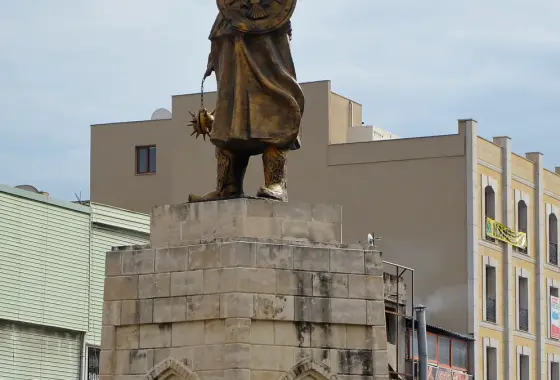
Suleyman’s father Qutalmish belonged to a branch of the Seljuk dynasty and died fighting Alp Arslan for the throne. Suleyman and his brothers lived for a time among the Turkmen chiefs on the Anatolian frontier.
Nicaea and the founding of the state
Taking advantage of civil wars in Byzantium after Manzikert, Suleyman advanced into western Anatolia and between 1075 and 1081 made Nicaea his base. This is taken as the founding of the Sultanate of Rum. His 1081 agreement with the Byzantine emperor Alexios I Komnenos effectively recognised the Turkish presence as far as the Marmara.
Antioch
Suleyman then turned south-east, took Cilicia and in December 1084 captured Antioch, an important Byzantine centre. This advance brought him into conflict with the Great Seljuk prince Tutush, who sought to rule Syria.
Death
He died in 1086 in a battle with Tutush’s army near Aleppo. His son Kilij Arslan returned to Anatolia in 1092 and took over his father’s state.
Byzantine succession struggles and the Turkmens
After the Battle of Manzikert in 1071, Turkmen groups spread rapidly into the interior of Anatolia. This expansion became intertwined with the severe succession struggles Byzantium went through in the same years. Byzantine commanders with an eye on the throne sought the support of Turkish troops against their rivals.
- Nikephoros Botaneiates: He is reported to have made use of Suleiman Shah's troops when he took the throne in 1078.
- Nikephoros Melissenos: He turned to Turkish support in his revolt of 1080–1081; in the process, the gates of western Anatolian cities such as Nicaea were opened to the Turks.
- Alexios Komnenos: Alexios, who took the throne in 1081, chose to reach an agreement with Suleiman Shah to secure his eastern frontier while fighting the Normans.
This turbulent environment made it easier for Suleiman Shah to reach the shores of the Sea of Marmara and make Nicaea his centre.
The state's name, title and aftermath
Because it was founded on Byzantine lands, the land of "Rum", the state Suleiman Shah founded is also called the "Seljuks of Rum" in the sources; in Turkish historical writing the names "Seljuks of Türkiye" or "Anatolian Seljuks" are common. How far Suleiman officially used the title "sultan" is debated, and his relations with the Great Seljuk sultan Malik-Shah were at times tense.
After Suleiman Shah's death the state was leaderless for a time. His son Kilij Arslan I returned to Nicaea in 1092 and gathered his father's legacy once more. But in 1097 the army of the First Crusade took Nicaea, and the centre of the Anatolian Seljuks shifted inland to Konya. Konya remained the state's capital for about two centuries.
One point often confused because of the shared name should also be noted: the Tomb of Suleyman Shah, which stood near Qal'at Ja'bar in Syria and was moved in 2015 to the village of Eşme near the Turkish border, is attributed not to Suleiman ibn Qutalmish but to another Suleiman Shah, traditionally regarded as the grandfather of Osman Gazi.
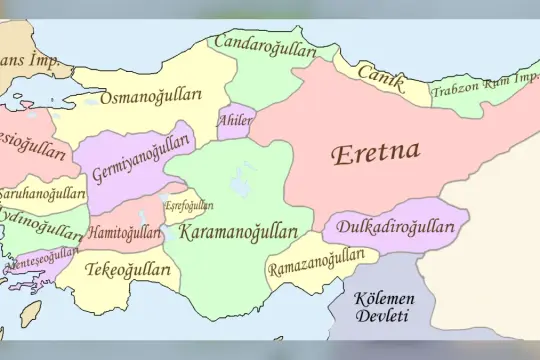
Contemporary Turkmen principalities
Suleiman Shah was not the only Turkish leader to win land in Anatolia after Manzikert. In the same years principalities were founded in different regions, independent of each other or only loosely linked; the Turkification of Anatolia advanced within this multi-centred structure.
- The Danishmendids: They ruled around Sivas, Tokat and Niksar and were long-time rivals of the Anatolian Seljuks.
- The Saltukids and Mengujekids: The Saltukids were established in Erzurum, the Mengujekids in Erzincan and Divriği. The Great Mosque and Hospital of Divriği were built under the Mengujekids in the following century.
- Chaka Bey: Based in Smyrna (İzmir), Chaka Bey led expeditions to the Aegean islands with the fleet he built and pressed Byzantium from the sea.
Sources and further reading
- Türkiye Diyanet Vakfı İslâm Ansiklopedisi, “Süleyman Şah I”.
- Osman Turan, Selçuklular Zamanında Türkiye.
- Encyclopaedia Britannica, “Sultanate of Rum”.
- Anna Komnene – The Alexiad
- Claude Cahen – The Formation of Turkey: The Seljukid Sultanate of Rūm, Eleventh to Fourteenth Century (Longman, 2001)
- Claude Cahen – The Formation of Turkey: The Seljukid Sultanate of Rūm (Routledge, 2001)
- UNESCO World Heritage – "Great Mosque and Hospital of Divriği" (1985)
People also ask
Who was Suleyman ibn Qutalmish? Suleyman was the son of Qutalmish, of the Seljuk dynasty.
When did Suleyman ibn Qutalmish reign? Reign: c. 1077 – 1086.
When did Suleyman ibn Qutalmish die? Died: 1086, near Aleppo.
Who was Suleyman ibn Qutalmish’s father? Father: Qutalmish (cousin of Tughril Beg).




Leave a comment
Your email address will not be published. Required fields are marked *