



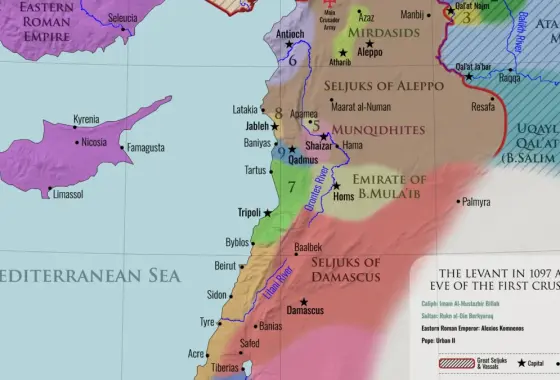
Kilij Arslan was the son of Suleyman ibn Qutalmish, founder of the Sultanate of Rum. After his father’s death in 1086 he was held at the court of the Great Seljuk sultan Malik-Shah. After Malik-Shah’s death in 1092 he returned to Anatolia and took the throne at Nicaea.
The First Crusade
In 1096 he scattered the disorderly crowd of the “People’s Crusade” near Nicomedia. But in 1097 the main crusader army besieged Nicaea, which surrendered to Byzantium. Kilij Arslan and the Danishmendids tried to stop the crusaders near Eskişehir (Dorylaeum) but failed.
Konya and the victories of 1101
After the crusaders moved on to Syria, Kilij Arslan moved his capital to Konya. In 1101, with the Danishmendids, he inflicted heavy defeats on new crusader armies near Merzifon and Ereğli, closing the Anatolian land route to the crusaders.
Death
After taking Mosul in the east, Kilij Arslan was defeated in battle with a Great Seljuk army and drowned while crossing the Khabur River in 1107. His sons succeeded him, and after a difficult period the state grew strong again.
His relationship with Tzachas (Çaka Bey) of Smyrna
In the years when Kilij Arslan came to the throne, Tzachas (Çaka Bey), who had founded a principality centred on Smyrna (İzmir) on the Aegean coast, was a powerful seafaring lord; he had assembled a fleet large enough to threaten the Byzantine capital from the sea. Kilij Arslan married Tzachas's daughter and so became related to this power. According to the Byzantine princess and historian Anna Komnene, Emperor Alexios I incited Kilij Arslan against his father-in-law, and in the early 1090s Kilij Arslan had Tzachas killed during a banquet. This removed the possibility of a united Turkish front against Byzantium in western Anatolia.
The Danishmendids and Malatya
Kilij Arslan and the Danishmendids were both allies and rivals. The two powers fought together against the crusaders but competed with each other for rich cities such as Malatya (Melitene). In 1100 Danishmend Gazi captured Bohemond, Prince of Antioch, near Malatya, which greatly raised the prestige of the Danishmendids. After Danishmend Gazi died in 1104, Kilij Arslan took Malatya in 1106 and gained a gateway to the east. This step was also the beginning of the campaigns that would bring him into conflict with the Great Seljuk commanders in Mosul and the Jazira.
The state after his death
Kilij Arslan's drowning in the Khabur River in 1107 left the young state suddenly without a head. His sons were held for a time at the Great Seljuk court; Malik Shah (Shahanshah) took the throne in Konya first, and from 1116 Mas'ud I reigned for forty years. Kilij Arslan's decision, after the defeat at Dorylaeum, to move his centre to Konya in central Anatolia was a lasting choice that shaped the next two centuries of the state. The heavy defeats suffered by the crusaders in Anatolia in 1101 also led armies coming from Europe in later crusades to prefer the sea route or the Byzantine coasts.
How was the Battle of Dorylaeum lost?
On 1 July 1097, near Eskişehir, Kilij Arslan surrounded the vanguard of the crusader army, Bohemond's troops, in the early hours of the morning. The Turkish horse archers pressed the heavily armoured knights for hours. In the afternoon, however, when the crusaders' second column, the troops of Godfrey and Raymond, reached the battlefield, the Seljuk army was caught between two fires and withdrew. After this defeat Kilij Arslan avoided pitched battle and chose to wear down the crusaders with scorched earth and hit-and-run tactics.
The meaning of his name
The name "Kilij Arslan" is made up of the Turkish words "kılıç", meaning "sword", and "arslan", meaning "lion". In later centuries the name was borne by four sultans of the Anatolian Seljuk dynasty and became one of the dynasty's favourite names.
Sources and further reading
- Türkiye Diyanet Vakfı İslâm Ansiklopedisi, “Kılıcarslan I”.
- Osman Turan, Selçuklular Zamanında Türkiye.
- Encyclopaedia Britannica, “Kilij Arslan I”.
- Anna Komnene – The Alexiad of Anna Comnena (trans. E. R. A. Sewter, Penguin, 1969)
- Claude Cahen – Pre-Ottoman Turkey (Sidgwick & Jackson, 1968)
People also ask
Who was Kilij Arslan I? Kilij Arslan I ruled the Seljuk Sultanate of Rum from 1092 to 1107.
When and where was Kilij Arslan I born? Born: c. 1079.
When did Kilij Arslan I reign? Reign: 1092 – 1107.
When did Kilij Arslan I die? Died: 1107, Khabur River.




Leave a comment
Your email address will not be published. Required fields are marked *