



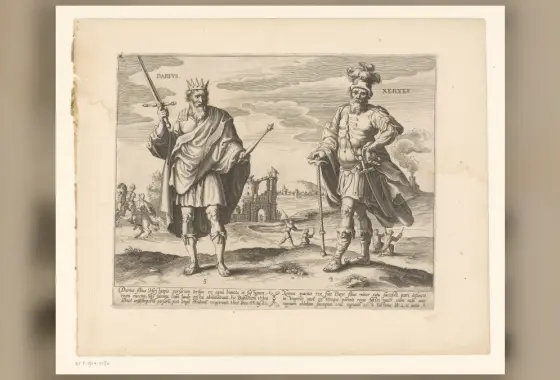
Xerxes was the son of Darius I and Atossa, daughter of Cyrus the Great. He succeeded his father in 486 BC and in the first years of his reign put down revolts in Egypt and Babylon.
The Greek campaign
He prepared for years to avenge his father’s defeat at Marathon. He had a canal dug across the Athos peninsula in northern Greece for his ships and bridges of boats built across the Dardanelles (Hellespont). In 480 BC his army crossed these bridges into Europe.
Thermopylae and Salamis
The Persian army forced the pass of Thermopylae, defended by a small Greek force under the Spartan king Leonidas, then took Athens and burned the Acropolis. But in September 480 the Persian fleet was defeated in the straits of Salamis by the Greek fleet led by the Athenian Themistocles. Xerxes returned to Asia; the army he left behind was defeated at Plataea in 479 BC.
Later years
Xerxes continued building at Persepolis in his later years; the “Gate of All Nations” dates from his reign. He was assassinated in his palace in 465 BC. Many historians identify him with King Ahasuerus of the Book of Esther in the Hebrew Bible.
How did he come to the throne?
Darius I also had older sons who had been born before he became king; the eldest of them was Artobazanes. According to Herodotus, Darius left the throne to Xerxes because Xerxes had been born after his father became king and because his mother, Atossa, was the daughter of Cyrus the Great, the founder of the empire. This lineage was the most important element strengthening Xerxes' legitimacy. After putting down the revolt in Egypt, he gave the government of the province to his brother Achaemenes.
Buildings and inscriptions at Persepolis
Xerxes enlarged the palace city of Persepolis that his father had begun. The great audience hall known as the Apadana was completed in his reign, his own palace was built, and work began on the "Hall of a Hundred Columns", which his son Artaxerxes I finished. Xerxes' trilingual inscriptions in Old Persian, Elamite and Babylonian are key documents for understanding Achaemenid royal ideology. One of them is in Turkey: the trilingual inscription in Xerxes' name, carved into the rock on the south face of Van Fortress, can still be seen today.
A palace assassination and his successor
In 465 BC, according to ancient sources, Xerxes was killed in a palace plot organised by Artabanus, the commander of the royal guard. The details of the plot are told differently in the sources; what is certain is that the throne eventually passed to his son Artaxerxes I. The portrayal of Xerxes by Greek writers as an arrogant tyrant largely reflects the point of view of the side that won the war. Modern historians assess his reign together with the buildings, inscriptions and administrative records of Persepolis and draw a more balanced picture.
The size of the army and the Athos canal
Herodotus describes the army Xerxes brought to Greece in millions. Modern historians regard these figures as exaggerated; once supplies and water sources are taken into account, much lower estimates are made, generally no more than a few hundred thousand. Although the exact number is unknown, there is agreement that this army was one of the largest military operations of the ancient world. The Athos canal described by Herodotus was long thought to be a legend; however, geophysical surveys and boreholes carried out by British and Greek researchers from the 1990s onwards revealed traces of a canal really dug across the narrow neck of the peninsula. According to Herodotus, when the first bridges over the Hellespont were destroyed in a storm, Xerxes had the sea whipped; this story is part of the image of the arrogant king in Greek eyes.
Sources and further reading
- Herodotus, Histories, books VII–IX.
- Encyclopaedia Britannica, “Xerxes I”.
- UNESCO World Heritage, “Persepolis”.
- Pierre Briant – From Cyrus to Alexander: A History of the Persian Empire (Eisenbrauns, 2002)
- Amélie Kuhrt – The Persian Empire: A Corpus of Sources from the Achaemenid Period (Routledge, 2007)
- Herodotus – Histories, book VII, chapters 22–24 and 34–35
People also ask
Who was Xerxes I? Xerxes I ruled the Achaemenid Persian Empire from 486 to 465 BC.
When and where was Xerxes I born? Born: c. 518 BC.
When did Xerxes I reign? Reign: 486 – 465 BC.
When did Xerxes I die? Died: 465 BC, assassinated.





Leave a comment
Your email address will not be published. Required fields are marked *