



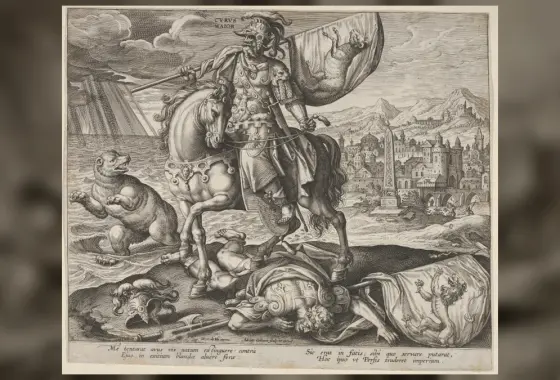
Cyrus was the Persian king of Anshan in today’s south-western Iran. Around 550 BC he defeated his overlord, the Median king Astyages, took over Media and laid the foundations of the Achaemenid Empire.
Lydia and Babylon
In 547/546 BC he defeated the famously wealthy Lydian king Croesus and took his capital Sardis (near today’s Salihli, Manisa); the Ionian cities of western Anatolia also came under Persian rule. In 539 BC he entered Babylon. Because he allowed the Jews exiled in Babylon to return to Jerusalem, he is remembered favourably in the Hebrew Bible.
The Cyrus Cylinder
The clay Cyrus Cylinder, made after the capture of Babylon and now in the British Museum, describes Cyrus honouring Babylon’s gods and allowing deported peoples to return home. It is sometimes called the “first charter of human rights”, but historians stress that this is a modern interpretation.
Death
According to Herodotus, in 530 BC Cyrus campaigned against the Massagetae beyond the Syr Darya in Central Asia and was killed in battle with the army of Queen Tomyris. Other ancient accounts of his death also exist. His tomb is at Pasargadae; he was succeeded by his son Cambyses II.
The childhood legend told by Herodotus
According to Herodotus, the Median king Astyages had a dream showing that the child of his daughter Mandane would take his throne, and he ordered his man Harpagus to kill the baby. Harpagus handed the infant to a herdsman, who raised him as his own son. At the age of ten, the boy's behaviour in a game of "kings" with the village children led to the truth coming out. While telling this story, Herodotus openly says he knows other accounts of Cyrus' birth. Historians regard the details of the story as legend, but the information that Cyrus descended from both Persian and Median lines agrees with other sources.
The fall of Babylon: the Nabonidus Chronicle
The most valuable contemporary document on how Babylon was taken is the Nabonidus Chronicle, written in cuneiform and now in the British Museum. According to the chronicle, the Persian army defeated the Babylonian army at Opis on the Tigris in the autumn of 539 BC; a few days later, troops under Gubaru (Ugbaru) entered Babylon without a battle. Cyrus himself reached the city only seventeen days later. The chronicle also records that ceremonies in the temples continued without interruption. This detail matches the Cyrus Cylinder's claim "I entered Babylon in peace"; even so, scholars remind us that the cylinder should be read as a propaganda text.
Eastern campaigns and Cyropolis
Cyrus' conquests were not limited to the west. Between or after the Lydian and Babylonian campaigns, he is believed to have turned east and brought Central Asian regions such as Bactria and Sogdiana under Persian rule; these regions are later listed as provinces of the empire in the Behistun Inscription. On the Syr Darya he founded a frontier fortress bearing his name, known in Greek sources as Cyropolis (Kyreschata). About two centuries later this fortress was among the cities that resisted Alexander the Great during his Central Asian campaign and was taken by his army. It is thought to have stood near present-day Istaravshan in Tajikistan.
The tomb at Pasargadae and Cyrus' memory
Pasargadae, the first capital founded by Cyrus, was added to the UNESCO World Heritage List in 2004. A plain stone tomb on a six-stepped base is traditionally attributed to Cyrus. Arrian relates that Alexander the Great visited the tomb in 324 BC, found it plundered and ordered the historian Aristobulus to restore it. Cyrus' memory also lived on in the Greek world: Xenophon's "Cyropaedia" (The Education of Cyrus) portrays him as an ideal ruler. The work is not a historical biography but a book of reflections on government, and it was widely read again in Europe during the Renaissance.
Frequently asked questions
What happened between Cyrus and Tomyris? According to Herodotus, Cyrus captured Tomyris’s son by a trick; after her son’s death Tomyris defeated the Persian army in a great battle.
Sources and further reading
- Herodotus, Histories, book I.
- Cyrus Cylinder, British Museum collection.
- Encyclopaedia Britannica, “Cyrus the Great”.
- Herodotus, Histories, Book I (107–130)
- British Museum – Nabonidus Chronicle (BM 35382)
- UNESCO World Heritage – “Pasargadae” (2004)
- Arrian, Anabasis of Alexander, Book VI
People also ask
Who was Cyrus the Great? Cyrus II, known as Cyrus the Great, founded the Achaemenid Persian Empire in the 6th century BC.
When did Cyrus the Great reign? Reign: c. 559 – 530 BC.
When did Cyrus the Great die? Died: 530 BC, campaign against the Massagetae.



Leave a comment
Your email address will not be published. Required fields are marked *