



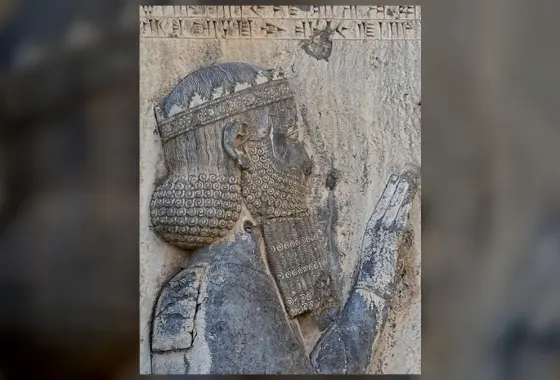
Darius came from a branch of the Achaemenid family. After the death of Cambyses II in 522 BC, he and a group of nobles killed the man who had seized the throne claiming to be Bardiya, son of Cyrus (according to Darius, an impostor priest named Gaumata), and Darius became king. He then crushed revolts across the empire.
The Behistun Inscription
Darius had the story of his accession and victories carved on the Behistun cliffs in western Iran in three languages: Old Persian, Elamite and Babylonian. Henry Rawlinson’s copying of the inscription in the 19th century greatly helped the decipherment of cuneiform. The inscription is on the UNESCO World Heritage List.
Order of the state
He divided the empire into satrapies ruled by governors and regulated taxation. Stations were built along the Royal Road from Sardis to Susa. The gold daric was struck, a canal was dug between the Nile and the Red Sea, and work began on the ceremonial capital of Persepolis.
Campaigns
Around 513 BC he crossed into Europe on a bridge of boats over the Bosphorus to campaign against the Scythians. He put down the Ionian Revolt that began in 499 BC, but the army he sent to Greece was defeated by the Athenians at Marathon in 490 BC. Darius died in 486 BC while preparing a new campaign and was buried in his rock tomb at Naqsh-e Rostam.
Persepolis and the Apadana reliefs
Around 518 BC Darius began building Persepolis in the region of Fars in what is now southern Iran. The city was designed as a ceremonial centre displaying the power of the kingship. The reliefs on the stairways of the audience hall, the Apadana, show envoys of more than twenty peoples of the empire, each in their own dress, bringing gifts to the king: the Lydians carry vases, the Babylonians textiles and the Indians gold dust. Thousands of Elamite clay tablets found in the University of Chicago's excavations in the 1930s record rations of grain, wine and beer issued to workers; these "Persepolis Fortification Tablets" are among the richest sources showing everyday administration in Darius's time.
The palace at Susa and its foundation charter
Darius also had a large palace built at Susa, the old city of Elam. The palace's foundation inscription relates that its materials were brought from every corner of the empire: cedar from Lebanon, gold from Sardis and Bactria, lapis lazuli from Sogdiana and ivory from Kush (Nubia) and India; the stone was worked by Ionians and Sardians, and Egyptians and Babylonians also worked on the building. The base of a headless statue of Darius found at Susa in 1972, which was evidently made in Egypt, lists the peoples subject to the empire. These documents clearly show that Darius wished to present his state as a structure of many peoples.
Darius in Egypt: the canal and temples
While bringing Egypt under Persian rule, Darius took care to respect local traditions. According to a later Demotic text, he ordered the laws of Egypt to be compiled. The stelae set up along the route to commemorate the completion of the canal linking the Nile to the Red Sea were inscribed in Old Persian, Elamite, Babylonian and Egyptian hieroglyphs. The construction and decoration of the Temple of Hibis in the Kharga Oasis in the Western Desert also largely belong to his reign. This approach is one of the examples showing that the Persian kings ruled subject lands by showing respect to local gods and traditions.
Ahura Mazda and royal ideology
Darius's inscriptions repeatedly stress that he received his kingship "by the favour of Ahura Mazda". At Behistun he describes those who opposed him as acting through "the Lie" and regards protecting truth and justice as the essential duty of a king. In his tomb inscription at Naqsh-e Rustam he also says that he was a just ruler who did wrong neither to the strong nor to the weak. How far Darius adhered to the teaching of Zoroaster is debated among researchers; but the opposition of "truth and the Lie" lies at the centre of his political language.
Sources and further reading
- Behistun Inscription (UNESCO World Heritage, “Bisotun”).
- Herodotus, Histories, books III–VI.
- Encyclopaedia Britannica, “Darius I”.
- Amélie Kuhrt – The Persian Empire: A Corpus of Sources from the Achaemenid Period (Routledge, 2007)
- Pierre Briant – From Cyrus to Alexander: A History of the Persian Empire (Eisenbrauns, 2002)
- University of Chicago ISAC – Persepolis Fortification Archive Project
People also ask
Who was Darius I? Darius I ruled the Achaemenid Persian Empire from 522 to 486 BC.
When and where was Darius I born? Born: c. 550 BC.
When did Darius I reign? Reign: 522 – 486 BC.


Leave a comment
Your email address will not be published. Required fields are marked *