



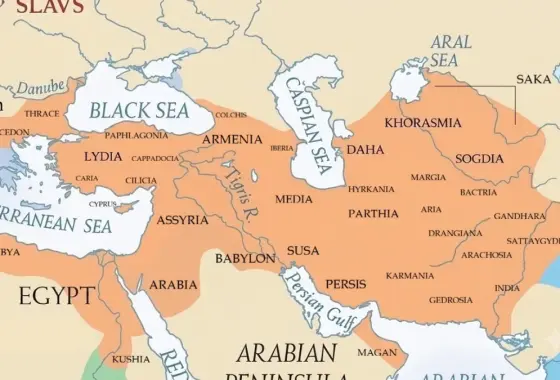
The Achaemenid Empire takes its name from the dynasty’s legendary ancestor, Achaemenes. Around 550 BC Cyrus the Great conquered the Medes, then Lydia, and in 539 BC Babylon. His son Cambyses II conquered Egypt in 525 BC.
Darius I and the order of the state
Darius I (522–486 BC) divided the empire into provinces ruled by governors, the satrapies. Thanks to the stations along the Royal Road from Sardis in western Anatolia to Susa, news travelled quickly. A standard gold coin (the daric) was struck and work began on the new capital, Persepolis.
Wars with the Greeks
The revolt of the Ionian cities of Anatolia in 499 BC began long wars with the Greeks. The Persian army was defeated by the Athenians at Marathon in 490 BC. In 480 BC King Xerxes I invaded Greece with a huge army; he passed Thermopylae and burned Athens, but was defeated at the naval battle of Salamis and the next year at Plataea.
End
From 334 BC Alexander the Great of Macedon defeated the Persian armies at the Granicus, at Issus and, in 331 BC, at Gaugamela. The last king, Darius III, was killed by his own commanders in 330 BC and the empire came to an end.
Legacy
The Achaemenids are seen as one of the first great empires to rule peoples of different languages and religions with broad autonomy. The ruins of Persepolis are now on the UNESCO World Heritage List.
Aramaic: the empire's common language of correspondence
The monumental inscriptions of the Achaemenid kings were usually written in three languages: Old Persian, Elamite and Babylonian. Old Persian cuneiform is thought to have been developed for royal inscriptions in the time of Darius. In everyday administration, however, Aramaic came to the fore: from Egypt to Bactria governors and officials corresponded with one another in Aramaic. Fifth-century BC papyri belonging to a Jewish garrison stationed on the island of Elephantine in Egypt and leather documents found in Bactria show that this common written language was used at both ends of the empire. The spread of Aramaic continued in the Middle East for centuries after the Persian period.
Qanats and "paradise" gardens
To sustain farming in arid lands, the Achaemenids made use of underground water channels, or qanats (kariz), and encouraged the spread of this technique. Iran's qanats were inscribed on the UNESCO World Heritage List in 2016 as "The Persian Qanat". Kings and satraps laid out gardens with geometric plans divided by irrigation channels. The Old Persian word describing these walled gardens passed through the Greek "paradeisos" into many languages with the meaning of "paradise". The royal garden at Pasargadae is regarded as the oldest of the gardens inscribed on the list in 2011 as "The Persian Garden".
A multicultural artistic style
Achaemenid art combined traditions from different regions of the empire. The winged bull statues at Persepolis recall Assyrian palaces, the cavetto cornices above the doorways recall Egyptian architecture and the fine stonework recalls Ionian masons; yet together they produced a distinctive royal style. The "Oxus Treasure", found between 1877 and 1880 on the banks of the Amu Darya in what is now Tajikistan and kept in the British Museum, is the richest collection of Achaemenid metalwork, with about 180 objects of gold and silver; the gold chariot model is the best known of them.
The army and the "Immortals"
The Persian army was made up of contingents raised from the peoples subject to the empire. Herodotus relates that during Xerxes' campaign against Greece in 480 BC, at a muster of the army at Doriscus in Thrace, dozens of peoples were lined up with their own weapons and dress; the troop numbers he gives are now considered exaggerated. The core of the army was the elite Persian infantry, called the "Immortals" by the Greeks because their number was always kept at ten thousand. The spear-bearing guards shown in the glazed brick reliefs at Susa give an idea of the appearance of these elite units.
Sources and further reading
- Herodotus, Histories.
- Encyclopaedia Britannica, “Achaemenian dynasty”.
- UNESCO World Heritage, “Persepolis”.
- UNESCO World Heritage – “The Persian Garden” (2011) and “The Persian Qanat” (2016)
- British Museum – Oxus Treasure collection record
- Herodotus, Histories, Book VII
People also ask
What was the Achaemenid Persian Empire? The Achaemenid Empire was founded around 550 BC by Cyrus the Great and lasted more than two hundred years.
When was the Achaemenid Persian Empire founded? Founded: c. 550 BC, Cyrus the Great.
What was the Achaemenid Persian Empire’s capital? Capitals: Pasargadae, Susa, Persepolis, Ecbatana.
When did the Achaemenid Persian Empire end? End: 330 BC, Alexander the Great.



Leave a comment
Your email address will not be published. Required fields are marked *