



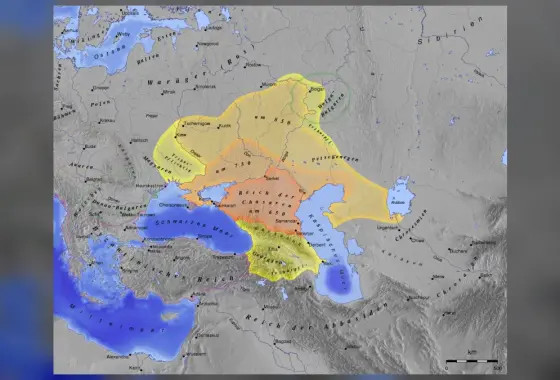
The Khazars were one of the tribes subject to the Western Göktürk Khaganate. After the khaganate weakened in the mid-7th century they founded an independent khaganate in the North Caucasus and the lower Volga region. Following Göktürk tradition, Khazar rulers used the title “qaghan”; over time a dual system developed, with a sacred qaghan and a “bek” who ran the government.
Arabs and Byzantium
In the 7th and 8th centuries the Khazars fought long wars with Umayyad armies seeking to advance north through the Caucasus. They won a great victory near Ardabil in 730, but suffered a heavy blow from the campaign of the Umayyad general Marwan in 737. The Khazars formed a close alliance with Byzantium: Emperor Constantine V married a Khazar princess, and their son Leo IV was known as “the Khazar”.
Trade and religion
The capital Itil was an important stop on the Volga trade in furs, honey and slaves from the north, and on East–West trade. In the 8th or 9th century the Khazar ruling class adopted Judaism; how widely it spread among the people is debated. The sources say the capital had separate judges for Muslim, Christian, Jewish and other communities.
End
In the 10th century the growing power of Kievan Rus’ became a major threat. In the 960s Prince Svyatoslav of Kiev took the Khazar fortress of Sarkel and the capital Itil. After these attacks the khaganate came to an end as a whole, although Khazar communities survived in the region for some time.
Administration: the khagan and the bek
The most striking feature of the Khazar state was that rule was shared between two figures. According to the sources, the khagan was the sacred and symbolic head of the state, while daily administration, the army and foreign relations were run by a second ruler called the “bek” or “khagan bek”. Arab geographers of the 10th century describe this dual structure, although much of their information comes from writers who never visited Khazar lands, and the details remain debated among researchers.
The arrangement is also read as the Göktürk idea of kingship adapted to new conditions. Reports that the khagan was seldom seen, while the bek led the army in wartime, suggest a division of labor between the two offices.
Economy, taxes and trade routes
The Khazar state controlled the steppe corridor between the Caspian and Black Seas. This position linked north and south along the Volga and Don rivers, and Byzantium with the Islamic world through the Caucasus. In the capital Itil and in cities such as Samandar, goods such as furs, honey, beeswax, fish products and slaves changed hands, while Abbasid dirhams and silk fabrics entered the region in return.
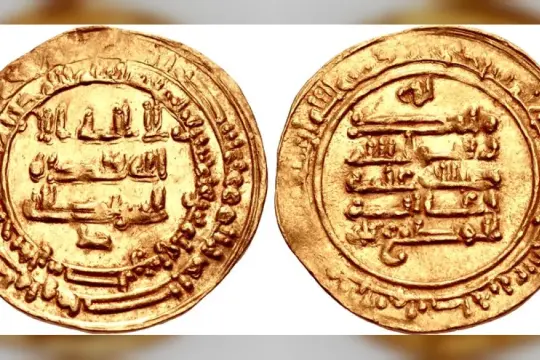
The state collected customs duties on this traffic and also took tribute from dependent tribes. According to the Rus chronicles written in Kiev, some East Slavic communities also paid tribute to the Khazars. Among archaeological finds, the many coins from the Islamic world that reached the region show how lively trade was.
Sarkel, Samandar and city life
The Khazars were not merely a nomadic society. The fortress of Sarkel, built on the Don River in the 9th century, shows the importance the state gave to settled life and defense. According to the Byzantine emperor Constantine VII, the fortress was built by Byzantine engineers at the request of the Khazar khagan. Much of the excavated fortress now lies beneath the reservoir of the Tsimlyansk Dam built in the 20th century.
Another important city in Khazar lands, Samandar, lay in the northern Caucasus close to the Caspian coast. Arab sources describe it as a populous city famous for its vineyards and gardens. These cities reflect the multi-ethnic and multi-faith character of the Khazar state.
The Khazar Correspondence and the debate over Judaism
The adoption of Judaism by the Khazar ruling class is one of the most intriguing topics in the sources. In the 10th century, a correspondence is reported between Hasdai ibn Shaprut, the Jewish physician and diplomat of the Umayyad caliph in Córdoba, and a Khazar ruler. It is known as the “Khazar Correspondence”, but the text exists in different versions and views on its authenticity differ. The philosophical book Kuzari, written by Yehuda Halevi in the 12th century, also deals with the religious search of a Khazar king.
It is also reported that in the early 860s the Byzantine missionary Cyril traveled to Khazar lands and took part in religious debates before the khagan. All of this shows that the Khazar state tried to keep a balance between different religions, although it is not certain which faith most of the population followed.
Legacy and modern debates
The name of the Khazar Khaganate was not forgotten after its fall. The Turkish name of the Caspian Sea, Hazar, comes from this people, and in many languages the sea is known by names derived from the root “Khazar”. Even so, the written information we have about the Khazars is limited: almost no state documents written in their own language have survived, and most information rests on the records of neighboring peoples.
Arthur Koestler’s book The Thirteenth Tribe, published in 1976, claimed that a significant part of Ashkenazi Jews were of Khazar origin. This claim has not gained wide acceptance in academic circles; historians and geneticists treat the subject with caution. Khazar history should be approached free of political readings and only as far as the sources allow.
The problem of sources: how do we know the Khazars?
Writing Khazar history is difficult because the sources are inadequate. Most of our information comes from Arabic, Persian, Byzantine Greek, Armenian and Old Russian texts, whose authors were outside observers who often met the Khazars through war or trade. For this reason the same event is told differently from source to source.
Archaeology partly fills this gap. Fortress remains, cemeteries and trade goods in the Volga–Don region provide the material traces of the Khazar world. Even so, the exact site of the capital Itil has not been settled to this day, which shows that Khazar history is still a research field that new finds may change. Readers should be careful with accounts that appear certain.
Sources and further reading
- Türkiye Diyanet Vakfı İslâm Ansiklopedisi, “Hazarlar”.
- Peter B. Golden, An Introduction to the History of the Turkic Peoples.
- Encyclopaedia Britannica, “Khazar”.
- Peter B. Golden – Khazar Studies: An Historico-Philological Inquiry into the Origins of the Khazars
- Constantine Porphyrogenitus – De Administrando Imperio (Dumbarton Oaks edition)
- Türkiye Diyanet Foundation Encyclopaedia of Islam – “Hazarlar” entry
People also ask
What was the Khazar Khaganate? The Khazar Khaganate was founded in the mid-7th century, after the break-up of the Western Göktürk Khaganate, on the steppes north of the Caucasus between the Black Sea and the Caspian.
When was the Khazar Khaganate founded? Founded: c. 650.
What was the Khazar Khaganate’s capital? Capital: Itil (Volga delta).
When did the Khazar Khaganate end? End: 960s, attacks of Prince Svyatoslav of Kiev.
Leave a comment
Your email address will not be published. Required fields are marked *