



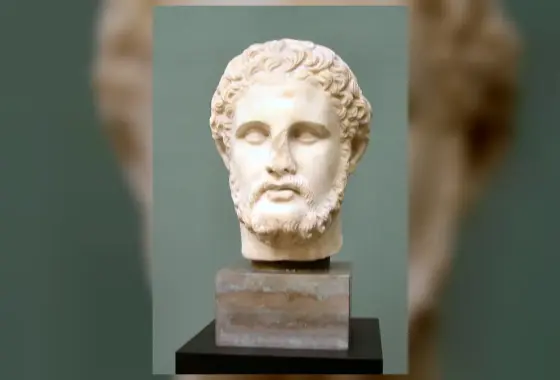
Philip was the son of King Amyntas III of Macedon. As a young man he spent several years as a hostage in Thebes, where he learned the military methods of the famous general Epaminondas. When his brother Perdiccas III was killed fighting the Illyrians in 359 BC, Philip took over the government.
A new army
Philip reorganised his army from top to bottom, forming his infantry into a tight phalanx armed with sarissas up to six metres long and supporting it with heavy cavalry. By taking Amphipolis and the rich gold mines of Mount Pangaion he gave his state a strong source of revenue. He lost an eye at the siege of Methone.
Chaeronea
Despite the warnings of the Athenian orator Demosthenes, Philip advanced into Greece. In 338 BC at Chaeronea he defeated the armies of Athens and Thebes, with the young Alexander commanding the cavalry. In 337 BC he gathered the Greek cities except Sparta into the League of Corinth under his leadership and had it vote for a campaign against Persia.
Death
In 336 BC, during his daughter’s wedding celebrations at the old capital Aigai, he was killed by Pausanias, a member of his bodyguard. He was succeeded by his son Alexander. One of the royal tombs found at Vergina (Aigai) in Greece in 1977 is thought to be Philip’s, though this is debated.
From Amphipolis to Olynthus: expansion in the northern Aegean
After taking Amphipolis in 357 BC, Philip brought the cities of the northern Aegean coast under his control one by one. In 348 BC he besieged and destroyed Olynthus, the centre of the Chalcidian League, and sold most of its people into slavery. The Athenian orator Demosthenes, in the "Philippics" and the Olynthiac speeches he delivered from 351 BC onwards, urged the Athenians to act against Philip; these speeches are still read today as models of political oratory.
Thessaly and the Third Sacred War
The Third Sacred War (356–346 BC), which broke out over the treasury of the temple of Apollo at Delphi, gave Philip the chance to enter central Greece. In 352 BC he defeated the Phocian army at the Crocus Field in Thessaly; the Phocian commander Onomarchus was killed in the battle. Philip was then chosen as leader of the Thessalian League. In 346 BC the Peace of Philocrates was signed with Athens, and Macedonia took a seat on the Amphictyonic Council that oversaw Delphi. Macedonia thus ceased to be a kingdom on the edge of the Greek world and settled at its political centre.
Marriage alliances and Aristotle
Philip also strengthened relations with his neighbours through marriage; ancient writers credit him with seven wives. One of them, the Epirote princess Olympias, was the mother of Alexander. His marriage in 337 BC to Cleopatra Eurydice, niece of the Macedonian noble Attalus, caused a rift with Olympias and Alexander. According to Plutarch, around 343 BC Philip invited the philosopher Aristotle to educate his son; the lessons were held at Mieza near Pella. Aristotle's father, Nicomachus, had been physician to Philip's father, Amyntas III.
His wounds and the debate over the tomb at Vergina
Philip was wounded many times on the battlefield. At the siege of Methone in 354 BC he lost an eye to an arrow; in 339 BC, fighting the Triballi near the Danube, he received a severe wound to the leg and, according to ancient writers, limped from then on. These details also played an important part in the search for his tomb. In 1977 the archaeologist Manolis Andronikos found a royal tomb in the Great Tumulus at Vergina containing a gold chest (larnax) and a gold wreath. For a long time this tomb was thought to be Philip's; a study published in 2015, however, suggested that leg bones with a healed wound around the knee, found in a neighbouring tomb, might be Philip's. The debate continues. The archaeological site of Aigai has been on the UNESCO World Heritage List since 1996.
Sources and further reading
- Diodorus Siculus, Library of History, book XVI.
- Encyclopaedia Britannica, “Philip II”.
- UNESCO World Heritage, “Archaeological Site of Aigai (modern name Vergina)”.
- Plutarch – Parallel Lives: Alexander, chapters 7–9
- Demosthenes – The Philippics and Olynthiac speeches (351–341 BC)
- Antonis Bartsiokas et al. – "The lameness of King Philip II and Royal Tomb I at Vergina, Macedonia", PNAS 112 (2015)
People also ask
Who was Philip II? Philip II ruled the Kingdom of Macedon from 359 to 336 BC.
When and where was Philip II born? Born: 382 BC.
When did Philip II reign? Reign: 359 – 336 BC.
When did Philip II die? Died: 336 BC, Aigai (assassinated).
Leave a comment
Your email address will not be published. Required fields are marked *