



Macedon was a kingdom on the plains north of Mount Olympus. Its royal family, the Argeads, traced their descent to the legendary hero Heracles. The first capital was Aigai (today’s Vergina); around 400 BC King Archelaus moved the capital to Pella.
Philip II and Alexander the Great
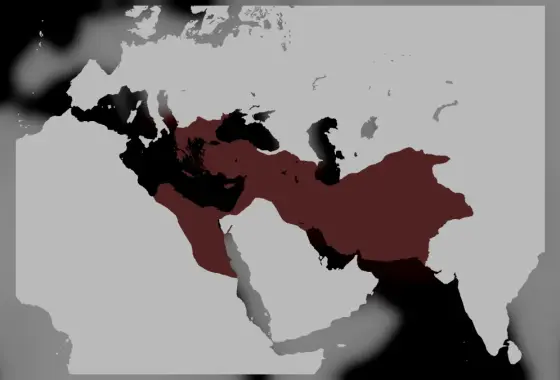
Philip II, who came to the throne in 359 BC, rebuilt the army around the sarissa phalanx and defeated Athens and Thebes at Chaeronea in 338 BC. His son Alexander the Great (336–323 BC) destroyed the Persian Empire and built an empire stretching from Greece to Egypt and north-western India.
The Antigonids
After Alexander’s death his generals divided the empire. In Macedon, after long struggles, the Antigonid dynasty was established around 277 BC by Antigonus II Gonatas, and the kingdom again became the strongest state in Greece.
Rome and the end
From the late 3rd century BC Macedon fought a series of wars with Rome. In 168 BC at Pydna the last king, Perseus, was defeated by the Roman general Aemilius Paullus, ending the kingdom. The region became a Roman province in 146 BC.
Legacy
The Macedonian conquests began the Hellenistic Age, in which Greek language and culture spread from the eastern Mediterranean to Central Asia. The royal tombs at Aigai are on the UNESCO World Heritage List.
The Macedonians and the Greek world
The place of the Macedonians in the Greek world was already a matter of debate in antiquity. Herodotus relates that when the Macedonian king Alexander I wished to compete at the Olympic Games, he had to prove he was Greek by tracing his descent to Argos. The Athenian orator Demosthenes called Philip II a "barbarian", but this remark was part of a political attack. Written finds such as a 4th-century BC curse tablet discovered at Pella show, according to many researchers, that Macedonian was a dialect of Greek. Although the question was long debated in scholarship, it is generally accepted that Macedonian court culture rested on the Greek language and religion.
Pella: palace, mosaics and Euripides
Pella, which became the capital under King Archelaus, soon turned into one of the important cultural centres of the Greek world. Archelaus invited the painter Zeuxis and the tragedian Euripides to his court; Euripides spent his last years in Macedonia and died there around 406 BC. It is generally accepted that he wrote "The Bacchae" during this period. The pebble mosaics uncovered in the excavations at Pella, especially the lion hunt and stag hunt scenes, are among the most striking examples of Hellenistic art; the stag hunt mosaic bears the signature "Gnosis made it". Some of the finds are displayed today in the Archaeological Museum of Pella.
The Macedonian army: phalanx and cavalry
The basis of Macedonian power was the military system created by Philip II and developed by Alexander. The infantry phalanx formed a dense wall with sarissa pikes more than five or six metres long and pinned the enemy from the front. The hetairoi cavalry, whose name means the king's "companions", delivered fast and decisive attacks from the wings. The combined use of light infantry, archers and siege specialists with this formation is regarded as an early and successful example of coordinating different types of troops in the same battle. This army became a model that the Hellenistic kingdoms also followed.
Four wars with Rome
The conflict between Macedonia and Rome began when Philip V allied with Hannibal of Carthage in 215 BC. The Second Macedonian War ended in 197 BC with the victory of the Roman commander Flamininus at Cynoscephalae; the flexible formation of the Roman legions had defeated the phalanx. After the defeat at Pydna in 168 BC, Rome divided the kingdom into four separate districts. When Andriscus, who claimed to be the son of Perseus, rebelled in 149 BC, the Fourth Macedonian War broke out; after this revolt was crushed the region became a Roman province. Soon afterwards the Via Egnatia, linking the Adriatic with the Aegean, was built to run through Macedonia.
Sources and further reading
- Encyclopaedia Britannica, “Macedonia (ancient kingdom)”.
- Plutarch, Parallel Lives: Aemilius Paullus.
- UNESCO World Heritage, “Archaeological Site of Aigai (modern name Vergina)”.
- Herodotus, Histories, Book V, 22
- Robin Lane Fox (ed.) – Brill’s Companion to Ancient Macedon (Brill, 2011)
People also ask
What was the Kingdom of Macedon? The Kingdom of Macedon was founded in northern Greece and long remained on the edge of the Greek world.
When was the Kingdom of Macedon founded? Founded: Traditionally 8th century BC.
What was the Kingdom of Macedon’s capital? Capitals: Aigai (Vergina), later Pella.
When was the Kingdom of Macedon at its height? Height: Philip II and Alexander the Great (359 – 323 BC).



Leave a comment
Your email address will not be published. Required fields are marked *