



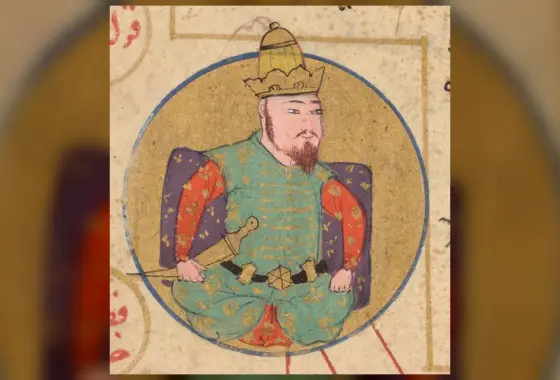
Mahmud was the son of Sebüktegin, the Turkic commander regarded as founder of the Ghaznavid state, who had risen from slave-soldier origins in Samanid service. Mahmud took the throne in 998 after setting aside his brother Ismail.
The title sultan
The Abbasid caliph al-Qadir recognised Mahmud’s rule and gave him honorific titles. Mahmud appears in the sources as one of the first Turkic Muslim rulers called “sultan”, though historians debate when the title was used officially.
The Indian campaigns
In campaigns traditionally numbered at seventeen, Mahmud invaded northern India, and the Punjab became permanent Ghaznavid territory. The 1025–1026 campaign against Somnath is the most famous. These campaigns opened the way for the spread of Islam in India, and are also remembered for great destruction and plunder.
Culture and science
Under Mahmud, Ghazni was adorned with mosques, madrasas and palaces. The great scholar al-Biruni accompanied Mahmud to India and wrote his study of Indian culture. Ferdowsi presented his famous Shahnameh to Mahmud.
Death
Mahmud died in Ghazni in 1030. Under his son Mas‘ud the Seljuks grew stronger and defeated the Ghaznavids at Dandanaqan in 1040.
The state system and the army
The Ghaznavid state largely inherited its idea of government from the Samanids. The language of the court and of the government offices was Persian, and taxation, the postal service and intelligence were run by officials appointed from the centre. The ruling family was of Turkic origin, but the state's secretaries and viziers were mostly drawn from Iranians of Khorasan. This dual structure became a model often seen in later Turkic-Islamic states.
- The army: The core of the army was made up of ghulams raised at court, that is, Turkic soldiers taken at a young age and trained. Alongside them, war elephants brought from India were the most striking force of the Ghaznavid army.
- Expansion in the west: Mahmud annexed Khwarazm in 1017 and took Rayy from the Buyids in 1029. The state thus stretched from the Punjab in the east to the heart of Iran in the west.
- The northern frontier: Beyond the Oxus he both fought and made agreements with the Karakhanids; the river largely became the border between the two Turkic dynasties.
His legacy and the sources that describe him
The most important contemporary work on Mahmud's life is the Kitab al-Yamini, written in Arabic by the secretary al-Utbi; its name comes from the title "Yamin al-Dawla" that the caliph gave Mahmud. The history by Bayhaqi, which describes the reign of his son Mas'ud in detail, is also a basic source for understanding the Ghaznavid court. The poet Unsuri, as chief poet of the court, wrote odes in Mahmud's name.
The story that Ferdowsi did not receive the reward he expected for the Shahnameh is told in sources from later centuries; how much of it is true is debated. Mahmud's legacy is still read in different ways today: in the Islamic world he is remembered as a powerful ghazi ruler, while in India the Somnath campaign in particular is remembered as a symbol of destruction. Historians recommend weighing both views together with the sources of the period.
Mahmud's court attracted not only poets but also scholars. After Khwarazm was taken in 1017, Khwarazmian scholars such as al-Biruni were brought to Ghazni. Very little survives of the palaces and mosques of Ghazni; the two brick minarets still standing near the city belong to later Ghaznavid sultans, Mas'ud III and Bahram Shah.
Mahmud and Ayaz in literature
Mahmud of Ghazni is a figure who lives on in Persian literature as well as in history books. The best-known example is the stories about the bond between the sultan and his loyal servant Ayaz. In many works, including those of Farid al-Din Attar and Rumi's Masnavi, Ayaz is portrayed as a model of humility who, although raised to high rank, keeps his old sandals and sheepskin coat and looks at them every day so as not to forget where he came from. In these stories Mahmud appears as a character through whom the relationship between power and love, and between ruler and servant, is explored.
Sources and further reading
- Türkiye Diyanet Vakfı İslâm Ansiklopedisi, “Mahmûd-ı Gaznevî”.
- Al-Biruni, Tahqiq ma li’l-Hind.
- Encyclopaedia Britannica, “Mahmud of Ghazna”.
- C. E. Bosworth – The Ghaznavids: Their Empire in Afghanistan and Eastern Iran 994–1040 (Edinburgh University Press, 1963)
- Encyclopaedia Iranica – "Ghaznavids"
- Encyclopaedia Iranica – "Ayāz, Abu'l-Najm"
- Jalal al-Din Rumi – Masnavi, Book 5
People also ask
Who was Mahmud of Ghazni? Mahmud of Ghazni ruled the Ghaznavid Empire from 998 to 1030.
When and where was Mahmud of Ghazni born? Born: 971, Ghazni.
When did Mahmud of Ghazni reign? Reign: 998 – 1030.
When did Mahmud of Ghazni die? Died: 1030, Ghazni.





Leave a comment
Your email address will not be published. Required fields are marked *