



Alptegin, a Turkic commander who rose in the Samanid state, settled at Ghazni in the early 960s. After his death Sebüktegin, also a commander of Turkic origin, took power in 977 and became the state’s true founder. As the Samanids weakened, the Ghaznavids became independent.
Mahmud of Ghazni
Sebüktegin’s son Mahmud (998–1030) took Khurasan and, through his Indian campaigns, annexed the Punjab. With its mosques, madrasas and court, Ghazni became one of the important centres of the Islamic world in his reign; figures such as Ferdowsi and al-Biruni are linked to his court.
Struggle with the Seljuks
Under Mahmud’s son Mas‘ud, the Seljuk Turkmens who had come into Khurasan grew stronger. At the Battle of Dandanaqan in 1040 the Ghaznavid army was defeated and Khurasan passed to the Seljuks. The Ghaznavids then withdrew to their lands in Afghanistan and northern India.
End
In the 12th century the Ghurids, from the mountains of today’s Afghanistan, burned and destroyed Ghazni around 1150. The Ghaznavids moved their centre to Lahore; the state ended when Lahore too fell to the Ghurids in 1186–1187.
Legacy
The Ghaznavids were one of the first great Muslim states ruled by a dynasty of Turkic origin. They patronised Persian literature and opened the way for the spread of Islam in India. The work of the historian Bayhaqi is one of the most important sources for the period.
Palaces, minarets and excavations
The material culture of the Ghaznavids is known today largely through archaeological excavations. The remains of some of the magnificent palaces described in the sources were brought to light in the twentieth century.
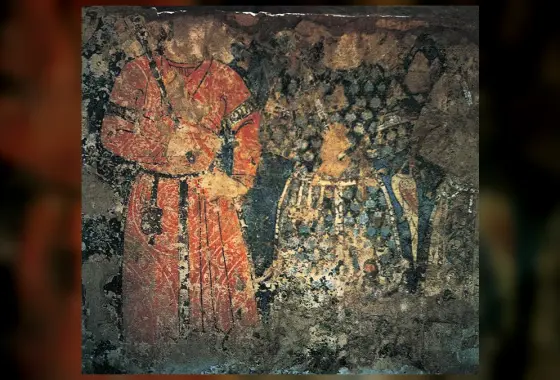
- Lashkari Bazar: This palace city near Bust, on the Helmand River in present-day Afghanistan, was excavated by French archaeologists in 1949–1951. Wall paintings were found showing the sultan's guards depicted in rows.
- The Ghazni palace: The palace of the time of Mas'ud III was excavated by Italian teams from the late 1950s onwards; marble reliefs and inscriptions of Persian poetry came to light.
- The minarets: The two brick minarets still standing near Ghazni date from the reigns of Mas'ud III and Bahram Shah and are known for their rich brick decoration.
The Lahore period
After the defeat at Dandanaqan in 1040 the state's centre of gravity gradually shifted east; after Ghazni was burned around 1150, Lahore effectively became the capital. This period marks the beginning of Lahore's rise as a centre of Islamic culture.
The Sufi Ali Hujwiri, who lived in Lahore in the Ghaznavid period, wrote the Kashf al-Mahjub, regarded as one of the oldest Sufi books written in Persian; his shrine in Lahore is still a major place of pilgrimage today. The Lahore-born poet Mas'ud-i Sa'd-i Salman won a distinct place in Persian literature with the poems he wrote during his long years in prison. The last Ghaznavid ruler, Khusraw Malik, surrendered to the Ghurid Mu'izz al-Din Muhammad in 1186, and the dynasty thus came to an end.
The Ghaznavid army
The foundation of Ghaznavid power was a core army of Turkish-origin ghulams, like the founders of the state themselves: guards taken at a young age and trained as soldiers in the palace schools. Around this core stood Arabs, Kurds, Afghans and contingents from India; under Sultan Mas'ud the Hindu-born commander Tilak is known to have held important posts.
War elephants captured during the Indian campaigns became one of the symbols of the Ghaznavid army and of court ceremonies.
Bayhaqi's history
The most vivid source on the Ghaznavids is the Persian history of Abu'l-Fazl Bayhaqi, who worked as a secretary in the chancery. Only part of Bayhaqi's work, reported to have run to thirty volumes, has survived, mostly the section covering the reign of Sultan Mas'ud. Recounting court intrigues, correspondence and personalities through the eyes of a witness, the text is counted among the classics of Persian prose.
Sources and further reading
- Türkiye Diyanet Vakfı İslâm Ansiklopedisi, “Gazneliler”.
- Abu’l-Fazl Bayhaqi, Tarikh-i Bayhaqi.
- Encyclopaedia Britannica, “Ghaznavid dynasty”.
- C. E. Bosworth – The Later Ghaznavids: Splendour and Decay (Edinburgh University Press, 1977)
- Encyclopaedia Iranica – "Ghaznavids"
- C. E. Bosworth – The Ghaznavids: Their Empire in Afghanistan and Eastern Iran 994–1040 (Edinburgh University Press, 1963)
- Encyclopaedia Iranica – "Bayhaqi, Abu'l-Fazl"
People also ask
What was the Ghaznavids? The Ghaznavid state was founded at Ghazni, in today’s Afghanistan, by Turkic commanders in Samanid service.
When was the Ghaznavids founded? Founded: c. 963, Ghazni.
What was the Ghaznavids’s capital? Capitals: Ghazni, later Lahore.
When was the Ghaznavids at its height? Height: Reign of Mahmud of Ghazni (998 – 1030).



Leave a comment
Your email address will not be published. Required fields are marked *