



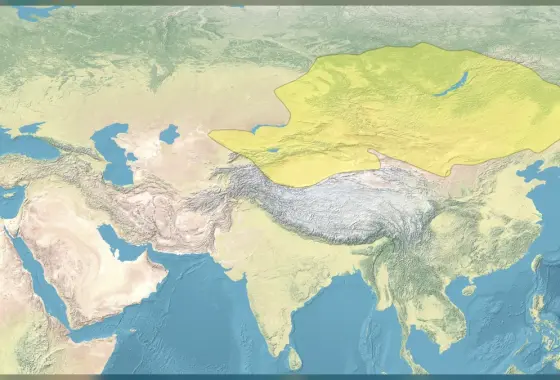
The Kyrgyz were a people of the Yenisei basin in southern Siberia, mentioned in Chinese sources from the 1st millennium BC. In the Göktürk era they were at times subject to the Göktürks; according to the Orkhon inscriptions, under Qapaghan Qaghan the Göktürk army crossed the snowy Sayan Mountains in 710 and defeated the Kyrgyz.
The fall of the Uyghur Khaganate
From the mid-8th century the Kyrgyz fought a long struggle with the Uyghur Khaganate. In 840, when the Uyghurs had been weakened by famine, disease and internal conflict, the Kyrgyz army entered Ötüken, took the Uyghur capital Ordu-Baliq and destroyed the khaganate. Most Uyghurs migrated south and west.
The Kyrgyz at Ötüken
The Kyrgyz Khaganate dominated the Mongolian steppe for a time and exchanged embassies with Tang China. But unlike the Uyghurs, the Kyrgyz did not build a lasting centre on the steppe. In the early 10th century, as the Khitan (Liao) state rose in the east, Kyrgyz rule at Ötüken ended and they withdrew to the Yenisei region.
The Yenisei inscriptions
Hundreds of inscriptions found in the Yenisei valley, most of them gravestones, are written in the Old Turkic script. They record the name, family and important events in the life of the deceased, and together with the Orkhon inscriptions are among the most important sources for Old Turkic. The Epic of Manas, the greatest work of Kyrgyz oral literature, took shape many centuries later.
Sources and further reading
- Orkhon inscriptions (Kül Tegin and Bilge Qaghan inscriptions).
- Türkiye Diyanet Vakfı İslâm Ansiklopedisi, “Kırgızlar”.
- Encyclopaedia Britannica, “Kyrgyz”.
People also ask
What was the Yenisei Kyrgyz Khaganate? The Yenisei Kyrgyz were a Turkic people of the Yenisei River basin in Siberia, mentioned in the Orkhon inscriptions.
When did the Yenisei Kyrgyz Khaganate end? End: Early 10th century, withdrawal from Ötüken.


Leave a comment
Your email address will not be published. Required fields are marked *