



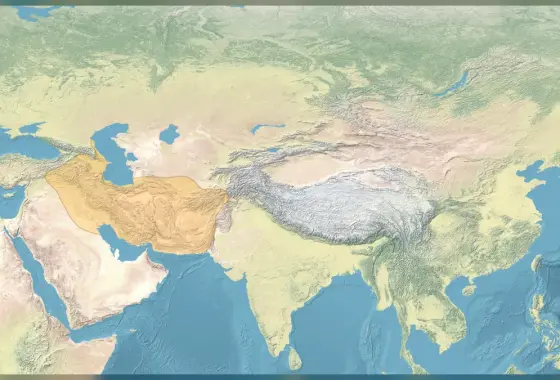
The Safavids emerged from the Safaviyya Sufi order, named after Sheikh Safi al-Din, who lived in Ardabil in the 14th century. In the 15th century the order spread among Turkmen tribes in Anatolia and Azerbaijan; known as the “Qizilbash” (red heads) for their red caps, these tribes formed the Safavids’ military power.
Shah Ismail
The order’s young leader Ismail defeated the Aq Qoyunlu and was proclaimed shah in Tabriz in 1501, making Twelver Shi‘ism the state’s official creed. He soon conquered all of Iran. Shah Ismail also wrote poetry in Turkish under the pen name “Khata’i”. In 1514 he was defeated by Selim I at Chaldiran.
Rivalry with the Ottomans
In the 16th and 17th centuries the Safavids and Ottomans fought long wars over eastern Anatolia, the Caucasus and Iraq. The Peace of Amasya (1555) was the first formal peace between them, and the border drawn by the Treaty of Qasr-e Shirin (1639) largely set the outline of today’s Turkey–Iran border.
Shah Abbas and Isfahan
Abbas I (1588–1629) created new units of Caucasian ghulams to balance the power of the Qizilbash chiefs, and recovered Tabriz from the Ottomans and Hormuz from the Portuguese. Isfahan, made the capital, became one of the most splendid cities of its age with its Naqsh-e Jahan Square (now a UNESCO World Heritage site), mosques and bridges. The silk trade brought the state great revenues.
End
Weakening from the late 17th century, the state collapsed when Afghan Hotaki forces took Isfahan in 1722. Nader, of the Turkmen Afshar tribe, who had fought in the Safavids’ name, proclaimed himself shah in 1736, effectively ending the Safavid dynasty.
The Kızılbaş and Shiitization
Kızılbaş Türkmen tribes formed the core of the Safavid army. They were devoted to the head of the order not only as a political leader but also as a spiritual guide. Tribes such as the Shamlu, Rumlu, Ustajlu, Tekelu, Dulkadir and Afshar gathered around Shah Ismail as a military force, and this loyalty was one of the main reasons for the rapid conquests of the early years.
Ismail’s decision to make Twelver Shiism the official creed was a deep change for Iran, whose population was largely Sunni at the time. The state brought in Shia scholars from regions such as Jabal Amil and reorganized madrasas and endowments. The process took centuries to settle in society; Iran’s present Shia majority formed gradually during and after the Safavid era rather than overnight.
Administration, the army and Abbas’s reforms
In the early period the state was largely run by Kızılbaş emirs, and provinces were handed to tribal chiefs. This limited the shah’s authority, and rivalries among the emirs sometimes turned into civil war. To change this balance, Abbas I created a force of ghulams of Georgian, Circassian and Armenian origin who were directly loyal to the shah, and he took some provinces from tribal chiefs and placed them under central administration.
In modernizing the army, the artillery and musket knowledge brought by the English Sherley brothers after 1598 played a role. Abbas also brought much of the silk trade under state control and, through Armenian merchants settled in New Julfa, turned Isfahan into a trading center connected to Europe. These steps strengthened the treasury and allowed the state to recover against the Ottomans.
Art, architecture and intellectual life
The Safavid period is one of the brightest ages of Iranian art history. Around the Naqsh-e Jahan Square in Isfahan, the Shah Mosque, the Sheikh Lutfullah Mosque, the Ali Qapu Palace and the covered bazaar form a city center that was designed as a whole. Structures such as the Allahverdi Khan Bridge and the Khaju Bridge gave the riverbank its own character. Tile-covered domes and geometric ornament shaped the visual language of the age.
Miniature painting, calligraphy, book arts and carpet weaving flourished in the workshops of Tabriz and Isfahan, and carpets from centers such as Ardabil and Kashan are held in museums around the world today. In thought, the “School of Isfahan”, associated with Mir Damad and his student Mulla Sadra, combined philosophy with Shia theology. Turkic was widely used at court alongside Persian, and the poems Shah Ismail wrote under the pen name Khatai hold an important place in Azerbaijani Turkic literature.
The Safavid legacy and its effect today
The most lasting mark of the Safavids is political geography. The border drawn through treaties with the Ottomans defined the main outline of today’s frontier between Türkiye and Iraq on one side and Iran on the other. That Iran kept its Shia identity under later dynasties as well changed the sectarian map of the region and, for centuries, made the Ottoman–Iranian rivalry a religious matter as well as a political one.
Historians do not agree on whether the Safavids formed an “Iranian nation-state”. Some see the period as the time when Iran’s political unity was rebuilt; others stress that it was a multilingual, multicultural dynastic empire resting on a Turkmen military elite. Both readings agree on one point: the Safavids are a shared starting point in the histories of Iran, Azerbaijan and the Caucasus.
Changing capitals and the fate of Tabriz
The Safavid capital did not stay in one city. The first capital was Tabriz, close to the Ottoman border; as Ottoman pressure grew under Shah Tahmasp, the capital was moved to Qazvin, further inland, around 1548. Abbas I then moved the center to Isfahan in 1598. These moves reflect both security concerns and the direction of trade routes and fertile land.
Tabriz was one of the cities that changed hands most often in the struggle between the two states. Sultan Selim entered the city in 1514 but did not remain there; the Ottomans took it in 1585 and Abbas won it back in 1603. Shah Tahmasp also gave refuge in 1544 to the Mughal ruler Humayun, who had fled India, and with Safavid support Humayun regained Delhi in 1555. This also strengthened Safavid cultural ties with Central Asia and India.
Safavid history is therefore not only a story of wars with the Ottomans but also of a wide network of culture and trade stretching from India to Anatolia; Iranian carpets, miniatures and Persian literature spread along this network and won admiration at neighboring courts.
Sources and further reading
- Türkiye Diyanet Vakfı İslâm Ansiklopedisi, “Safevîler”.
- UNESCO World Heritage, “Meidan Emam, Esfahan”.
- Encyclopaedia Britannica, “Safavid dynasty”.
- Roger Savory – Iran Under the Safavids (Cambridge University Press, 1980).
- Encyclopaedia Iranica, “Safavid dynasty” entry.
- UNESCO World Heritage, “Meidan Emam, Esfahan”.
People also ask
What was the Safavid Empire? The Safavid state was founded in Tabriz in 1501 by Shah Ismail and ruled Iran and its surroundings until 1736.
When was the Safavid Empire founded? Founded: 1501, Shah Ismail (Tabriz).
What was the Safavid Empire’s capital? Capitals: Tabriz, Qazvin, Isfahan.
When was the Safavid Empire at its height? Height: Reign of Abbas I (1588 – 1629).

Leave a comment
Your email address will not be published. Required fields are marked *