



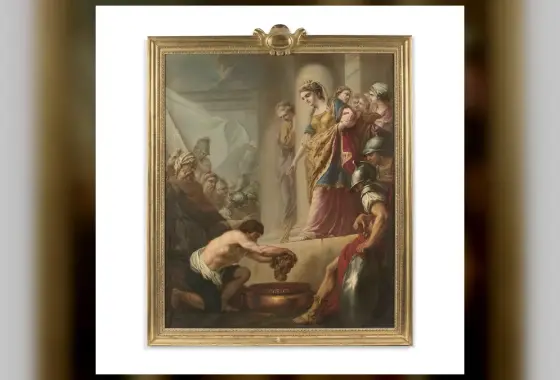
The Massagetae were a mounted nomadic people living on the broad plains east of the Caspian Sea, in western Central Asia. The Greek historian Herodotus, writing in the 5th century BC, describes them as a numerous, warlike people beyond the river Araxes, and the geographer Strabo later mentions them too.
Way of life
According to Herodotus, the Massagetae fought both on horseback and on foot with bows, spears and battle-axes, and used bronze and gold in their weapons and harness. They lived largely from herding and fishing and offered sacrifices to the Sun. Some of these details reflect a Greek point of view and are treated with caution.
Victory over Cyrus
The Massagetae are best remembered for their war with Cyrus the Great, founder of the Persian Empire. According to Herodotus, led by Queen Tomyris, they defeated the Persian army around 530 BC, and Cyrus died in the battle.
Origins
Their origins are debated. Turkish historiography counts the Massagetae, together with the Saka (Scythians), among the ancestors or relatives of the Turks, while international scholarship mostly describes them as one of the Scythian-Saka peoples. After the 2nd century BC they appear less and less in the sources and are thought to have merged into other steppe peoples.
The Massagetae as described by Strabo
Writing at the end of the 1st century BC, the geographer Strabo describes the Massagetae in Book 11 of his Geography as groups with different ways of life. According to him, some lived in the mountains, some on the plains and some in the marshes and islands formed by the rivers; those on the islands and in the marshes lived mainly on fish. This account suggests that the Massagetae were not a uniform community but a confederation of tribes spread over a wide area.
The Massagetae in the age of Alexander the Great
The Massagetae also appear during Alexander the Great's campaign in Central Asia. In 329–328 BC the Sogdian leader Spitamenes, who resisted the Macedonians in Sogdiana, fought alongside Massagetae horsemen. According to Arrian, after a final defeat the Massagetae, fearing that Alexander would attack them, killed Spitamenes and sent his head to Alexander. Curtius Rufus tells of his death differently; the difference shows how ancient sources could report the same event in different ways.
What does archaeology say?
The Khorezm Archaeological-Ethnographic Expedition, launched in 1937 by the Soviet archaeologist Sergei Tolstov, linked some settlements and burials south of the Aral Sea and along the lower Syr Darya to Saka and Massagetae groups. Horse harness, weapons and decoration in the animal style were found at these sites. However, it is difficult to tie the name of a people who left no written records firmly to a particular excavation site, so researchers treat these identifications with caution.
What happened in the region after the Massagetae?
After the 2nd century BC the Massagetae are mentioned less and less in the sources. The Dahae, whom Strabo counts among the Scythians, lived to the southwest of the same region; the Parni, a branch of the Dahae, founded the Parthian state under Arsaces in the mid-3rd century BC. In the same period the migration of the Yuezhi from the east redrew the political map of Central Asia and began the process that led to the rise of the Kushan Empire in the region.
Frequently asked questions
Where did the Massagetae live? On the steppes around the Caspian Sea and the Aral Sea, in parts of today’s Turkmenistan, Uzbekistan and western Kazakhstan.
Why are they important? For their victory over one of the most powerful rulers of the ancient world and for the legendary figure of Tomyris.
Sources and further reading
- Herodotus, Histories, Book I, 201–216.
- Strabo, Geography, Book XI.
- İbrahim Kafesoğlu, Türk Millî Kültürü.
- Encyclopaedia Iranica, “Massagetae”.
- Strabo, Geography, Book XI
- Arrian, Anabasis of Alexander, Book IV
- Encyclopaedia Iranica – "Massagetae" entry
People also ask
What was the Massagetae? The Massagetae were a nomadic people who lived on the steppes east of the Caspian Sea between roughly the 6th and 2nd centuries BC.



Leave a comment
Your email address will not be published. Required fields are marked *