



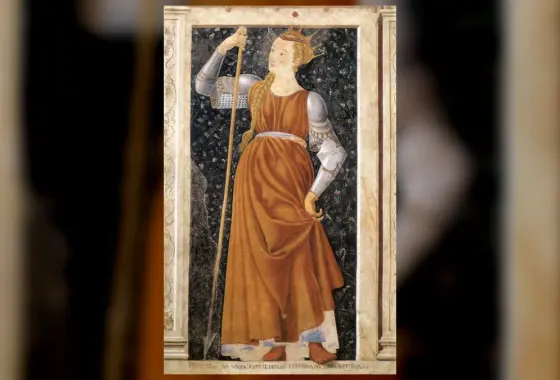
Tomyris is one of the most remarkable female rulers of antiquity. In the 6th century BC she led the nomadic Massagetae, who lived on the vast steppes east of the Caspian Sea. Most of what we know about her comes from the Histories of the Greek historian Herodotus, written in the 5th century BC.
Cyrus’s proposal and the war
According to Herodotus, Cyrus the Great, founder of the Persian Empire, first proposed marriage to Tomyris in order to take over the land of the Massagetae. Realising that he wanted her kingdom rather than her, Tomyris refused. Cyrus then prepared to cross the river Araxes, often identified with today’s Amu Darya, and invade.
Cyrus defeated the Massagetae vanguard with a ruse, and Tomyris’s son Spargapises, commander of the army, was taken prisoner. Herodotus says Spargapises took his own life in captivity. After her son’s death, Tomyris led all her forces against the Persians.
Victory
Herodotus describes the battle that followed as one of the fiercest of his time. The Massagetae won, much of the Persian army was destroyed and Cyrus died on the battlefield, an event usually dated to about 530 BC. Herodotus closes the story with a harsh, symbolic scene showing Tomyris keeping her vow, although other ancient writers give different accounts of Cyrus’s death.
Who were the Massagetae?
The Massagetae were a horse-riding pastoral people of the steppe. In Turkish historiography they are often counted, together with the Saka (Scythian) tribes, among the ancestors or relatives of the Turks, with historians such as İbrahim Kafesoğlu pointing to continuities in steppe culture. International scholarship mostly describes them as one of the Scythian-Saka peoples; their origins remain debated.
Tomyris in Turkish culture
In Türkiye and Central Asia, Tomyris is remembered as a brave ruler who defended her homeland. Her name is given to girls, and she has inspired poems, novels, plays and paintings; productions and monuments in Kazakhstan also bear her name. In European art she inspired many works, most famously Rubens’s painting “Tomyris and Cyrus”.
Bargaining and a ruse before the battle, according to Herodotus
In Herodotus's account, Tomyris sends a messenger to Cyrus offering two choices: the Massagetae will withdraw three days' march so that the Persian army can cross the river in peace, or the Persians will withdraw the same distance and let the Massagetae cross. Cyrus's adviser, the former Lydian king Croesus, recommends meeting the Massagetae on their own land and setting a trap for them. The Persians left plenty of food and wine in their camp, kept their weakest troops there and pulled back. The Massagetan vanguard, unused to wine, captured the camp and began to feast; the Persians then returned and routed them.
Massagetan life through the eyes of Herodotus
Herodotus ends his account of the war with a short section on how the Massagetae lived. According to him, they fought both on horseback and on foot, using bows, spears and a battle axe called the sagaris. They used bronze for weapon points and harness fittings and gold for headgear and belts, while iron and silver were unknown to them. They did not sow crops but lived on their herds and on fish, and drank milk. He also writes that the only god they worshipped was the Sun, to whom they sacrificed horses. These details also reflect how Greek eyes viewed the steppe peoples.
Different accounts of the death of Cyrus
Herodotus states openly that he had heard many accounts of the death of Cyrus and passed on the one he found most convincing. In Xenophon's Cyropaedia, Cyrus dies peacefully in his bed in old age in Persia, but that work is read more as a portrait of an ideal ruler than as a history book. Ctesias, for his part, writes that Cyrus died of a wound received while fighting another steppe people. What is certain is that Cyrus died on a campaign on the north-eastern frontier and was buried in the tomb at Pasargadae; the role of Tomyris rests largely on Herodotus.
Frequently asked questions
Did Tomyris really exist? Herodotus is the main source. Many historians accept her as a historical figure, while considering some details of the story legendary.
How did Cyrus die? According to Herodotus, in battle against the Massagetae. Some ancient authors, such as Xenophon, give a different account.
Sources and further reading
- Herodotus, Histories, Book I, 201–216.
- İbrahim Kafesoğlu, Türk Millî Kültürü (Turkish National Culture), Ötüken.
- Encyclopaedia Britannica, “Tomyris” and “Massagetae”.
- Encyclopaedia Iranica, “Massagetae”.
- Herodotus, The Histories, Book I, chapters 205–216
- Encyclopaedia Iranica – "Cyrus iii. Cyrus II the Great"
People also ask
Who was Tomyris? Tomyris was queen of the Massagetae, a nomadic people of the Central Asian steppe, in the 6th century BC.



Leave a comment
Your email address will not be published. Required fields are marked *