



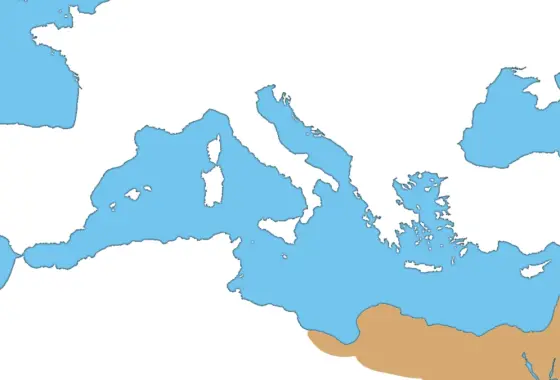
The word Mamluk means "owned" in Arabic. The Mamluks were elite soldiers brought at a young age from various regions, above all the Kipchak steppe, and put through rigorous military training. In 1250 they seized power in Egypt and founded a state that ruled Egypt and Syria for more than two and a half centuries. Most of the rulers of the state's first period (the Bahri Mamluks) were Kipchak Turks.
A seemingly unstoppable force
By the mid-13th century, Mongol armies had conquered much of Asia. The fall of Baghdad in 1258 shook the Islamic world to its core; the Mongols then advanced into Syria and took Aleppo and Damascus. Egypt was next.
Ain Jalut, 1260
On 3 September 1260, the Mamluk army under Sultan Qutuz, with Baybars leading the vanguard, met the Mongol army at Ain Jalut in Palestine. The Mamluks skilfully used the classic steppe tactic of feigned retreat to draw the enemy onto favourable ground and won a decisive victory. The battle is regarded as the first major defeat the Mongols suffered in this region. The victory halted the Mongol advance towards Egypt and North Africa, and Cairo rose as the new cultural and scholarly centre of the Islamic world.
Sultan Baybars
Baybars, who became sultan soon after Ain Jalut (reigned 1260–1277), is remembered as the true founder of the Mamluk state. He created a fast communication network (the barid) of carrier pigeons and mounted couriers between Cairo and Syria, strengthened the army and navy and rebuilt Egypt. His life became a heroic epic told for centuries in Arabic folk literature.
Architecture that adorns Cairo
Mamluk sultans and emirs filled Cairo with mosques, madrasas, hospitals and fountains. The Mosque-Madrasa of Sultan Hasan, the Qalawun complex and elegant minarets are among the grandest buildings of Historic Cairo, today a UNESCO World Heritage Site.
Afterwards
From the late 14th century the Mamluk state passed into the hands of the Circassian Mamluks of Caucasian origin, and it came to an end in 1517 when the Ottoman Sultan Selim I conquered Egypt.
How did the Mongols reach Syria?
Two years before Ayn Jalut, in 1258, the Mongol army under Hülegü captured Baghdad and ended the Abbasid caliphate's presence in Baghdad. Then, at the beginning of 1260, Aleppo was besieged and taken; Damascus also surrendered shortly afterwards without resistance. This rapid advance made it clear that the Mamluk regime in Egypt was the next target.
Just at this moment an unexpected development occurred: the Great Khan Möngke had died in 1259. When the news arrived, Hülegü withdrew east with most of his army and left the commander Kitbuqa in Syria with a relatively small force. The Mamluks seized this opportunity. Sultan Qutuz rejected the Mongol envoys' demand for surrender and led his army north to Ayn Jalut, in present-day Palestinian lands.
After the battle: the Mamluk–Ilkhanid struggle
Ayn Jalut was not the end of the conflict between the Mongols and the Mamluks but its beginning. The Ilkhanate founded by Hülegü and the Mamluks clashed repeatedly over Syria during the following half century. Sultan Qalawun won the Second Battle of Homs in 1281; in 1303 the Mamluks prevailed again at Marj al-Saffar.
Historian Reuven Amitai-Preiss's comprehensive study of the Mamluk–Ilkhanid war emphasises that Ayn Jalut was won militarily not against a huge Mongol army but against a limited force left in Syria; its psychological and political impact, however, was enormous. The victory strengthened the legitimacy of the Mamluks and laid the groundwork for Egypt to remain one of the important centres of the Islamic world for two and a half centuries.
Frequently asked questions
Why is Ain Jalut so important?
As the first major battle in which the Mongol advance was stopped in the west, and for preserving the cultural heritage of Egypt and North Africa, it is considered one of the turning points of world history.
What language did the Mamluks speak among themselves?
In the early period, Kipchak Turkic was widespread among the Mamluk military class; Arabic–Kipchak dictionaries and grammars were even written at the time.
Sources and further reading
- Encyclopaedia Britannica – Battle of Ain Jalut
- Reuven Amitai-Preiss, Mongols and Mamluks: The Mamluk-Ilkhanid War, 1260–1281 (Cambridge University Press, 1995)
People also ask
What was the Mamluk Sultanate? The Mamluk Sultanate was founded in Egypt in 1250 when the slave soldiers (mamluks) of the Ayyubids seized power.
When was the Mamluk Sultanate founded? Founded: 1250, Cairo.
When did the Mamluk Sultanate end? End: 1517, Battle of Ridaniya.






Leave a comment
Your email address will not be published. Required fields are marked *