



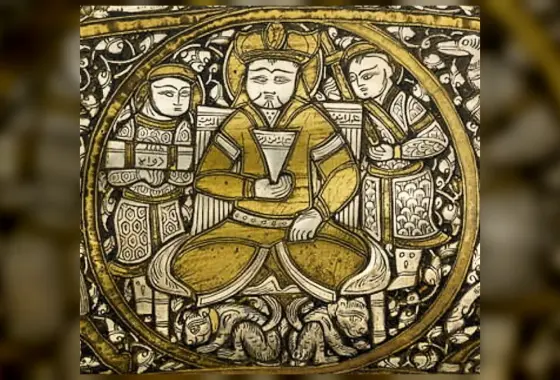
Baybars was born in the 1220s on the Kipchak steppe north of the Black Sea. Captured during the Mongol invasions, he was sold as a slave and joined the mamluk (slave-soldier) regiments of the Ayyubid sultan al-Salih Ayyub, where his courage and ability soon made him a commander.
Ayn Jalut
When the Mongols took Baghdad in 1258 and advanced into Syria, the Mamluk sultan Qutuz went out to meet them. On 3 September 1260 at Ayn Jalut in Palestine the Mongol army was defeated, with Baybars playing a key role as commander of the vanguard. The victory halted the Mongol advance west.
His sultanate
On the way back to Cairo Qutuz was killed and Baybars was proclaimed sultan. In 1261 he installed a member of the Abbasid family who had fled Baghdad as caliph in Cairo, reviving the caliphate in Egypt. He took Crusader strongholds such as Caesarea, Arsuf and Safed, and in 1268 conquered Antioch. He set up a fast postal system (barid) between Cairo and Damascus.
The Anatolian campaign and death
In 1277 he entered Anatolia, defeated Mongol and Seljuk forces at Elbistan and advanced as far as Kayseri. He died in Damascus the same year and was buried in the city’s al-Zahiriyya Madrasa.
The alliance with the Golden Horde
One of the most striking steps in Baybars's foreign policy was his rapprochement with Berke Khan, ruler of the Golden Horde. Berke had become a Muslim and was in a territorial dispute with Hülegü, the Ilkhanid ruler of Iran, over the Caucasus. From the early 1260s Baybars exchanged envoys and letters with Berke. This alliance kept the Ilkhanids busy on two fronts. It also helped keep open the slave-trade route that brought young Kipchaks from north of the Black Sea into the Mamluk army.
The Crusader castles and Krak des Chevaliers (1271)
Throughout his reign Baybars steadily reduced the Crusader presence on the Syrian coast. After Caesarea, Arsuf, Safed and Antioch, in 1271 he took the surrender of Krak des Chevaliers, held by the Knights Hospitaller and regarded as one of the strongest castles of the Middle Ages. In the same years he also brought the Nizari Ismaili castles in the Syrian mountains under his control. After these campaigns the Crusaders held only a few coastal cities, such as Acre, Tripoli and Tyre.
His buildings in Cairo and Damascus
Baybars was not only a soldier but also a great builder. The Mosque of al-Zahir Baybars, built in Cairo between 1267 and 1269, is one of the largest mosques of the Mamluk period; in later centuries the building was also used as a barracks and a depot, and it has been restored in recent times. The Zahiriyya building in Damascus, where he was buried, was completed after his death by his son. Centuries later this building housed the Zahiriyya Library, founded in the 19th century and holding one of Syria's most important manuscript collections.
Baybars in popular storytelling
Baybars's life became the subject of the long popular epic Sirat Baybars (Sirat al-Zahir Baybars), told for centuries in the coffeehouses of the Arab world. In this narrative the sultan appears as a hero who rose from captivity and protected the people against oppressors. Most of the events in the epic reflect popular imagination rather than historical fact. Even so, the fact that Baybars came from the Kipchak steppe as a slave and became sultan has kept his story appealing across generations.
Frequently asked questions
What does “mamluk” mean? In Arabic it means “owned”, referring to men bought and trained as soldiers. In Egypt these soldiers founded a state that lasted from 1250 to 1517.
Sources and further reading
- Türkiye Diyanet Vakfı İslâm Ansiklopedisi, “Baybars I” and “Aynicâlût Savaşı”.
- Ibn Abd al-Zahir, al-Rawd al-zahir fi sirat al-Malik al-Zahir.
- Encyclopaedia Britannica, “Baybars I”.
- Peter Thorau – The Lion of Egypt: Sultan Baybars I and the Near East in the Thirteenth Century (1992)
- UNESCO World Heritage Centre – Crac des Chevaliers and Qal’at Salah El-Din, inscribed 2006
People also ask
Who was Baybars? Baybars was a Kipchak Turk brought to Egypt as a slave who rose to become a Mamluk sultan.
When did Baybars reign? Reign: 1260 – 1277.
When did Baybars die? Died: July 1277, Damascus.




Leave a comment
Your email address will not be published. Required fields are marked *