



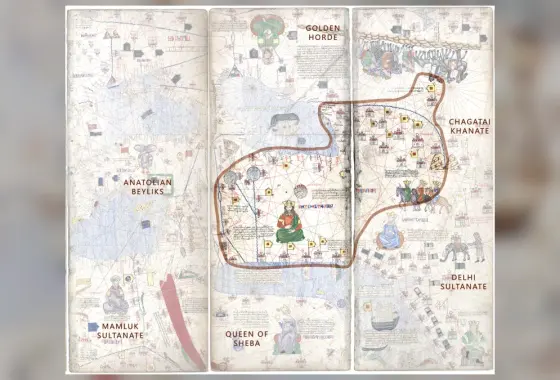
The great khan Möngke charged his brother Hülegü with conquering Iran and the lands to its west. Hülegü took Alamut, centre of the Nizari Ismailis of Iran, in 1256 and Baghdad in 1258, having the Abbasid caliph al-Musta‘sim killed. Hülegü and his successors used the title “Ilkhan”, expressing subordination to the great khan.
The Mamluks and the Golden Horde
The Ilkhanate’s westward advance was halted by defeat at the hands of the Mamluks at Ayn Jalut in 1260. They also fought long wars with the khans of the Golden Horde, who had become Muslim, over disputes in the Caucasus. The Seljuk Sultanate of Rum, subject to the Mongols since Köse Dağ in 1243, remained under the Ilkhanate.
Ghazan Khan
Ghazan Khan (1295–1304) became a Muslim on taking the throne, and Islam became the state religion. He carried out sweeping reforms of taxation, weights and measures and the postal system. His vizier Rashid al-Din wrote the Jami al-Tawarikh, a great work on world history and the Turco-Mongol tribes.
Science and architecture
With Hülegü’s support Nasir al-Din al-Tusi founded one of the most advanced observatories of its time at Maragheh in 1259. The giant domed mausoleum built by Öljeitü at Soltaniyeh is on the UNESCO World Heritage List.
End
The last strong ruler, Abu Sa‘id, died without an heir in 1335. The Ilkhanid lands were divided among local dynasties such as the Jalayirids, the Chobanids and the Muzaffarids, while in Anatolia the Eretnid principality emerged.
Origins and the early years
The foundation of the Ilkhanate was laid when the Mongol Empire split into great khanates after Genghis Khan. The Great Khan Möngke gave his brother Hulagu the task of putting Iran and the lands to its west in order. Hulagu’s army eliminated the Nizari Ismaili fortresses at Alamut and in 1258 took Baghdad, effectively ending the centuries-old Abbasid caliphate. This event is remembered as one of the most shattering turning points in Islamic history, and the sources discuss at length the destruction of the city’s libraries and population.
After Möngke’s death, Hulagu did not return east to Mongol internal politics; he stayed in Iran and built his own state. The title “Ilkhan” designated a ruler subordinate to the Great Khan, but over time the Ilkhanids acted as effectively independent. Maragha, Tabriz and Sultaniyya were used in turn as capitals. In the early period the rulers continued the Mongol nomadic tradition and showed closeness to beliefs such as Buddhism, Nestorian Christianity and Shamanism. The presence of people close to the Christian faith in Hulagu’s family is also noted in the sources, which helps explain Ilkhanid efforts to seek diplomatic contact with the Crusaders and European powers.
Anatolia and relations with neighbours
The Ilkhanid policy in Anatolia was decisive for the region’s Turkish history. After the Battle of Köse Dağ in 1243 the Anatolian Seljuk state had become subject to the Mongols; under the Ilkhanids this dependence became more systematic. Mongol governors and military units were sent to Anatolia, taxes were collected, and Seljuk sultans reigned effectively under Ilkhanid supervision. This pressure caused movement among the Turkmen tribes and frontier beyliks in Anatolia; over time, the strengthening of beyliks such as the Karamanids coincided with periods when Ilkhanid authority weakened.
Rivalry with the Mamluk state in the west was central to Ilkhanid foreign policy. At the Battle of Ayn Jalut in 1260 the Mongol advance was halted, and the struggle for control of Syria continued for many years. In the north, conflict with the Golden Horde over the Caucasus never ended. Thus the Ilkhanids had to fight on two fronts, west and north. This drained the state’s resources and aggravated problems in domestic politics. Even so, Ilkhanid diplomacy had a network wide enough to exchange envoys with European kingdoms and the papacy; these contacts show how many-sided international relations of the period were.
Ghazan’s reforms, science and collapse
Ghazan Khan’s accession in 1295 is a turning point in Ilkhanid history. He became a Muslim, made Islam the state religion, and then embarked on a broad reform programme. The tax system was reorganised, weights and measures standardised, and the postal and communications network strengthened. The aim was to limit the pressure of the nomadic Mongol aristocracy on the peasant and urban population and to stabilise state revenues. His vizier Rashid al-Din Fazlullah wrote his great historical work, the Jami al-Tawarikh, in this period; it is among the most important sources on Mongol, Turkic and world history.
The Ilkhanids also made significant contributions in science and architecture. The observatory established by Nasir al-Din al-Tusi at Maragha became one of the most advanced astronomical centres of its time. The domed mausoleum Öljeitü had built at Sultaniyya is among the striking examples of Islamic architecture. However, when Abu Said died childless in 1335, the dynasty fell into crisis. With no heir to the throne, regional emirs gained power and the state soon split into small dynasties such as the Jalayirids, Chobanids and Muzaffarids. This fragmentation later paved the way for Timur’s conquest of the region. Historians assess the Ilkhanids by considering both their destructive conquests and their cultural and administrative contributions together.
Religion, society and the Mongol-Iranian synthesis in rule
Ilkhanid society had a mixed structure in which the Mongol nomadic aristocracy lived together with the settled Iranian and Turkic population. While Mongol commanders held the upper levels of administration, experienced Iranian viziers and scribes served in areas such as tax collection, correspondence and court administration. This division of labour became even more pronounced after Ghazan Khan’s reforms. The khans did not entirely abandon Mongol customs; they kept the framework of the yasa, the rules attributed to Genghis Khan, but also brought Islamic law and local traditions into practice, creating a hybrid legal order.
Religious diversity was also a feature of the Ilkhanid world. Muslims, Christians, Jews and Buddhists were subjects of the same state. The adoption of Islam as the official religion after Ghazan did not completely end this diversity, but it shifted the balance of power in favour of the Muslim majority. Historians and travellers of the period describe in detail the lively trade in the cities, the great markets of Tabriz and the flow of goods between East and West. In this respect the Ilkhanids were an important link in the wide trade network known as the Mongol peace.
Sources and further reading
- Rashid al-Din, Jami al-Tawarikh.
- Türkiye Diyanet Vakfı İslâm Ansiklopedisi, “İlhanlılar”.
- UNESCO World Heritage, “Soltaniyeh”.
- Türkiye Diyanet Foundation Encyclopaedia of Islam – “İlhanlılar” entry
- Rashid al-Din Fazlullah – Jami al-Tawarikh
- Encyclopaedia Britannica – Ilkhanate
- Türkiye Diyanet Foundation Encyclopaedia of Islam – “İlhanlılar” entry
- Encyclopaedia Britannica – Ilkhanate
People also ask
What was the Ilkhanate? The Ilkhanate was founded in Iran in 1256 by Hülegü, a grandson of Genghis Khan.
When was the Ilkhanate founded? Founded: 1256, Hülegü Khan.
What was the Ilkhanate’s capital? Capitals: Maragheh, Tabriz, Soltaniyeh.
When did the Ilkhanate end? End: 1335, death of Abu Sa‘id.

Leave a comment
Your email address will not be published. Required fields are marked *