



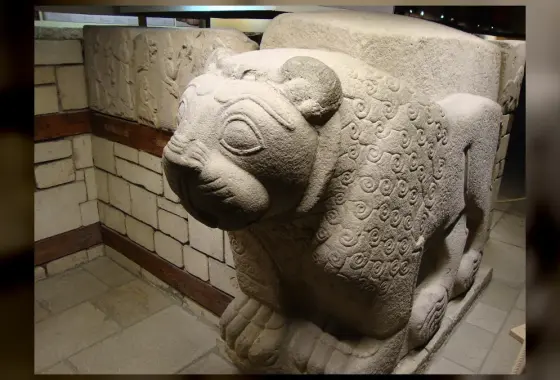
The Hittites appeared in Anatolia in the early 2nd millennium BC and adopted many elements of the native Hattian culture. In the 17th century BC the kingdom made Hattusa its capital. King Mursili I advanced as far as Mesopotamia and sacked Babylon around 1595 BC.
The imperial period
In the 14th century BC King Suppiluliuma I defeated the kingdom of Mitanni and brought northern Syria under Hittite rule. The Hittites became one of the great powers of the Near East, alongside Egypt and Babylon.
Kadesh and peace
Around 1274 BC King Muwatalli II fought Pharaoh Ramses II of Egypt at Kadesh in today’s Syria; the battle was indecisive. The treaty signed around 1259 BC between Hattusili III and Ramses II is one of the earliest peace treaties whose text survives; the clay tablet copy found at Hattusa is in the Istanbul Archaeology Museums.
Religion and culture
The Hittites are called the “people of a thousand gods” because they added the gods of conquered lands to their own pantheon. The open-air sanctuary of Yazılıkaya near Hattusa bears reliefs of gods. Tens of thousands of cuneiform tablets found at Hattusa became readable after the Czech scholar Bedřich Hrozný deciphered Hittite in 1915. Hattusa was added to the UNESCO World Heritage List in 1986, and the Boğazköy tablets to UNESCO’s Memory of the World Register in 2001.
End
The Hittite Empire collapsed around 1200 BC during the Late Bronze Age collapse that affected many states of the eastern Mediterranean, and Hattusa was abandoned. “Neo-Hittite” city-states such as Carchemish survived for several more centuries in south-eastern Anatolia and northern Syria.
Hattusa and the structure of the state
The Hittite kingdom was a centralized state ruled from its capital Hattusa. The king was also regarded as chief priest and answerable to the gods of the land. The queen held the title “Tawananna” and had an important role in religious duties. A council of nobles, the “pankus”, advised the king and in some cases judged the king’s rights.
The edict issued by King Telipinu in the late 16th century BC set out rules of succession and tried to stop murders inside the dynasty. The remains of Hattusa help us understand this system of government: structures such as the Lion Gate, the King’s Gate and Yerkapı show the city’s walls and sacred areas. The city was built on a rocky slope and enclosed by a broad wall that runs from north to south.
Law, society and economy
The surviving Hittite Laws are a collection of about two hundred articles. They cover offences against persons, property disputes, marriage and inheritance. The principle of compensation prevails: in many offences, payment in goods or silver is set in place of the death penalty. Differences between copies of the text show that some articles were softened over time, meaning penalties were reduced.
The economy rested on barley and wheat farming and on raising sheep and cattle. Anatolia’s copper and silver deposits were an important source of income for the state. Before the Hittites, at the beginning of the 2nd millennium BC, Assyrian trading colonies at Kültepe had been founded and had brought a tradition of writing and record keeping to the region. The idea that “the Hittites began the Iron Age” is widespread, yet iron was rare and valuable in this period, and the view that the Hittites held a monopoly on iron weapons is disputed today.
Language, writing and tablets
Hittite is the oldest attested written Indo-European language. The Hittites themselves called their language “Nesili”, that is, the language of the city of Nesa (Kanesh). The tens of thousands of cuneiform tablets found in the state archive at Hattusa cover a wide range, from royal annals and treaties to prayers, ritual texts and letters. Besides Hittite, the texts also show Akkadian, Hattic, Hurrian and Luwian.
Akkadian was the international language of diplomacy of the age and was used in correspondence between states. On official seals and monumental inscriptions, Luwian hieroglyphs were preferred. Myths such as those of Telepinu and Illuyanka help us understand the belief world of the period. Bedřich Hrozný’s demonstration in 1915 that Hittite belonged to the Indo-European language family is regarded as one of the most important discoveries in ancient linguistics.
The army, chariots and diplomacy
The strength of the Hittite army rested on light, mobile war chariots. Egyptian chariots carried two men, while Hittite chariots held three: a driver, a spearman and a shield bearer. The horse-training manual written by the Mitannian trainer Kikkuli survives among the Hattusa tablets and shows how important the horse was for the army. The chariot numbers given by Egyptian sources for Kadesh may be exaggerated.
Besides war, the Hittites also used diplomacy well. Vassal treaties made with defeated kings contained mutual obligations, tribute and promises of aid, and treaties were confirmed by oaths before the gods. The peace treaty with Egypt is the best-known example of this tradition, and a copy of it is displayed at the United Nations building today.
The abandonment of Hattusa and the Late Hittite states
The fall of the Hittite capital did not wipe out Hittite culture entirely. In southeastern Anatolia and northern Syria, “Late Hittite” or “Neo-Hittite” kingdoms such as Carchemish, Malatya and Hama kept going for about five centuries, using the Luwian language and hieroglyphic script. These city states were absorbed into the Assyrian empire in the 8th century BC; Carchemish fell in 717 BC.
The rediscovery of Hattusa goes back to the 19th century. After European travelers first described the ruins at Boğazköy, tablets were found in the excavations that Hugo Winckler began in 1906, and the Hittite state returned to scholarly attention. Excavations continue today through work led by the German Archaeological Institute. Over this long period, Hittite history has been rebuilt by reading Egyptian and Mesopotamian sources together with the Hattusa archive.
The Hittites also hold a lasting importance for modern Türkiye: Hittite works displayed in the Museum of Anatolian Civilizations in Ankara show visitors that these lands hosted great states long before the Turks, and that Anatolia’s written history reaches far back.
Sources and further reading
- UNESCO World Heritage, “Hattusha: the Hittite Capital”.
- Ekrem Akurgal, Ancient Civilizations and Ruins of Turkey.
- Encyclopaedia Britannica, “Hittite”.
- Trevor Bryce – The Kingdom of the Hittites (Oxford University Press, 2005).
- Türkiye Diyanet Foundation Encyclopaedia of Islam and literature on Anatolian civilizations.
- UNESCO World Heritage, “Hattusha: the Hittite Capital”.
People also ask
What was the Hittites? The Hittites built a powerful kingdom and empire in central Anatolia from the 17th century to the early 12th century BC.
What was the Hittites’s capital? Capital: Hattusa (Boğazkale, Çorum).
When did the Hittites end? End: c. 1180 BC, Late Bronze Age collapse.



Leave a comment
Your email address will not be published. Required fields are marked *