



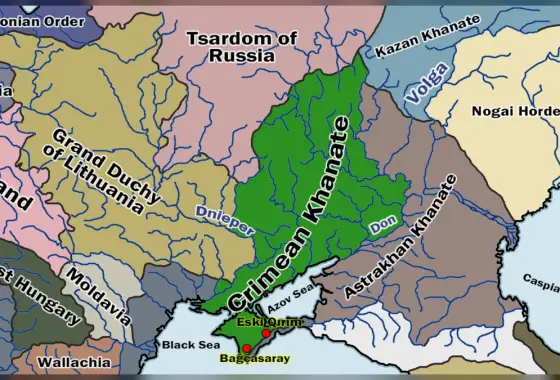
The Crimean Khanate was founded in the Crimean peninsula and the steppes north of the Black Sea during the break-up of the Golden Horde in the 15th century. Its founder was Hacı Giray, a descendant of Genghis Khan’s son Jochi. Most of its population were Crimean Tatars speaking a Kipchak Turkic language.
Ottoman protection
In 1475 the Ottoman commander Gedik Ahmed Pasha took the Genoese colony of Kaffa on the Crimean coast. Hacı Giray’s son Meñli Giray accepted Ottoman protection. From then on the khans were confirmed by the Ottoman sultan, and the Giray dynasty was so respected that it was seen as the family that could take the throne if the Ottoman line died out.
Military power
Crimean cavalry played an important role in Ottoman campaigns in Europe and Iran. The khanate was in constant conflict with Muscovy and Poland–Lithuania to the north; in 1571 Devlet Giray burned Moscow. Crimean raids also caused heavy losses and the taking of captives in neighbouring regions.
Bakhchisaray and culture
The Khan’s Palace in the capital Bakhchisaray is the khanate’s best-known building. Crimea was one of the important northern centres of Turkic-Islamic culture, and khans such as the poet Gazi Giray were also men of letters.
End
Under the Treaty of Küçük Kaynarca, signed after the Russo-Turkish War of 1768–1774, the Crimean Khanate was separated from the Ottomans and declared independent, while the caliph’s religious authority was recognised. Russia annexed Crimea in 1783 under Catherine II, one of the first major cases of lands inhabited by a Muslim people being permanently lost to the Ottomans.
Society and economy
The population of the Crimean Khanate consisted of Crimean Tatars, the nomadic Nogais of the steppe, and Greek, Armenian, Karaite and Jewish communities in the coastal towns. Great clan families such as the Shirin, Barin, Argin and Kipchak played an important role among the khan’s nobility, sharing in government as advisers and commanders.
A large part of the economy rested on herding and farming. Raids on neighbouring regions and the slave trade were also among the khanate’s sources of income. Caffa became one of the most important trading and slave markets on the Black Sea, from which people and goods were sold to Ottoman lands and the Mediterranean world.
The struggle with Moscow and Poland
In the sixteenth century Crimea pursued a policy that sought to balance Muscovy and Poland-Lithuania. The khans sometimes allied with Moscow and sometimes with Poland; protecting the Kazan and Astrakhan khanates against Moscow was also among Crimea’s priorities. In 1521 a raid reached the outskirts of Moscow.
In 1571 Devlet Giray entered Moscow and much of the city burned. The following year he was defeated by the Russian army at the Battle of Molodi, and the hope of recovering Kazan and Astrakhan was not realised. After this defeat Moscow’s expansion southward continued slowly but steadily.
Decline and Küçük Kaynarca
In the seventeenth and eighteenth centuries, as Ottoman power weakened, Crimea’s support was shaken too. Russia’s advance into Azov and the Ukrainian steppe encircled the khanate. During the Ottoman–Russian war of 1768–1774, Russian armies entered Crimea; under the Treaty of Küçük Kaynarca in 1774 the khanate was separated politically from the Ottomans and declared “independent”, although the sultan continued to be recognised as caliph in religious terms.
In practice this arrangement increased Russian influence. Şahin Giray, backed by Russia, became khan; his reforms provoked a reaction in part of society and revolts broke out. As the political structure of the khanate came apart, Russian intervention deepened.
The 1783 annexation and the later history of the Crimean Tatars
In 1783 Russia declared the annexation of Crimea and the Crimean Khanate came to an end. After the annexation a large part of the Crimean Tatars migrated to Ottoman lands in successive waves; these migrations, which continued through the nineteenth century, contributed to the formation of a large community of Crimean origin in present-day Türkiye.
Another heavy turning point in the history of the Crimean Tatars was the mass deportation of the community to Central Asia by the Soviet authorities in 1944. A part of the Tatars began returning to Crimea from the late 1980s. Today the legacy of the khanate is kept alive through the Khan’s Palace in Bakhchisaray, the language and cultural traditions.
Government and legal order
The khanate’s government consisted of the khan, the divan and the nobles. Beside the khan stood high officials called the qalga and the nureddin, usually chosen from among members of the dynasty. Important decisions were taken at meetings attended by nobles and religious men.
The legal order combined Islamic law with customary practice. In the eastern and northern parts of the khanate the Nogai tribes continued to live according to their own traditions. The fact that khans took the throne with the approval of the Ottoman sultan and were sometimes deposed from Istanbul was an important factor in internal political balances.
Religion, education and cultural life
In Crimea, madrasas, lodges and mosques shaped the religious and educational life of society. Cities such as Bakhchisaray, Karasubazar and Gözleve stood out as cultural centres of the region. Literature, music and calligraphy were patronised at the khan’s court, and some khans wrote poetry.
Crimean Tatar Turkic served as a bridge between Ottoman Turkish and Kipchak Turkic. Armenian and Greek communities also maintained their own churches and schools. This multi-religious and multilingual structure was one of the important features of the khanate’s social makeup.
The nature of the relationship with the Ottomans
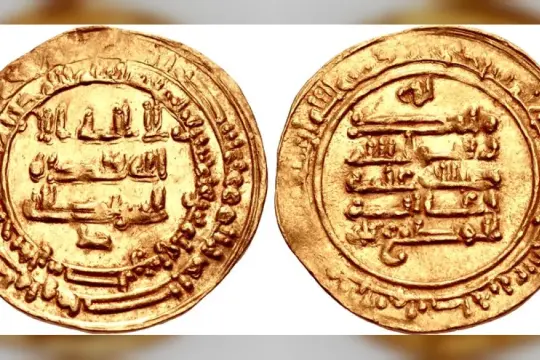
Crimea’s relationship with the Ottomans cannot be described either as complete dependence or as an alliance of equals. The khan sent cavalry on Ottoman campaigns, and in return the Ottomans gave the khanate financial support and political protection. The reading of the Friday sermon and the minting of coins in the khans’ names continued as symbols of sovereignty.
However, the Ottoman power to appoint and depose khans sometimes caused reaction inside Crimea. The Giray dynasty tried to preserve its own idea of independence. This dual structure created a constant field of tension and bargaining in the khanate’s political history.
Sources and further reading
- Türkiye Diyanet Vakfı İslâm Ansiklopedisi, “Kırım Hanlığı”.
- Halil İnalcık, studies on the Crimean Khanate.
- Encyclopaedia Britannica, “Crimean Khanate”.
- Alan W. Fisher – The Crimean Tatars
- Halil İnalcık – “Giray” and “Ḳirim” entries, Encyclopaedia of Islam
- Türkiye Diyanet Foundation Encyclopaedia of Islam – “Kırım Hanlığı” entry
- Alan W. Fisher – The Crimean Tatars
- Halil İnalcık – “Giray” and “Ḳirim” entries, Encyclopaedia of Islam
- Türkiye Diyanet Foundation Encyclopaedia of Islam – “Kırım Hanlığı” entry
People also ask
What was the Crimean Khanate? The Crimean Khanate was founded around 1441, during the break-up of the Golden Horde, by Hacı Giray, a descendant of Genghis Khan.
When was the Crimean Khanate founded? Founded: c. 1441, Hacı Giray.
What was the Crimean Khanate’s capital? Capital: Bakhchisaray.
When did the Crimean Khanate end? End: 1783, annexation by Russia.

Leave a comment
Your email address will not be published. Required fields are marked *