



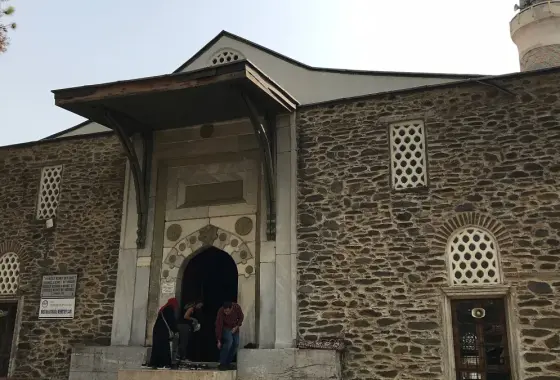
The Aydınid principality was founded by Mehmed Bey, one of the Germiyanids’ commanders. Making Birgi his centre, Mehmed Bey took the Küçük Menderes basin and the upper castle of Smyrna (Kadifekale).
Umur Bey and naval campaigns
Mehmed Bey’s son Umur Bey took the harbour castle of Smyrna and built a powerful fleet there. He raided the Aegean islands, the coasts of Greece and the Balkans, and backed John Kantakouzenos in the Byzantine civil war. Umur Bey’s life and campaigns are recounted in Enveri’s Düsturname.
The Smyrniote Crusade
Aydınid activity in the Aegean provoked a reaction in Europe. A crusading league of the Papacy, Venice, Cyprus and the Knights of Rhodes captured the harbour castle of Smyrna in 1344. Umur Bey was killed in 1348 trying to retake it.
Architecture and the end
The Great Mosque of Birgi (1312) and the İsa Bey Mosque in Selçuk (1375) are important examples of the architecture of the principalities period. Bayezid I annexed the principality in 1390; although Timur restored it in 1402, after the long struggle of Cüneyd Bey it was finally annexed by the Ottomans under Murad II in 1426.
The Birth of the Principalities and the Place of the Aydınids
The weakening of the Anatolian Seljuk State in the late 13th century and the erosion of central authority by Mongol domination led to the emergence of frontier principalities in western Anatolia. Karesi, Saruhan, Menteşe, Germiyan and the Aydınids were the main ones. Byzantine power on the Aegean coast had weakened, and the Turkmen lords on the frontier found opportunities to expand both on land and by sea.
The Aydınids were the principality of this region most closely tied to the sea. They bordered Saruhan to the north, Menteşe to the south and Germiyan to the east; the fertile lands between the Küçük Menderes and Gediz basins and the Aegean ports gave the principality both an agricultural and a commercial advantage. While the political centre remained at Birgi, maritime trade and naval activity were carried out from the coastal ports, especially around İzmir and Ayasuluk (Selçuk).
Birgi: Life in a Principality’s Capital
Birgi was a small but lively town on the slopes of Bozdağ, surrounded by streams. Its Great Mosque, dated 1312, with its woodwork, mihrab and tiles, is among the most striking examples of art from the principalities period. The town was also a centre of learning; madrasas and lodges gave instruction here.
The Moroccan traveller Ibn Battuta visited Birgi in the first half of the 14th century and described being hosted by the ruler. In his travel account he describes Birgi as a large and beautiful city and reports the attention the ruler showed him. This account is one of the few contemporary testimonies showing that the Aydınids built an important court culture before both locals and visiting foreigners. Later buildings in Birgi, such as the Çakırağa Mansion, show that the town has also been preserved as a historic fabric.
Maritime Trade, the Fleet and the Mediterranean World
The strength of the Aydınids rested not only on warships but also on trade. The ports of Ayasuluk and İzmir were the gateways through which relations with Venetian and Genoese merchants were conducted. Grapes, figs, cotton and other agricultural products were exported from the principality’s lands, while cloth and various manufactured goods came in from Europe. Trade agreements and port taxes made up an important part of the principality’s revenue.
The fleet, in turn, was used both for raids and to protect trade. Raids toward the Aegean islands and Anatolian coasts provoked a reaction from the Latin and Byzantine powers in the region. For this reason the Aydınids are treated in the Mediterranean world not simply as a Turkish principality but as a naval power that had both alliances and rivalries with Venice, the Knights of Rhodes and Byzantium.
The Düstûrnâme-i Enverî and Historical Writing
The Turkish source that introduces the Aydınids best is Enverî’s Düstûrnâme, written in the middle of the 15th century. The work narrates Umur Bey’s campaigns in a poetic style and is also important as one of the first historical verse narratives written in Turkish. However, because Enverî wrote more than a century after the events, historical reality and legendary elements are intertwined in the work.
For this reason historians use the Düstûrnâme by comparing it with the account of John Kantakouzenos in Byzantine sources, with Latin historians and with papal documents. Umur Bey’s life thus becomes a field of research where sources written in different languages and from different viewpoints intersect. The story of the Aydınids also shows that the Aegean was a sea shared not by one nation but by many societies living together.
The Aydınids and the Ottomans
The relationship between the Aydınids and the Ottoman principality from the mid-14th century was a mixture of diplomacy and rivalry. Umur Bey’s friendship with the Byzantine emperor John VI Kantakouzenos was an important element shaping the balance of power in the region; Kantakouzenos had also formed an alliance with the Ottoman ruler Orhan and given him his daughter. This produced a complex network in which the western Anatolian principalities became involved in Byzantine struggles for the throne.
After Umur Bey’s death the Aydınids’ naval power weakened and the principality came under pressure from its neighbours. In 1390 Bayezid I annexed the principalities and Aydın lands joined the Ottomans. When Timur returned the principalities’ lands after the Battle of Ankara, the Aydınids briefly re-emerged, but with the Ottoman recovery this period ended definitively in 1426.
Aydınid Traces Today
Aydınid traces can be seen today around Birgi, Selçuk, Aydın, Tire and İzmir. The Great Mosque of Birgi, the İsa Bey Mosque in Selçuk and the buildings around Ayasuluk Castle reflect the architectural taste of the period. With its reused columns and stonework, the İsa Bey Mosque shows how the remains of ancient Ephesus and principality architecture are intertwined.
These places are not only touristic but also examples that show different layers of history together. Seeing the ancient city of Ephesus, the Basilica of St John, the İsa Bey Mosque and Ayasuluk Castle together while travelling in the region makes it easier to understand how the Aegean’s ancient, Christian and Turkish-Islamic periods built up on top of each other.
The General Importance of the Principalities
The Anatolian principalities show the regional diversity of the post-Seljuk period. Each developed in a different geography and under different economic and political conditions; the Aydınids stood out for seafaring, Karesi and the Ottomans for frontier warfare, and Germiyan for its position on the trade routes of the interior. The adoption of Turkish as an official and literary language in the principalities was also important for strengthening the tradition of written Turkish in Anatolia.
The Ottomans’ eventual inheritance of this rich legacy meant that part of the Ottoman state tradition drew on these regional experiences. For this reason, understanding the Aydınids helps us understand not just a small principality but the broad historical transformation of Anatolia in the 14th century.
Sources and further reading
- Türkiye Diyanet Vakfı İslâm Ansiklopedisi, “Aydınoğulları” and “Umur Bey”.
- Enveri, Düsturname.
- Encyclopaedia Britannica, “Aydın dynasty”.
- Türkiye Diyanet Foundation Encyclopaedia of Islam, entries “Aydınoğulları” and “Umur Bey”.
- Enverî, Düstûrnâme-i Enverî (edition by Irène Mélikoff-Sayar, 1954).
- Ibn Battuta – The Travels of Ibn Battuta (Anatolia section; translation by H. A. R. Gibb).
People also ask
What was the Aydınids? The Aydınids were a Turkmen principality founded in western Anatolia by Mehmed Bey at the start of the 14th century.
When was the Aydınids founded? Founded: c. 1308, Mehmed Bey.
When did the Aydınids end? End: 1426, annexed by the Ottomans under Murad II.





Leave a comment
Your email address will not be published. Required fields are marked *