



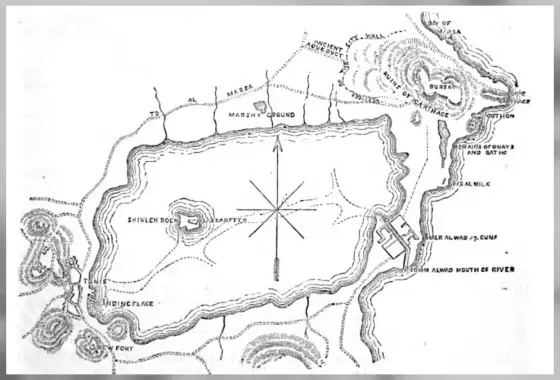
Carthage was founded by Phoenicians from Tyre on the coast of today’s Lebanon. According to legend its founder was Queen Elissa (Dido), and its traditional founding date is 814 BC. Its Phoenician name, Qart-hadasht (“New City”), became Carthago in Latin.
A trading empire
With its powerful navy, Carthage controlled trade in the western Mediterranean. It founded colonies and trading posts on the North African coast, in western Sicily, Sardinia and southern Spain. The city was governed by elected magistrates and a senate.
The Punic Wars
Rivalry over Sicily led to the First Punic War (264–241 BC), in which Carthage was defeated and lost Sicily. In the Second Punic War (218–201 BC) the general Hannibal set out from Spain and crossed the Alps with his elephants into Italy, crushing a Roman army at Cannae in 216 BC. But Rome held out, and Scipio defeated Hannibal at Zama in 202 BC.
Destruction
At the end of the Third Punic War (149–146 BC) Rome besieged and destroyed Carthage; most of its people were killed or enslaved, and the region became the Roman province of Africa. Carthage was later refounded as a Roman city. Its archaeological site is now on the UNESCO World Heritage List.
Hannibal’s end
After the war Hannibal served for a time as a statesman in Carthage before going into exile under Roman pressure. He spent his last years in Anatolia and died at Libyssa, near today’s Gebze.
City, Harbour and Government
Carthage was founded on the shore of the Gulf of Tunis, around the hill of Byrsa. The city’s most striking structure was its artificial harbour of two connected parts: one for merchant ships and the other, circular, for warships. Ancient sources describe the war harbour as able to shelter hundreds of ships.
Government consisted of two “suffetes” (magistrates) elected each year, a senate and a council drawn from wealthy families; sources also mention a popular assembly. Aristotle cited Carthage as an example of a well-balanced mixed constitution. The city’s wealth rested on trade, agriculture and mining. The multi-volume work on agriculture by the Carthaginian Mago shows that even the Roman senate valued Carthaginian learning; after the city fell Rome had the work translated into Latin.
Religion, Society and the Debated Tophet
The Carthaginians worshipped gods from the Phoenician tradition. Baal Hammon and his consort Tanit were the most revered deities; the sign of Tanit is common on the city’s steles and gravestones. The city had a cosmopolitan character, hosting people of different origins; Phoenicians, Berbers and Greeks lived together.
Child and animal remains found in the sacred precinct called the “tophet” at Carthage have caused a long debate in historiography. Some ancient Greek and Roman writers speak of child sacrifice, but Roman sources may contain enemy propaganda. Archaeologists still debate whether the site was a place of sacrifice or a cemetery for children who died young. This uncertainty is a reminder that much of what is known about Carthage comes from the pens of Roman rivals.
The Barcids in Spain and Hannibal’s Rise
Having lost the First Punic War, Carthage lost Sicily and had to pay a heavy indemnity. The commander Hamilcar Barca crossed to Spain in 237 BC and set about founding a new power base to make up for Carthage’s loss. Silver mines and commercial links gave the Barca family financial resources. His son-in-law Hasdrubal founded New Carthage (today’s Cartagena) around 228 BC.
Hamilcar’s son Hannibal took command in 221 BC. His siege of Rome’s ally Saguntum in 219 BC began the Second Punic War. In 218 BC Hannibal crossed the Pyrenees and the Alps into Italy; he lost much of his army on the way to cold, disease and attrition, yet inflicted heavy defeats on Rome at Trebia, Lake Trasimene and, in 216 BC, Cannae. Cannae is regarded as the classic example of a battle of encirclement in military history.
From Zama to the Peace Treaty
Rather than break Hannibal’s presence in Italy, Rome carried the war to other fronts. Scipio captured Carthaginian bases in Spain and then landed in North Africa in 204 BC. Hannibal was recalled from Italy and was defeated by Scipio at Zama in 202 BC. The peace treaty of 201 BC removed Carthage from Spain and overseas territories, imposed a heavy indemnity, limited the fleet and forbade war without Rome’s permission.
After the war Hannibal served for a time as suffete in Carthage and proposed reforms. Under Roman pressure he fled east, finding refuge with the Seleucid king Antiochus III and then with the king of Bithynia. Around 183 BC, as he was about to fall into Roman hands, he is said to have ended his life by taking poison.
The Third Punic War and the Fall of the City
After the war Carthage recovered economically, which caused anxiety in Rome. Senator Cato is said to have ended every speech with the words “Moreover, I think Carthage must be destroyed.” Attacks by the neighbouring Numidian king Masinissa also left Carthage in a difficult position. When Carthage went to war against Numidia in breach of the treaty, Rome used this as its pretext.
The siege, begun in 149 BC, lasted three years. In the spring of 146 BC the Romans under Scipio Aemilianus entered the city and, after days of street fighting, burned Carthage. Most of the population was killed or enslaved. The widespread story that the city’s soil was salted and made unfarmable does not appear in ancient sources; it is regarded as a legend that became popular in modern times.
Roman Carthage and the Ruins
The story of Carthage did not end with its destruction. In 44 BC Julius Caesar decided to refound the city; under Augustus Carthage became the capital of Rome’s province of Africa and grew into one of the great cities of the Roman Empire. The Baths of Antoninus were among the largest baths on the Mediterranean coast. In 439 the Vandal king Geiseric took the city; with the Arab conquests in 698 Carthage was abandoned and its population shifted to newly founded Tunis.
Today in northern Tunisia the Archaeological Site of Carthage has been on the UNESCO World Heritage List since 1979. The Punic harbours, cemeteries and Roman structures on the site show a city in which different layers lie on top of one another. Because knowledge of Carthage rests largely on Greek and Roman historians such as Polybius, archaeology has special importance in reaching the Carthaginians’ own voice.
Carthage’s Maritime and Commercial Legacy
The Carthaginians carried the Phoenician maritime tradition to its furthest point in the western Mediterranean. Their ships reached the Atlantic coasts, Britain and the western shores of Africa; the voyage of the Carthaginian navigator Hanno along the African coast has come down to us in a Greek text. The city’s merchants carried tin, silver, cloth, dyes and agricultural goods.
Among Carthage’s best-known commercial achievements was the development of Phoenician crafts such as purple dye and glass production. Prefabricated parts are thought to have been used in shipbuilding, which fits the story that Rome built a fleet in a short time in the First Punic War by copying a Carthaginian ship. Thus, despite its defeat, Carthage made lasting contributions to the development of Mediterranean trade and seafaring.
Sources and further reading
- Polybius, Histories.
- Livy, Ab Urbe Condita, books XXI–XXX.
- UNESCO World Heritage, “Archaeological Site of Carthage”.
- Encyclopaedia Britannica, entries “Carthage”, “Punic Wars” and “Hannibal”.
- UNESCO World Heritage Centre, “Site of Carthage” (1979).
- Polybius, Histories (Punic War books); Türkiye Diyanet Foundation Encyclopaedia of Islam, “Kartaca”.
People also ask
What was Carthage? Carthage was a city founded by the Phoenicians in today’s Tunisia that became the most powerful trading and naval state of the western Mediterranean.
When was Carthage founded? Founded: Traditionally 814 BC, by Phoenicians from Tyre.
When did Carthage end? End: 146 BC, destroyed by Rome.
Leave a comment
Your email address will not be published. Required fields are marked *